


Crime, inequality and public health: a survey of emerging trends in urban data science
- PMID: 37303974
- PMCID: PMC10248183
- DOI: 10.3389/fdata.2023.1124526
Crime, inequality and public health: a survey of emerging trends in urban data science
Abstract
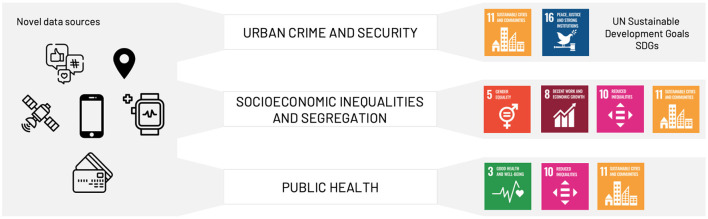
Urban agglomerations are constantly and rapidly evolving ecosystems, with globalization and increasing urbanization posing new challenges in sustainable urban development well summarized in the United Nations' Sustainable Development Goals (SDGs). The advent of the digital age generated by modern alternative data sources provides new tools to tackle these challenges with spatio-temporal scales that were previously unavailable with census statistics. In this review, we present how new digital data sources are employed to provide data-driven insights to study and track (i) urban crime and public safety; (ii) socioeconomic inequalities and segregation; and (iii) public health, with a particular focus on the city scale.
Keywords: cities; crime; digital data; public health; segregation and inequalities.
Copyright © 2023 Luca, Campedelli, Centellegher, Tizzoni and Lepri.
Conflict of interest statement
The authors declare that the research was conducted in the absence of any commercial or financial relationships that could be construed as a potential conflict of interest.
Figures
References
-
- Aaltonen M., Kivivuori J., Kuitunen L. (2018). Short-term temporal clustering of police-reported violent offending and victimization: examining timing and the role of revenge. Crim. Justice Rev. 43, 309–324. 10.1177/0734016818761100 - DOI
Publication types
LinkOut - more resources
Full Text Sources
