


Number of medications and polypharmacy are associated with frailty in older adults: results from the Midlife in the United States study
- PMID: 37304087
- PMCID: PMC10248878
- DOI: 10.3389/fpubh.2023.1148671
Number of medications and polypharmacy are associated with frailty in older adults: results from the Midlife in the United States study
Abstract
Objectives: The current study aimed to examine the association between the number of medications, polypharmacy, and frailty in community-dwelling older adults. In addition, the cutoff score for the number of medications related with frailty in this sample was determined.
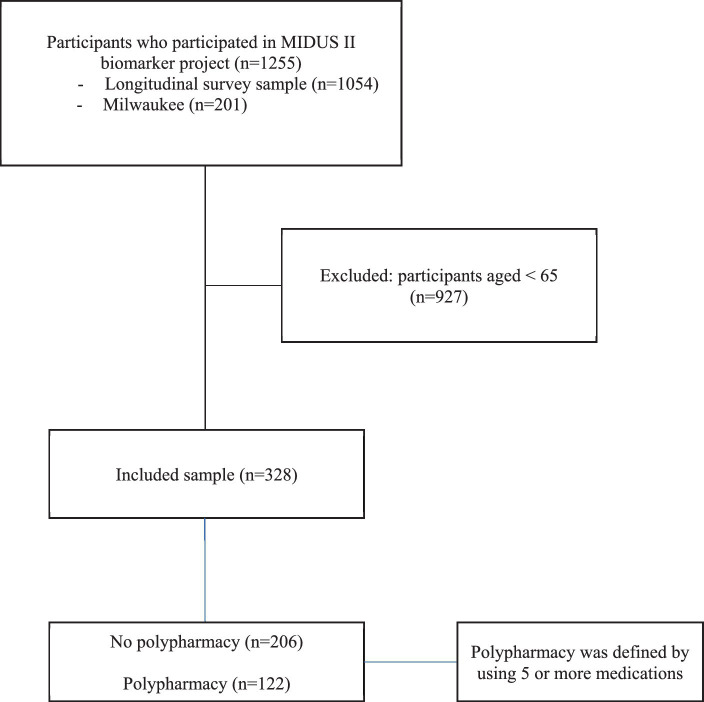
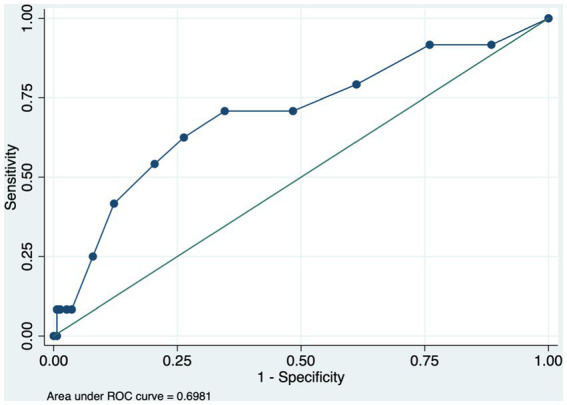
Methods: A cross-sectional analysis was performed using data of 328 individual aged between 65 and 85 years from the Midlife in the United States (MIDUS 2): Biomarker Project, 2004-2009, a multisite longitudinal study, for 328 individuals aged between 65 and 85 years. All the participants were categorized into two groups based on the number of medications used: no polypharmacy (n = 206) and polypharmacy (n = 122). The polypharmacy was defined as having 5 or more medication per day. Frailty status was measured using a modified form of Fried frailty phenotype through the presences of the following indicators include low physical activity; exhaustion; weight loss; slow gait speed and muscle weakness. Participants were categorized into three different groups based on total score: 0 as robust, 1 to 2 as prefrail, 3 or more as frail. The relationship between no. of medications, polypharmacy, and frailty was examined using a multinomial logistic regression model. The model was adjusted for age, sex, BMI, and no. of chronic conditions. Receiver operator characteristics and area under the curve were used to determine the cutoff number of medications.
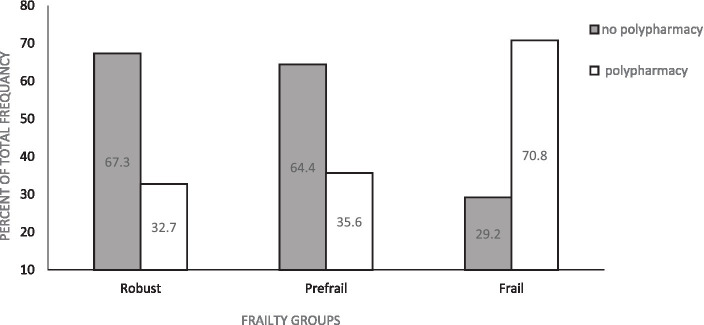
Results: Number of medications, and polypharmacy were associated with being frail (relative risk ratio [RRR]: 1.30; 95% confidence interval [CI]: [1.12, 1.50], p = 0.001), (RRR: 4.77; 95% CI [1.69, 13.4], p = 0.003), respectively. Number of medications with cutoff 6 medication or more was associated with being in frail category with sensitivity of 62% and specificity of 73%.
Conclusion: Polypharmacy was shown to be significantly related to frailty. A cutoff score of 6 or more medications distinguished frail from non-frail. Addressing polypharmacy in the older population might ameliorate the impact of physical frailty.
Keywords: aging; frailty; medications; older; polypharmacy.
Copyright © 2023 Alqahtani.
Conflict of interest statement
The author declares that the research was conducted in the absence of any commercial or financial relationships that could be construed as a potential conflict of interest.
Figures
Similar articles
-
The association between polypharmacy, frailty and disability-free survival in community-dwelling healthy older individuals.Arch Gerontol Geriatr. 2022 Jul-Aug;101:104694. doi: 10.1016/j.archger.2022.104694. Epub 2022 Mar 23. Arch Gerontol Geriatr. 2022. PMID: 35349875 Free PMC article. Clinical Trial.
-
Associations of polypharmacy with frailty severity and each frailty phenotype in community-dwelling older adults: Itabashi Longitudinal Study on Aging.Geriatr Gerontol Int. 2024 Mar;24 Suppl 1:196-201. doi: 10.1111/ggi.14789. Epub 2024 Jan 2. Geriatr Gerontol Int. 2024. PMID: 38169078
-
Polypharmacy is associated with frailty in Japanese community-dwelling older adults.Geriatr Gerontol Int. 2018 Oct;18(10):1497-1500. doi: 10.1111/ggi.13507. Epub 2018 Aug 30. Geriatr Gerontol Int. 2018. PMID: 30168240
-
Scoping Review of Studies Evaluating Frailty and Its Association with Medication Harm.Drugs Aging. 2022 May;39(5):333-353. doi: 10.1007/s40266-022-00940-3. Epub 2022 May 22. Drugs Aging. 2022. PMID: 35597861 Free PMC article.
-
The relationship between frailty and polypharmacy in older people: A systematic review.Br J Clin Pharmacol. 2018 Jul;84(7):1432-1444. doi: 10.1111/bcp.13590. Epub 2018 May 3. Br J Clin Pharmacol. 2018. PMID: 29575094 Free PMC article.
Cited by
-
Examining the Effect of Polypharmacy on Quality of Life and Frailty in Older Adults from the Perspective of Community-Based Rehabilitation.Healthcare (Basel). 2025 Jun 27;13(13):1531. doi: 10.3390/healthcare13131531. Healthcare (Basel). 2025. PMID: 40648556 Free PMC article.
-
Investigating Frailty, Polypharmacy, Malnutrition, Chronic Conditions, and Quality of Life in Older Adults: Large Population-Based Study.JMIR Public Health Surveill. 2024 Oct 11;10:e50617. doi: 10.2196/50617. JMIR Public Health Surveill. 2024. PMID: 39145920 Free PMC article.
References
-
- Gnjidic D, Hilmer SN, Blyth FM, Naganathan V, Waite L, Seibel MJ, et al. . Polypharmacy cutoff and outcomes: five or more medicines were used to identify community-dwelling older men at risk of different adverse outcomes. J Clin Epidemiol. (2012) 65:989–95. doi: 10.1016/J.JCLINEPI.2012.02.018, PMID: - DOI - PubMed
Publication types
MeSH terms
LinkOut - more resources
Full Text Sources
