


Minimal Kidney Disease Phenotype in Shroom3 Heterozygous Null Mice
- PMID: 37313360
- PMCID: PMC10259099
- DOI: 10.1177/20543581231165716
Minimal Kidney Disease Phenotype in Shroom3 Heterozygous Null Mice
Abstract
Background: Shroom family member 3 (SHROOM3) encodes an actin-associated protein that regulates epithelial morphology during development. Several genome-wide association studies (GWAS) have identified genetic variances primarily in the 5' region of SHROOM3, associated with chronic kidney disease (CKD) and poor transplant outcomes. These genetic variants are associated with alterations in Shroom3 expression.
Objective: Characterize the phenotypic abnormalities associated with reduced Shroom3 expression in postnatal day 3-, 1-month and 3-month-old mice.
Methods: The Shroom3 protein expression pattern was determined by immunofluorescence. We generated Shroom3 heterozygous null mice (Shroom3Gt/+) and performed comparative analyses with wild type littermates based on somatic and kidney growth, gross renal anatomy, renal histology, renal function at postnatal day 3, 1 month, and 3 months.
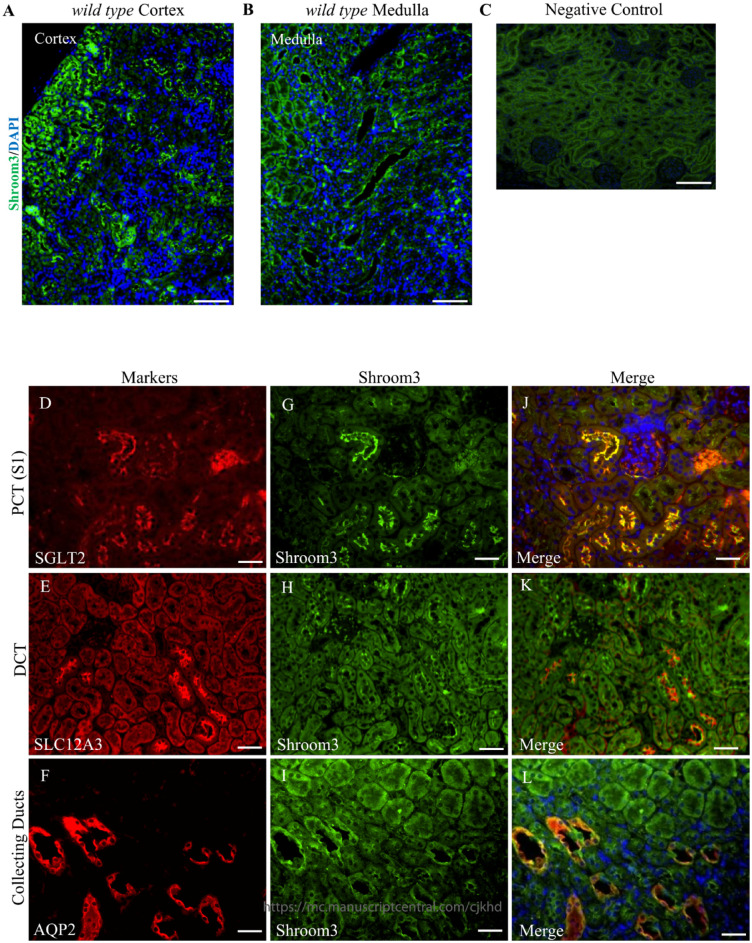
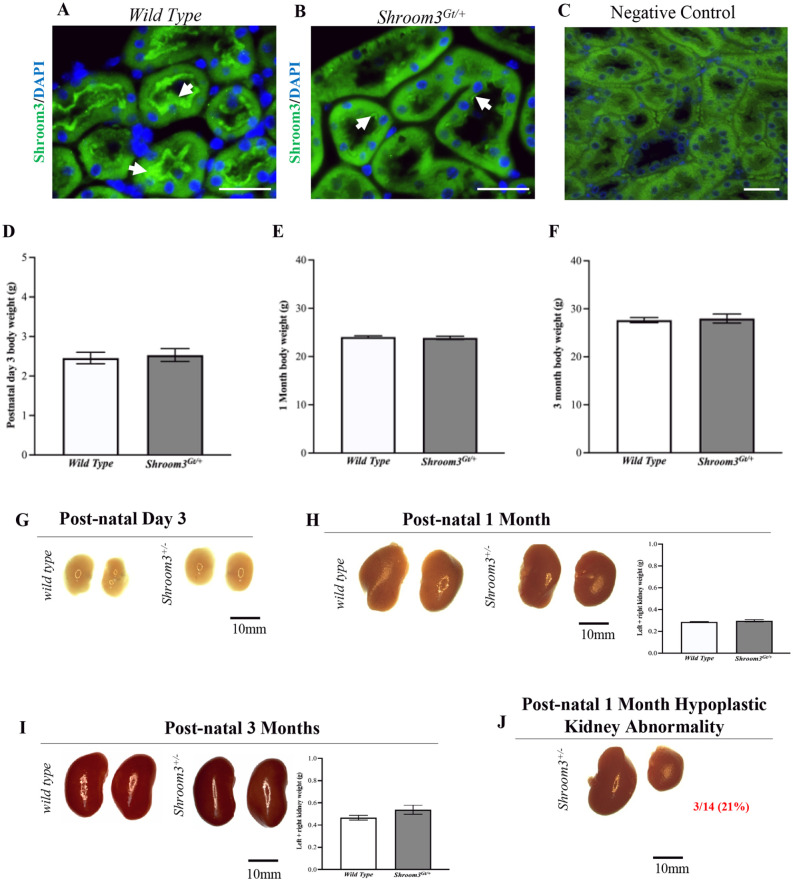
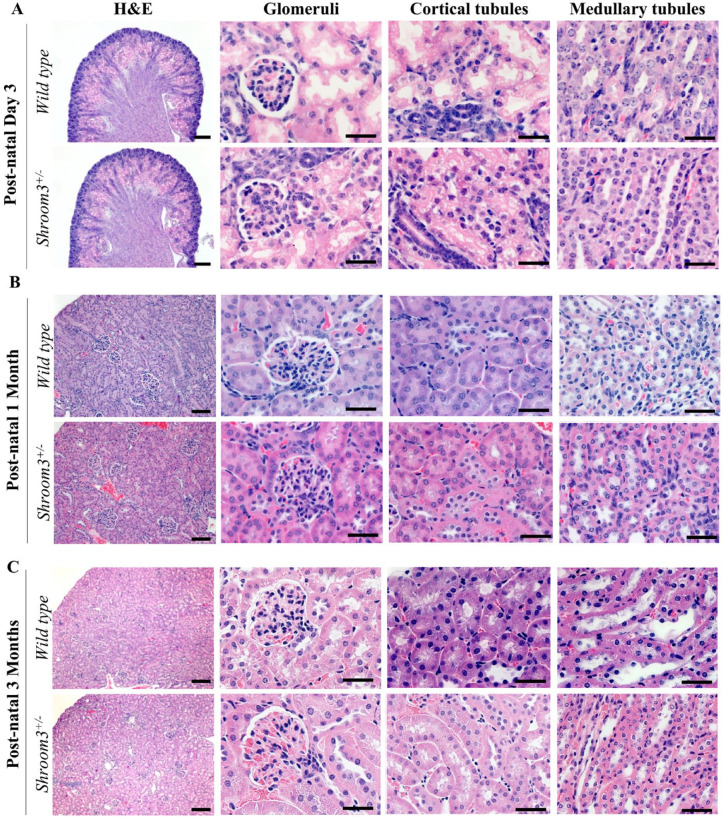
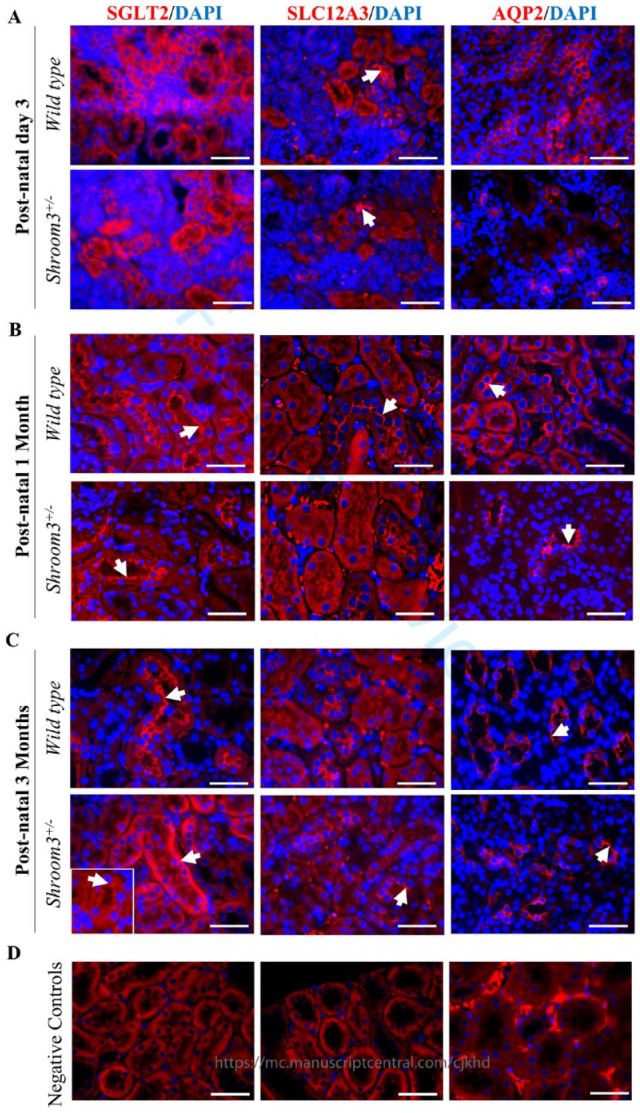
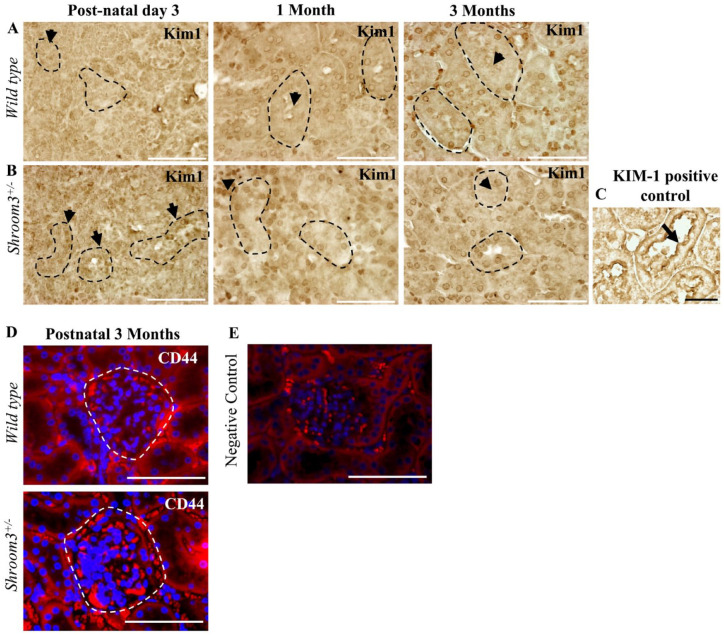
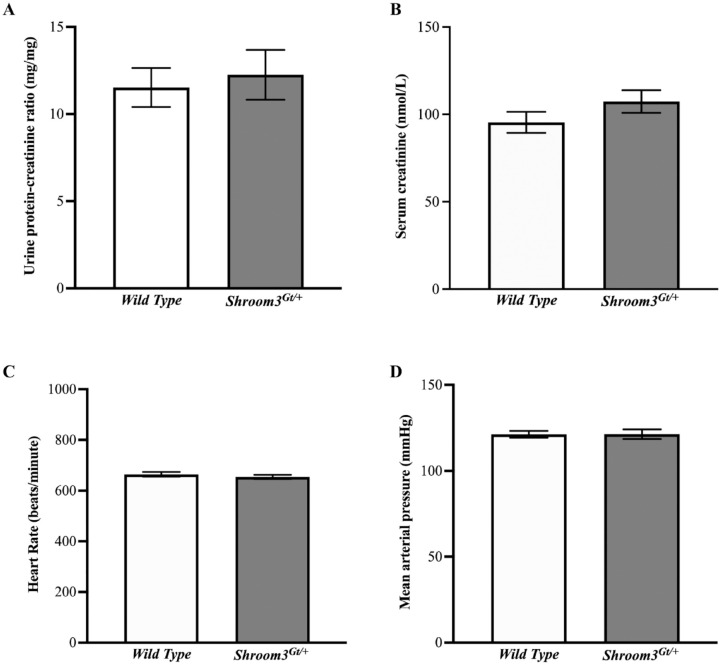
Results: The Shroom3 protein expression localized to the apical regions of medullary and cortical tubular epithelium in postnatal wild type kidneys. Co-immunofluorescence studies confirmed protein expression localized to the apical side of the tubular epithelium in proximal convoluted tubules, distal convoluted tubules, and collecting ducts. While Shroom3 heterozygous null mice exhibited reduced Shroom3 protein expression, no differences in somatic and kidney growth were observed when compared to wild type mice. Although, rare cases of unilateral hypoplasia of the right kidney were observed at postnatal 1 month in Shroom3 heterozygotes. Yet renal histological analysis did not reveal any overt abnormalities in overall kidney structure or in glomerular and tubular organization in Shroom3 heterozygous null mice when compared to wild type mice. Analysis of the apical-basolateral orientation of the tubule epithelium demonstrated alterations in the proximal convoluted tubules and modest disorganization in the distal convoluted tubules at 3 months in Shroom3 heterozygotes. Additionally, these modest abnormalities were not accompanied by tubular injury or physiological defects in renal and cardiovascular function.
Conclusion: Taken together, our results describe a mild kidney disease phenotype in adult Shroom3 heterozygous null mice, suggesting that Shroom3 expression and function may be required for proper structure and maintenance of the various tubular epithelial parenchyma of the kidney.
Contexte: Le gène SHROOM3 (membre 3 de la famille Shroom) code pour une protéine associée à l’actine qui régule la morphologie épithéliale pendant le développement. Plusieurs études d’association à l’échelle du génome (GWAS — Genome-wide association studies) ont identifié des variations génétiques, principalement dans la région 5’ du gène SHROOM3, associées à l’insuffisance rénale chronique (IRC) et à de mauvais résultats de transplantation. Ces variations génétiques sont associées à des altérations dans l’expression de (Shroom3).
Objectif: Caractériser les anomalies phénotypiques associées à une diminution de l’expression de Shroom3 chez des souris à l’âge postnatal de 3 jours, 1 mois et 3 mois.
Méthodologie: Le profil d’expression des protéines Shroom3 a été déterminé par immunofluorescence. Nous avons généré des souris hétérozygotes Shroom3 (Shroom3Gt/+) et procédé à des analyses comparatives avec des congénères de type sauvage en ce qui concerne la croissance somatique et rénale, l’anatomie rénale, l’histologie rénale et la fonction rénale à l’âge postnatal de 3 jours, 1 mois et 3 mois.
Résultats: L’expression de la protéine Shroom3 est localisée dans les régions apicales de l’épithélium tubulaire médullaire et cortical des reins des souris de type sauvage après la naissance. Des études de co-immunofluorescence ont confirmé l’expression des protéines localisée sur le côté apical de l’épithélium tubulaire dans les tubules contournés proximaux, les tubules contournés distaux et les tubes collecteurs. Les souris hétérozygotes Shroom3 ont présenté une expression réduite de la protéine Shroom3, mais aucune différence dans la croissance somatique et rénale n’a été observée par rapport aux souris de type sauvage. Cependant, de rares cas d’hypoplasie unilatérale du rein droit ont été observés à l’âge postnatal de 1 mois chez les souris hétérozygotes Shroom3. L’analyze histologique rénale n’a révélé aucune anomalie manifeste dans la structure globale des reins ou dans l’organization des glomérules et des tubules chez les souris hétérozygotes Shroom3 par rapport aux souris de type sauvage. L’analyze de l’orientation apicale-basolatérale de l’épithélium tubulaire a montré des altérations dans les tubules contournés proximaux et une légère désorganisation dans les tubules contournés distaux à l’âge de 3 mois chez les souris hétérozygotes Shroom3. En outre, ces légères anomalies n’étaient pas accompagnées d’une lésion tubulaire ou d’anomalies physiologiques dans la fonction rénale et cardiovasculaire.
Conclusion: Pris dans leur ensemble, nos résultats décrivent un phénotype d’insuffisance rénale légère chez les souris hétérozygotes Shroom3 adultes, ce qui suggère que l’expression et la fonction de la protéine Shroom3 peuvent être nécessaires pour la structure et le maintien appropriés des différents parenchymes épithéliaux tubulaires du rein.
Keywords: Shroom3; apical-basolateral cell orientation; chronic kidney disease (CKD); kidney function; renal tubular epithelium.
© The Author(s) 2023.
Conflict of interest statement
The author(s) declared no potential conflicts of interest with respect to the research, authorship, and/or publication of this article.
Figures
References
-
- Jha V, Garcia-Garcia G, Iseki K, et al. Chronic kidney disease: global dimension and perspectives. Lancet. 2013;382(9888):260-272. - PubMed
-
- Dietz ML, Bernaciak TM, Vendetti F, Kielec JM, Hildebrand JD.Differential actin-dependent localization modulates the evolutionarily conserved activity of shroom family proteins. J Biologic Chem. 2006;281(29):20542-20554. - PubMed
-
- Nishimura T, Takeichi M.Shroom3-mediated recruitment of Rho kinases to the apical cell junctions regulates epithelial and neuroepithelial planar remodeling. Development. 2008;135(8):1493-1502. - PubMed
LinkOut - more resources
Full Text Sources
Miscellaneous
