Review
. 2023 Sep 13;67(5):797-809.
doi: 10.1042/EBC20220221.

Diverse mycotoxin threats to safe food and feed cereals

Affiliations
Review

Diverse mycotoxin threats to safe food and feed cereals

Rosie L Latham et al. Essays Biochem. .

Abstract

Toxigenic fungi, including Aspergillus and Fusarium species, contaminate our major cereal crops with an array of harmful mycotoxins, which threaten the health of humans and farmed animals. Despite our best efforts to prevent crop diseases, or postharvest spoilage, our cereals are consistently contaminated with aflatoxins and deoxynivalenol, and while established monitoring systems effectively prevent acute exposure, Aspergillus and Fusarium mycotoxins still threaten our food security. This is through the understudied impacts of: (i) our chronic exposure to these mycotoxins, (ii) the underestimated dietary intake of masked mycotoxins, and (iii) the synergistic threat of cocontaminations by multiple mycotoxins. Mycotoxins also have profound economic consequences for cereal and farmed-animal producers, plus their associated food and feed industries, which results in higher food prices for consumers. Climate change and altering agronomic practices are predicted to exacerbate the extent and intensity of mycotoxin contaminations of cereals. Collectively, this review of the diverse threats from Aspergillus and Fusarium mycotoxins highlights the need for renewed and concerted efforts to understand, and mitigate, the increased risks they pose to our food and feed cereals.

Keywords: Aspergillus; Cereals; Fusarium; Mycotoxins.


Conflict of interest statement

The authors declare that there are no competing interests associated with this manuscript.

Figures
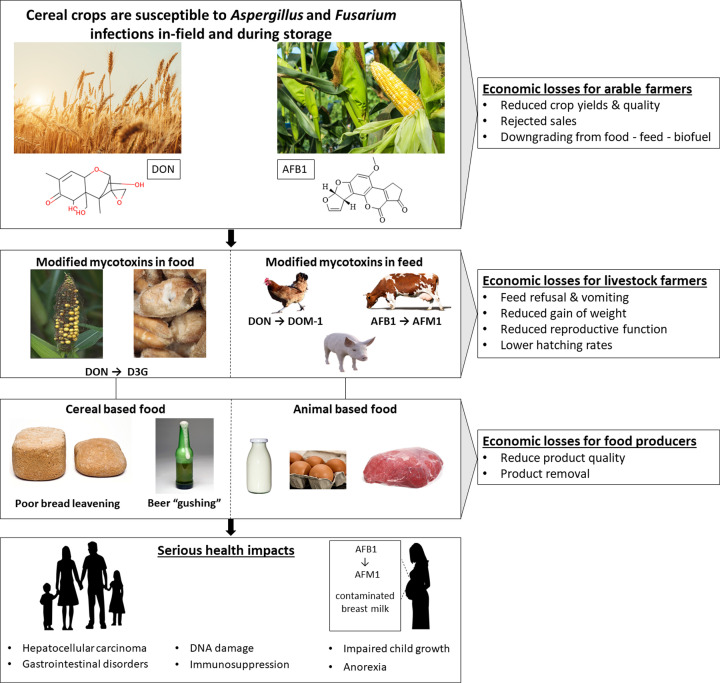
Figure 1
Figure 1. Economic and health impacts of mycotoxin in the food and feed supply chains
Highlights the impact of aflatoxin B1 (AFB1) and DON on cereal famers and the associated issues for farmed animal producers. Ultimately cereal- or animal-based foods contaminated with these mycotoxins, or their masked derivates, can seriously threaten human health.
Figure 2
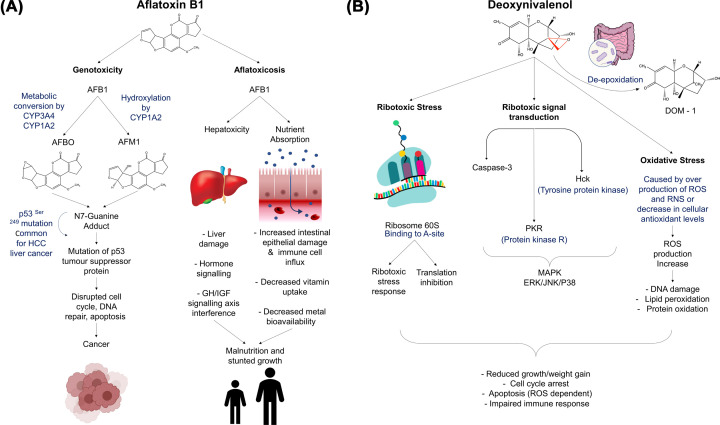
Figure 2. Mechanism of AFB1 induced cancer, malnutrition and stunted growth, and DON induced impairment of immune response, cell cycle arrest, and apoptosis
(A) AFB1 causes genotoxicity through the conversion and hydroxylation of AFB1 to AFBO and AFM1, resulting in mutation in the tumour-suppression protein p53. AFB1 additionally causes hepatoxicity and interferes with nutrient absorption, resulting in cancer and growth reduction. (B) DON can be de-epoxidated into DOM-1 by gut bacteria that is less stable than DON and does not cause the ribotoxic stress response. DON can cause ribotoxic stress and interfere with translation inhibition. DON activates PKR and HcK resulting in increased MAPK. Oxidative stress is caused by increased ROS and RNS, and results in DNA damage, and protein oxidation whereby this leads to cell cycle arrest and apoptosis and impairment of immune response.
Figure 3
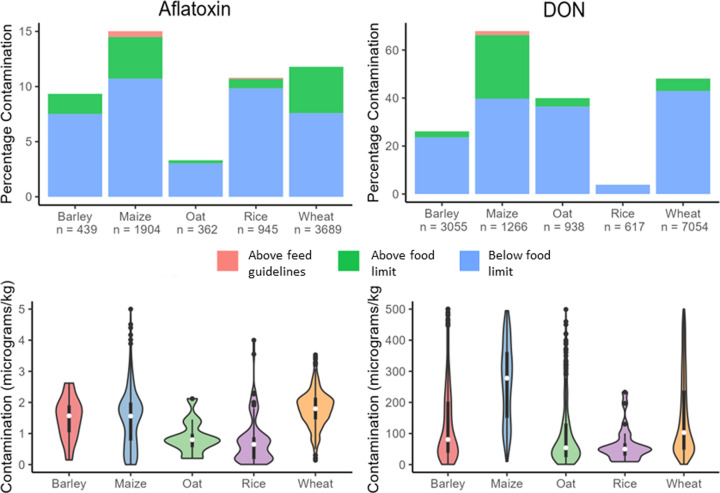
Figure 3. Contamination levels of food grains differ by grain for DON and aflatoxin
Contamination data are derived from EFSA records spanning from 2010 to 2020. The percent of contaminated samples below the regulatory limit for food (blue), above the food limit (green), and above the higher feed guideline/recommendation (red), with the total number of samples tested (n) for each cereal. Violin plots outlining the distribution of mycotoxin concentrations (µg mycotoxin per kg of grain) with superimposed boxplots displaying medians, interquartile ranges, and outliers. Due to a small number of extreme outliers for maize (as high as 790 µg/kg for aflatoxin and 32300 µg/kg for DON), y-axes were limited to the ranges shown.
Figure 4
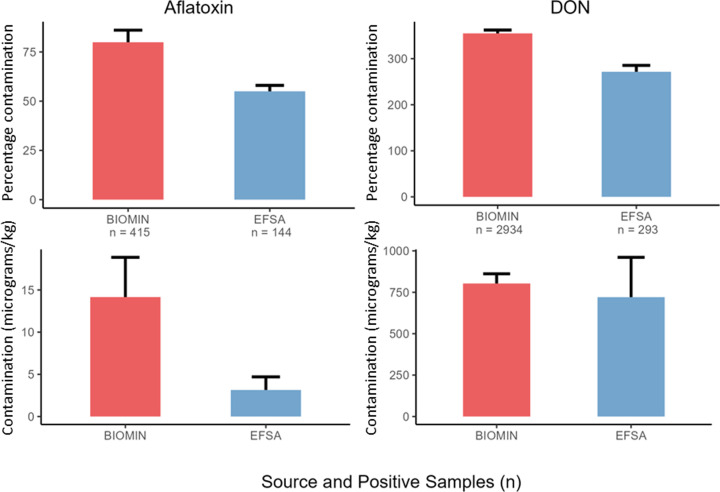
Figure 4. Mycotoxin contamination of animal feed maize exceeds contamination for food maize
Bar plots depicting the percentage and number (n) of samples containing aflatoxin and DON and the mean concentration (µg mycotoxin per kg of grain) of each mycotoxin. Contamination data for European feed maize from 2016 to 2022 were taken from BIOMIN GmbH annual mycotoxin reports and EFSA mycotoxin surveillance data were used for food cereals. Two outliers with excessively high contamination (790 µg/kg aflatoxin, 23500 µg/kg DON) were omitted from analysis. Error bars represent standard deviation around the mean.
Figure 5
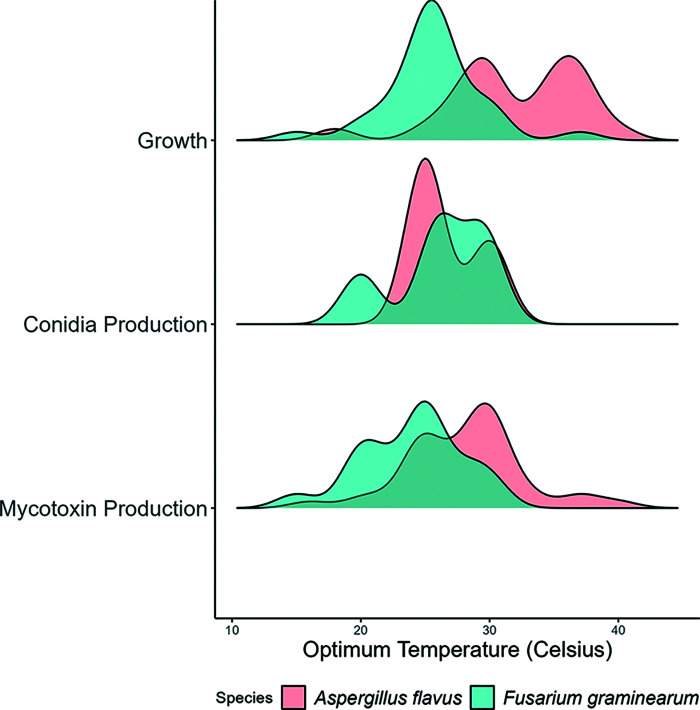
Figure 5. The optimum temperatures for key life processes for A. flavus and F. graminearum
Key life processes shown are the production of respective mycotoxins (aflatoxin and DON), mycelial growth in culture, and asexual conidia production. The density curves represent the distribution of published temperature optima. The height of a curve corresponds to the proportion of reports of optima at a given temperature.
Figure 6
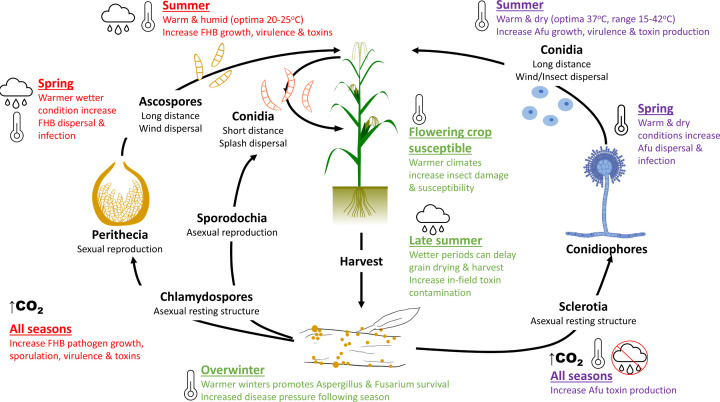
Figure 6. Climate change impacts on risk of cereal contamination by A. flavus and F. graminearum
Influence of climatic conditions on life process is shown in red (F. graminearum), purple (A. flavus), and green (both). Climate change is predicted to drive conditions in northern Europe towards warmer wetter environments favoured by F. graminearum. In contrast, southern Europe is expected to become hotter and dryer, as favoured by A. flavus. In both systems, elevated CO2 is associated with increased mycotoxin contamination. Climate change projections may therefore allow for increased contamination of our cereals by mycotoxigenic fungi.

References

    1. Bennett J.W. and Klich M. (2003) Mycotoxins. Clin. Microbiol. Rev. 16, 497 10.1128/CMR.16.3.497-516.2003 - DOI - PMC - PubMed
    1. Navale V., Vamkudoth K.R., Ajmera S. and Dhuri V. (2021) Aspergillus derived mycotoxins in food and the environment: prevalence, detection, and toxicity. Toxicol. Rep. 8, 1008–1030 10.1016/j.toxrep.2021.04.013 - DOI - PMC - PubMed
    1. Pitt J.I. and Miller J.D. (2017) A concise history of mycotoxin research. J. Agric. Food Chem. 65, 7021–7033 10.1021/acs.jafc.6b04494 - DOI - PubMed
    1. Eskola M., Altieri A. and Galobart J. (2018) Overview of the activities of the European Food Safety Authority on mycotoxins in food and feed. World Mycotoxin J. 11, 277–289 10.3920/WMJ2017.2270 - DOI
    1. Jallow A., Xie H.L., Tang X.Q., Qi Z. and Li P.W. (2021) Worldwide aflatoxin contamination of agricultural products and foods: from occurrence to control. Compr. Rev. Food Sci. Food Saf. 20, 2332–2381 10.1111/1541-4337.12734 - DOI - PubMed

Publication types