Blood Donors' Preferences Toward Incentives for Donation in China
- PMID: 37314802
- PMCID: PMC10267764
- DOI: 10.1001/jamanetworkopen.2023.18320
Blood Donors' Preferences Toward Incentives for Donation in China
Erratum in
-
Error in Bylines.JAMA Netw Open. 2024 Feb 5;7(2):e240325. doi: 10.1001/jamanetworkopen.2024.0325. JAMA Netw Open. 2024. PMID: 38324319 Free PMC article. No abstract available.
Abstract
Importance: Blood donation is critical for health care systems, but donor retention remains challenging. Understanding donors' preferences can inform incentive design and improve retention rates.
Objective: To identify donor preferences for incentive attributes and their relative importance in promoting blood donation among Chinese donors in Shandong.
Design, setting, and participants: This survey study fielded a discrete choice experiment (DCE) with a dual response design among blood donors, analyzing the responses under forced and unforced choice settings. The study took place from January 1 to April 30, 2022, in 3 cities (Yantai, Jinan, and Heze) representing diverse socioeconomic strata in Shandong, China. Eligible participants were blood donors aged 18 to 60 years who had donated within the preceding 12 months. Participants were recruited using convenience sampling. Data were analyzed from May to June 2022.
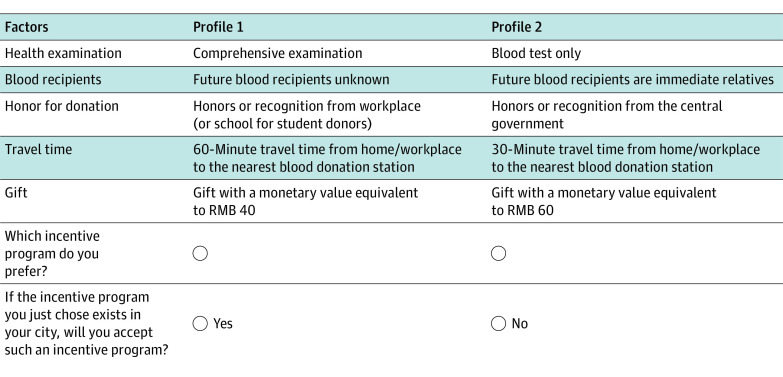
Exposure: Respondents were presented with different blood donation incentive profiles, varying in health examination, blood recipient, honor recognition, travel time, and gift value.
Main outcome and measure: Respondent preferences for nonmonetary incentive attributes, attribute relative importance, willingness-to-discard values for attribute improvement, and estimated uptake of new incentive profiles.
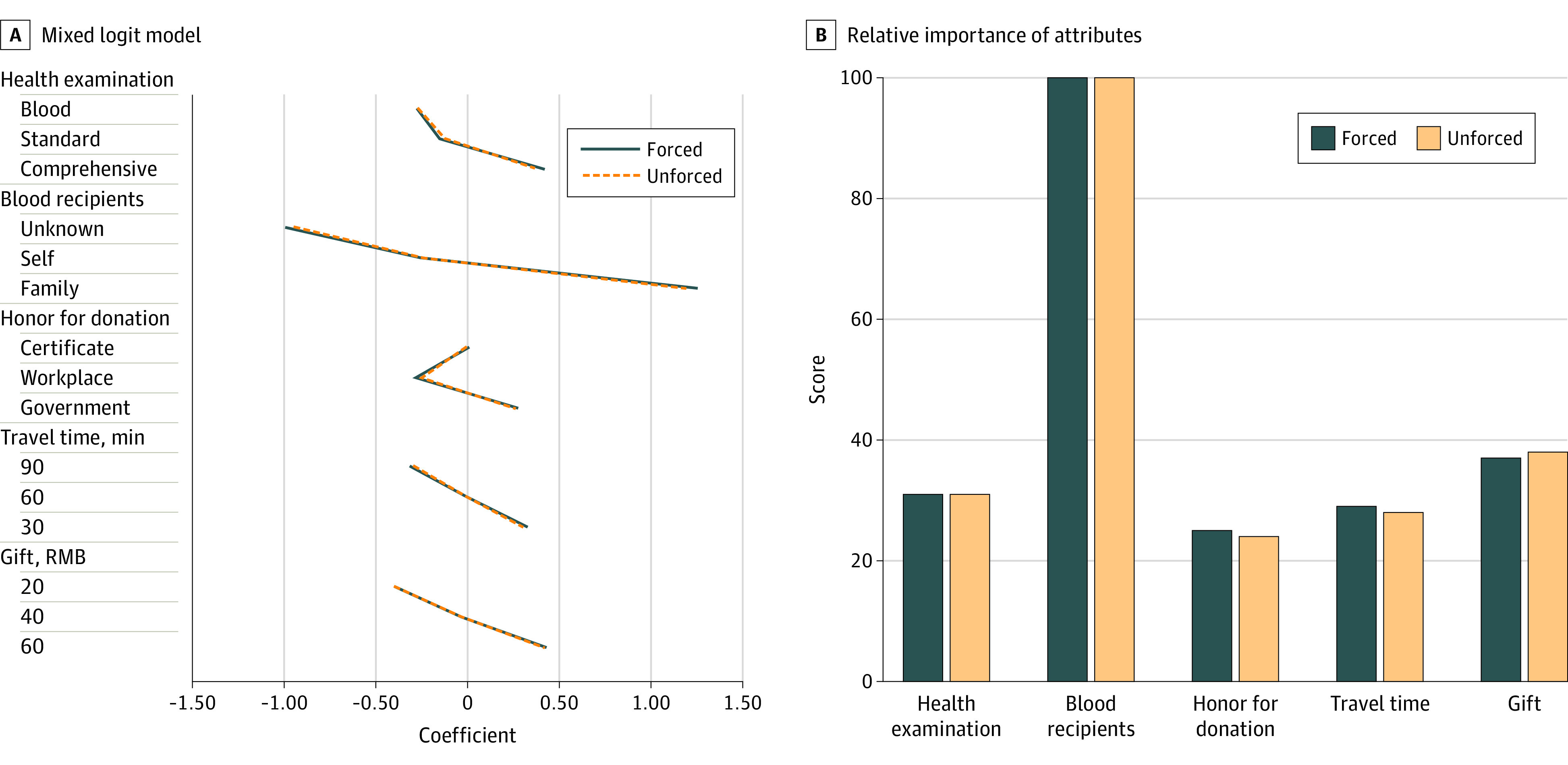
Results: A total of 650 donors were invited, of which 477 were included for analysis. The respondents were predominately male (308 respondents [64.6%]), aged 18 to 34 years (291 respondents [61.0%]), and had undergraduate degrees or higher (286 respondents [59.9%]). Among the 477 valid respondents, the mean (SD) age was 31.9 (11.2) years. Respondents preferred comprehensive health examination, family members as recipients, central government recognition, 30-minute travel time, and a gift valued at 60 Renminbi (RMB). No significant differences were found between the model results of forced and unforced choice setting. Blood recipient was the most important attribute, followed by health examination and gifts, and then honor and travel time. Respondents were willing to discard RMB 32 (95% CI, 18-46) for an improved health examination and RMB 69 (95% CI, 47-92) for changing the recipient from themselves to family members. Scenario analysis estimated 80.3% (SE, 0.024) of donors would endorse the new incentive profile if the recipient was changed from themselves to family members.
Conclusions and relevance: In this survey study, blood recipient, health examination, and gift value were perceived more important as nonmonetary incentives than travel time and honor recognition. Tailoring incentives according to these preferences may improve donor retention. Further research could help refine and optimize incentive schemes for blood donation promotion.
Conflict of interest statement
Figures
References
-
- World Health Organization . Strategic framework for blood safety and availability 2016-2025. 2016. Accessed May 17, 2023. https://apps.who.int/iris/handle/10665/259656
-
- World Health Organization . Action Framework to Advance Universal Access to Safe, Effective and Quality-Assured Blood Products 2020–2023. World Health Organization; 2020.
-
- National Health Commission of the People’s Republic of China . Statistical Bulletin of China's Health Development 2021 [in Chinese]. September 7, 2022. Accessed July 12, 2022. http://www.nhc.gov.cn/guihuaxxs/s3586s/202207/51b55216c2154332a660157abf...
-
- World Health Organization . Global status report on blood safety and availability 2021. World Health Organization; 2022.
-
- National Health Commission of the People’s Republic of China . China’s Report on Blood Safety 2018. People's Medical Publishing House; 2020.
Publication types
MeSH terms
LinkOut - more resources
Full Text Sources
Medical
Miscellaneous