. 2023 Sep 15;4(3):102357.
doi: 10.1016/j.xpro.2023.102357. Epub 2023 Jun 13.

Optimized single-cell RNA sequencing protocol to study early genome activation in mammalian preimplantation development

Affiliations

Optimized single-cell RNA sequencing protocol to study early genome activation in mammalian preimplantation development

Nina Boskovic et al. STAR Protoc. .

Abstract

Here, we present a modification of single-cell tagged reverse transcription protocol to study gene expression on a single-cell level or with limited RNA input. We describe different enzymes for reverse transcription and cDNA amplification, modified lysis buffer, and additional clean-up steps before cDNA amplification. We also detail an optimized single-cell RNA sequencing method for handpicked single cells, or tens to hundreds of cells, as input material to study mammalian preimplantation development. For complete details on the use and execution of this protocol, please refer to Ezer et al.1.

Keywords: Bioinformatics; Developmental biology; Gene Expression; Genomics; Molecular Biology; RNA-seq; Sequence analysis; Sequencing; Single Cell.


Conflict of interest statement

Declaration of interests The authors declare no competing interests.

Figures

None
Graphical abstract
Figure 1
Figure 1
Overview of the step-by-step STRT-N library preparation Embryo is placed in the cell lysis buffer and mRNA is released. This mRNA is then mixed with reverse transcription reagents containing ERCC Spike-In RNA. First-strand cDNA synthesis is performed by capturing mRNA polyA tail with oligo dT(30)+V, and the mRNA is transcribed with the addition of 3 cytosine molecules on the 5′ end of mRNA. Oligo TSO-8UMI is used to bind to those cytosine molecules, promoting template switching and introduction of UMIs into the cDNA. cDNA is then cleaned, and the barcodes are introduced at the 5′ end. After the cDNA amplification, each sample is barcoded, and all the reactions can be pooled for the next steps which include purification, fragmentation, and adapter cassette ligation. The library preparation is finished by the further 5′ end amplification before sending the ready library for sequencing. Adapted from Ezer et al.
Figure 2
Figure 2
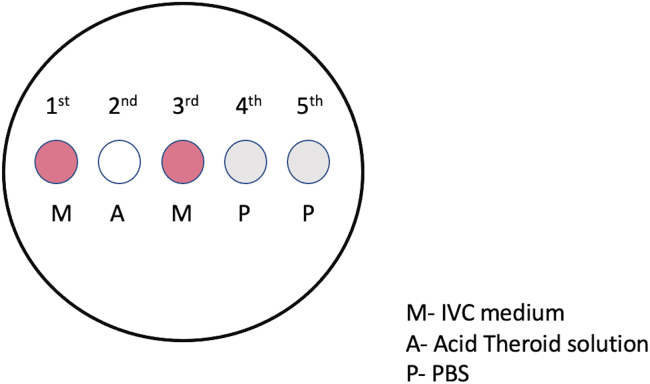
Graphical demonstration of the plate preparation for the removal of zona pellucida There are 5 drops, each 30 μL placed on a 60 mm embryo safe dish. First and third drop in pink color represent IVC medium, 2nd drop is Acid Tyrode’s solution and 4th and 5th drops are PBS.
Figure 3
Figure 3
cDNA visualized on 2% TAE gel After cDNA amplification in step 25 it is possible to visualize the product on the 2% TAE gel. You should observe a smear representing a variety in the length of the cDNA. In this figure you can see the difference between the strength of the smear based on the amount of initial RNA input going from 500 pg in the first 3 lanes, 50 pg in the second 3 lanes to single cell level (5 pg) in the next 3 lanes. Non template control (NTC) should not have the smear. Ladder is 1 kb.
Figure 4
Figure 4
Quality controls of the library using TapeStation In step 29, QC1 is performed using HS D5000 ScreenTape. You should see similarly to the gel visualization, a variety of transcripts in the size range of 200 bp to >2000 bp long. In step 39, QC3 is performed after fragmentation. As protocol is aiming for the fragments that are 350bp long, you should observe a wide peak around 350 bp. In step 66, QC3 is performed, and you should see a sharp peak around 350 bp.
Figure 5
Figure 5
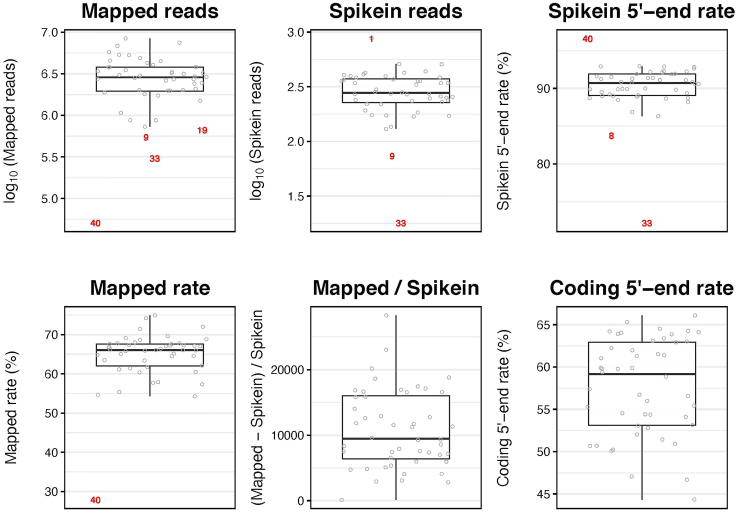
Output from the sequence analysis Mapped reads, Spike-In reads, Spike-In 5′ end rate, mapped rate, mapped/Spike-In, coding 5′ end rate from a successful library containing 47 RNA samples of mouse embryos at different developmental stages and one non-template control (NTC). We removed outliers that are samples 1, 8, 9, 19, 33, and 40 for further steps.
Figure 6
Figure 6
Differences in the expression profiling for 6 genes between the two ways of normalizing the samples: per-10000 normalization or Spike-In based normalization (A) violin plots obtained based on per-10000 normalization of 6 genes in early embryo development; (B) violin plot obtained based on Spike-In normalization.
Figure 7
Figure 7
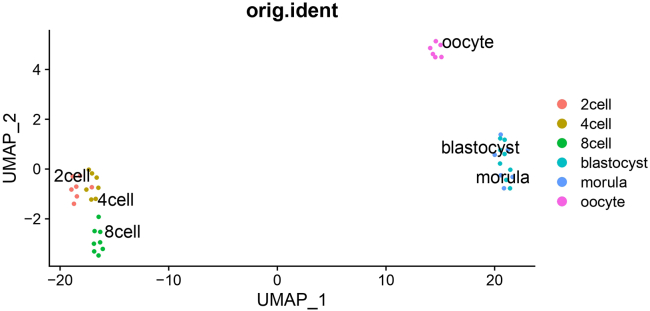
Output from single-cell RNA sequence analysis UMAP plot representation of a successful library, showing the developmental stages from 42 RNA samples.

References

    1. Ezer S., Yoshihara M., Katayama S., DoGA consortium. Daub C., Lohi H., Krjutskov K., Kere J. Generation of RNA sequencing libraries for transcriptome analysis of globin-rich tissues of the domestic dog. STAR Protoc. 2021;2:100995. doi: 10.1016/j.xpro.2021.100995. - DOI - PMC - PubMed
    1. Islam S., Kjällquist U., Moliner A., Zajac P., Fan J.-B., Lönnerberg P., Linnarsson S. Highly multiplexed and strand-specific single-cell RNA 5′ end sequencing. Nat. Protoc. 2012;7:813–828. doi: 10.1038/nprot.2012.022. - DOI - PubMed
    1. Islam S., Zeisel A., Joost S., La Manno G., Zajac P., Kasper M., Lönnerberg P., Linnarsson S. Quantitative single-cell RNA-seq with unique molecular identifiers. Nat. Methods. 2014;11:163–166. doi: 10.1038/nmeth.2772. - DOI - PubMed
    1. Zheng G.X.Y., Terry J.M., Belgrader P., Ryvkin P., Bent Z.W., Wilson R., Ziraldo S.B., Wheeler T.D., McDermott G.P., Zhu J., et al. Massively parallel digital transcriptional profiling of single cells. Nat. Commun. 2017;8:14049. doi: 10.1038/ncomms14049. - DOI - PMC - PubMed
    1. Dobson A.T., Raja R., Abeyta M.J., Taylor T., Shen S., Haqq C., Pera R.A.R. The unique transcriptome through day 3 of human preimplantation development. Hum. Mol. Genet. 2004;13:1461–1470. doi: 10.1093/hmg/ddh157. - DOI - PubMed

Publication types

LinkOut - more resources