


Comprehensive Approaches for the Search and Characterization of Staphylococcins
- PMID: 37317303
- PMCID: PMC10221470
- DOI: 10.3390/microorganisms11051329
Comprehensive Approaches for the Search and Characterization of Staphylococcins
Abstract
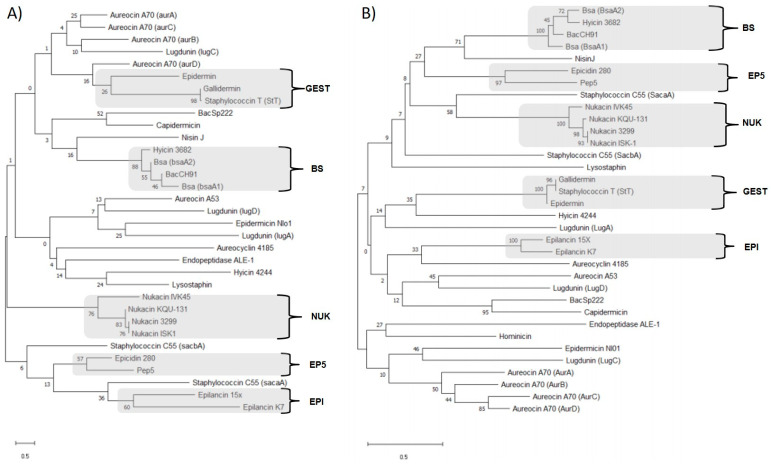
Novel and sustainable approaches are required to curb the increasing threat of antimicrobial resistance (AMR). Within the last decades, antimicrobial peptides, especially bacteriocins, have received increased attention and are being explored as suitable alternatives to antibiotics. Bacteriocins are ribosomally synthesized antimicrobial peptides produced by bacteria as a self-preservation method against competitors. Bacteriocins produced by Staphylococcus, also referred to as staphylococcins, have steadily shown great antimicrobial potential and are currently being considered promising candidates to mitigate the AMR menace. Moreover, several bacteriocin-producing Staphylococcus isolates of different species, especially coagulase-negative staphylococci (CoNS), have been described and are being targeted as a good alternative. This revision aims to help researchers in the search and characterization of staphylococcins, so we provide an up-to-date list of bacteriocin produced by Staphylococcus. Moreover, a universal nucleotide and amino acid-based phylogeny system of the well-characterized staphylococcins is proposed that could be of interest in the classification and search for these promising antimicrobials. Finally, we discuss the state of art of the staphylococcin applications and an overview of the emerging concerns.
Keywords: Staphylococcus; antimicrobial-resistance alternatives; applications; staphylococcin.
Conflict of interest statement
The authors declare no conflict of interest.
Figures
References
-
- World Health Organization WHO Publishes List of Bacteria for Which New Antibiotics Are Urgently Needed. 2017. [(accessed on 13 January 2023)]. WHO Jt. News Release. Available online: https://www.who.int/news/item/27-02-2017-who-publishes-list-ofbacteria-f....
-
- Anyaegbunam N.J., Anekpo C.C., Anyaegbunam Z.K.G., Doowuese Y., Chinaka C.B., Odo O.J., Sharndama H.C., Okeke O.P., Mba I.E. The Resurgence of Phage-Based Therapy in the Era of Increasing Antibiotic Resistance: From Research Progress to Challenges and Prospects. Microbiol. Res. 2022;264:127155. doi: 10.1016/j.micres.2022.127155. - DOI - PubMed
-
- Mba I.E., Nweze E.I. Application of Nanotechnology in the Treatment of Infectious Diseases: An Overview. In: Hameed S., Rehman S., editors. Nanotechnology for Infectious Diseases. Springer; Singapore: 2022. pp. 25–51. - DOI
Grants and funding
LinkOut - more resources
Full Text Sources
