Review
. 2023;1(6):426-439.
doi: 10.1038/s44222-023-00044-6. Epub 2023 Mar 21.

Plant-based biopharmaceutical engineering

Affiliations
Review

Plant-based biopharmaceutical engineering

Lukas Eidenberger et al. Nat Rev Bioeng. 2023.

Abstract

Plants can be engineered to recombinantly produce high-quality proteins such as therapeutic proteins and vaccines, also known as molecular farming. Molecular farming can be established in various settings with minimal cold-chain requirements and could thus ensure rapid and global-scale deployment of biopharmaceuticals, promoting equitable access to pharmaceuticals. State of the art plant-based engineering relies on rationally assembled genetic circuits, engineered to enable the high-throughput and rapid expression of multimeric proteins with complex post-translational modifications. In this Review, we discuss the design of expression hosts and vectors, including Nicotiana benthamiana, viral elements and transient expression vectors, for the production of biopharmaceuticals in plants. We examine engineering of post-translational modifications and highlight the plant-based expression of monoclonal antibodies and nanoparticles, such as virus-like particles and protein bodies. Techno-economic analyses suggest a cost advantage of molecular farming compared with mammalian cell-based protein production systems. However, regulatory challenges remain to be addressed to enable the widespread translation of plant-based biopharmaceuticals.

Keywords: Glycosylation; Molecular engineering in plants; Plant molecular biology.


Conflict of interest statement

Competing interestsThe authors have no competing interests.

Figures
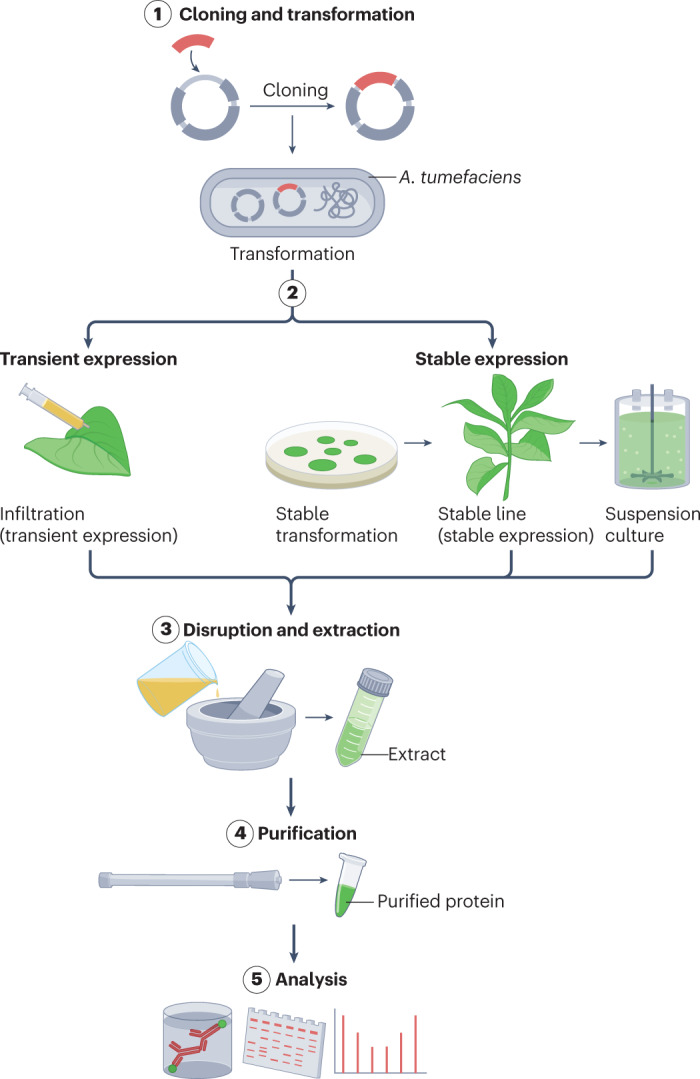
Fig. 1
Fig. 1. Plant-based production of recombinant proteins.
Expression vectors (based on binary plasmids) are transformed into Agrobacterium tumefaciens, which delivers DNA into plants for stable expression by agro-transformation (for example, using the leaf-disc method) or biolistic tools, or through transient expression by agro-infiltration. In transient expression, suspensions of bacteria (carrying the plasmids) are delivered by infiltration into leaves either manually by a syringe (small scale) or by vacuum infiltration (large scale). Following infiltration, plant expression machinery drives the expression of the genes within days. Plant tissues or cells are then harvested and extracted, followed by purification and analyses of the product.
Fig. 2
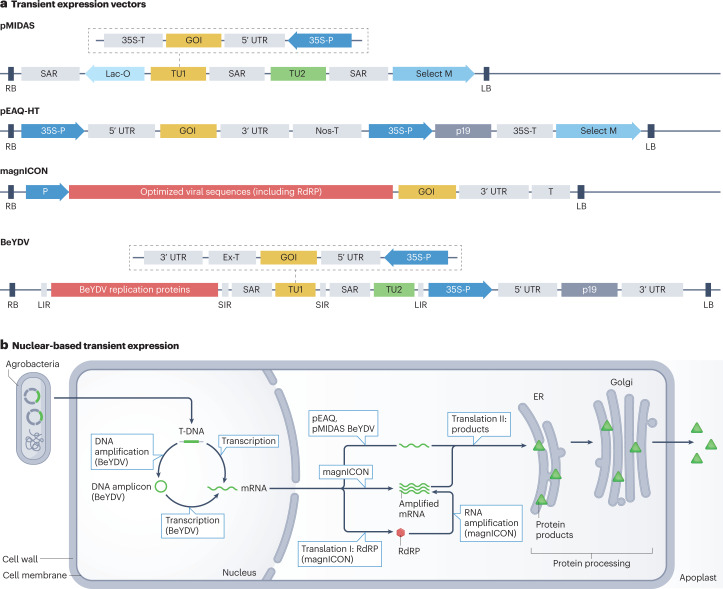
Fig. 2. Transient expression in plants.
a, Plant transient expression vectors. A binary plasmid is the standard tool for nuclear expression in higher plants. Binary plasmids are composed of transfer DNA (T-DNA) borders (right border (RB), left border (LB)), cloning sites, a selection marker and replication functions for Escherichia coli and Agrobacterium tumefaciens. Transient expression vectors, including pMIDAS, pEAQ-HT, magnICON and Geminivector bean yellow dwarf virus (BeYDV), use such a plasmid backbone for foreign sequence insertion. However, the vectors differ by regulatory elements that drive gene of interest (GOI) expression. b, Nuclear-based transient expression. A. tumefaciens is used as a vehicle to deliver T-DNA to the plant cell nucleus (agro-infiltration), where mRNA is transcribed (single transcripts or multiple transcripts, depending on the expression cassettes). Prior to transcription, BeYDV-based vectors undergo a DNA amplification step by rolling circle replication in the nucleus (DNA amplification). Once transcripts leave the nucleus, they are either directly translated into proteins (pMIDAS, pEAQ, BeYDV) or undergo a (viral) RNA amplification step (magnICON) prior to translation by a specific RNA-dependent RNA-polymerase (RdRP). Engineered expression vectors, based either on potato virus X or tobacco mosaic virus sequences carry a gene coding for RdRP. Recombinant proteins (green triangles) are transported to final subcellular compartments (in case of secreted proteins to the apoplast). 35S-P and 35S-T, cauliflower mosaic virus 35S promoter and terminator; ER, endoplasmic reticulum; Ex-T, Nicotiana tabacum extensin terminator; Lac-O, lac operon; LIR, long intergenic region; Nos-T, A. tumefaciens nopaline synthase terminator; P, actin 2 promoter or 35S promoter (depending on vector); p19, tomato bushy stunt virus p19 silencing suppressor; SAR, scaffold attachment region (of diverse origins); Select M, selection marker; SIR, short intergenic region; T, either Nos terminator or no regulatory element (depending on vector); TU, transcription unit; UTR, untranslated regions (of diverse origins).
Fig. 3
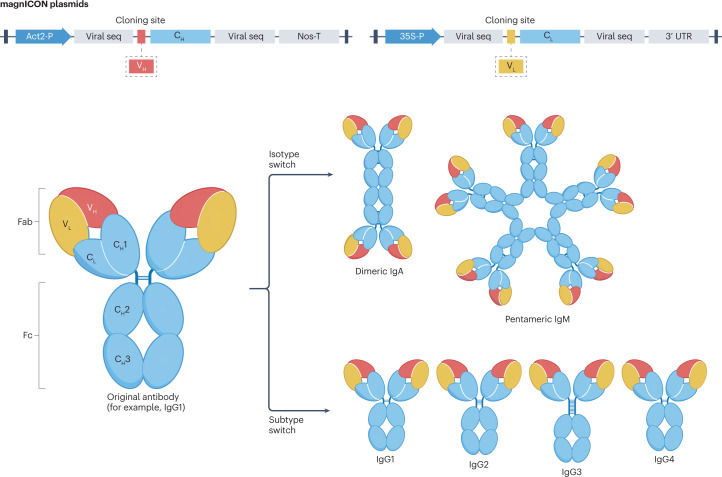
Fig. 3. Antibody engineering in plants.
A modular cloning approach using magnICON plasmids facilitates the rapid engineering and expression of antibody variants, exploiting the largely independent nature of constant and variable regions (Fab). The N-terminally located Fab is generated by variable heavy and light chains (VH, VL). The C-terminally located constant region is generated by constant heavy and light chains (CH, CL) which, in part make up the Fc region. Two plasmids are generated, carrying the CH, CL, respectively. Both plasmids carry a cloning site for rapid insertion of variable sequences (VH or VL). This design allows the rapid cloning and expression of various monoclonal antibody formats with identical antigen binding but a different constant region,. 3′ UTR, 3′ untranslated region of potato virus X; 35S-P, cauliflower mosaic virus 35S promoter; Act2-P, Arabidopsis thaliana actin 2 promoter; Nos-T, Agrobacterium tumefaciens nopaline synthase terminator; seq, sequences.
Fig. 4
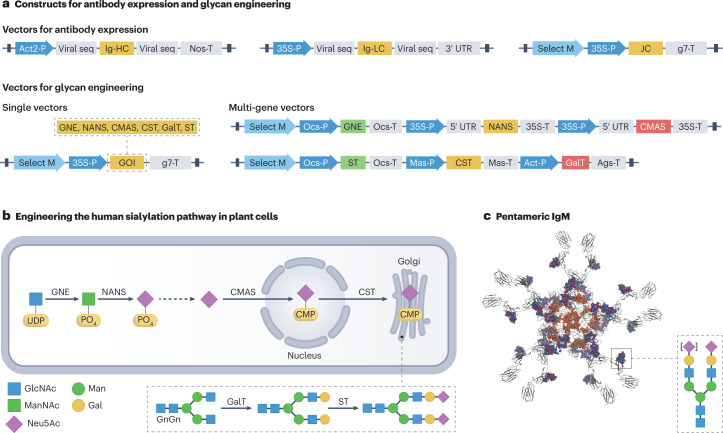
Fig. 4. Engineering post-translational modifications in plants.
a, Constructs for antibody expression and glycan engineering. The expression of antibodies requires the simultaneous delivery of two (IgG) or three (multimeric antibodies) genes into plants. Although genes of interest (GOIs) can be expressed by highly potent vectors, glycan engineering uses low-expressing to medium-expressing modules, with appropriate regulatory elements,,,,. The modules may be co-delivered in single-gene or multi-gene constructs, together with the antibody genes. b, Human sialylation pathway engineering in plant cells. Starting from the sugar nucleotide uridine diphosphate (UDP)-GlcNAc, which is abundantly present in plants, the recombinant expression of six foreign proteins is needed for in planta generation of sialylated N-glycans. The foreign proteins act in the cytoplasm, nucleus and Golgi. Mouse UDP-N-acetylglucosamine-2-epimerase/N-acetylmannosamine kinase (GNE), human N-acetylneuraminic acid phosphate synthase (NANS) and human cytidine monophosphate (CMP)-N-acetylneuraminic acid synthase (CMAS) are required to produce the activated sugar nucleotide precursor CMP-Neu5Ac. Mouse CMP-sialic acid transporter (CST) transports CMP-Neu5Ac to the Golgi, where it is transferred to the acceptor substrate, galactosylated N-glycans, by rat α-2,6-sialyltransferase (ST) to form sialylated structures. Galactosylated structures are generated by human β-1,4-galactosyltransferase (GalT), an enzyme that transfers UDP-galactose to GlcNAc-terminating structures. GlcNAc-terminated glycans and UDP-galactose are plant-intrinsic elements; however, GalT has to be expressed ectopically. c, Model of pentameric IgM. The protein contains complex N-glycans, which are represented in red and blue, and oligomannosidic glycans, which are shown in orange and red (top view). 35S-P and 35S-T, cauliflower mosaic virus 35S promoter and terminator; 3′ UTR, 3′ untranslated region of potato virus X; 5′ UTR, 5′ untranslated region from tobacco etch virus; Act-P, Arabidopsis thaliana actin; Act2-P, A. thaliana actin 2 promoter; Ags-T, Agrobacterium tumefaciens agropin synthase terminator; g7-T, A. tumefaciens gene 7 terminator; GnGn, N-glycan structure; Ig-HC and LC, immunoglobulin heavy and light chain; JC, joining chain; Mas-P, A. tumefaciens mannopine synthase promoter; Mas-T, A. tumefaciens mannopine synthase terminator; Nos-T, A. tumefaciens nopaline synthase terminator; Ocs-P, A. tumefaciens octopine synthase promoter; Ocs-T, A. tumefaciens octopine synthase terminator; Select M, selection marker; seq, sequences.

References

    1. Ecker, D. M. & Seymour, P. Supply and Demand Trends: Mammalian Biomanufacturing Industry Overview. Pharma’s Year of Accelerated Innovation & Convergence (CPhIinsights, 2020).
    1. Kaplon H, Chenoweth A, Crescioli S, Reichert JM. Antibodies to watch in 2022. mAbs. 2022;14:2014296. doi: 10.1080/19420862.2021.2014296. - DOI - PMC - PubMed
    1. He W, et al. Contributions of the international plant science community to the fight against infectious diseases in humans — part 2: affordable drugs in edible plants for endemic and re‐emerging diseases. Plant Biotechnol. J. 2021;19:1921–1936. doi: 10.1111/pbi.13658. - DOI - PMC - PubMed
    1. Lobato Gomez M, et al. Contributions of the international plant science community to the fight against human infectious diseases — part 1: epidemic and pandemic diseases. Plant Biotechnol. J. 2021;19:1901–1920. doi: 10.1111/pbi.13657. - DOI - PMC - PubMed
    1. Yang SJ, Carter SA, Cole AB, Cheng NH, Nelson RS. A natural variant of a host RNA-dependent RNA polymerase is associated with increased susceptibility to viruses by Nicotiana benthamiana. Proc. Natl Acad. Sci. USA. 2004;101:6297–6302. doi: 10.1073/pnas.0304346101. - DOI - PMC - PubMed

LinkOut - more resources