


Apo CIII Proteoforms, Plasma Lipids, and Cardiovascular Risk in MESA
- PMID: 37317850
- PMCID: PMC10516344
- DOI: 10.1161/ATVBAHA.123.319035
Apo CIII Proteoforms, Plasma Lipids, and Cardiovascular Risk in MESA
Abstract
Background: Apo CIII (apolipoprotein CIII) is an important regulator of triglyceride metabolism and was associated with cardiovascular risk in several cohorts. It is present in 4 major proteoforms, a native peptide (CIII0a), and glycosylated proteoforms with zero (CIII0b), 1 (CIII1, most abundant), or 2 (CIII2) sialic acids, which may differentially modify lipoprotein metabolism. We studied the relationships of these proteoforms with plasma lipids and cardiovascular risk.
Methods: Apo CIII proteoforms were measured by mass spectrometry immunoassay in baseline plasma samples of 5791 participants of Multi-Ethnic Study of Atherosclerosis, an observational community-based cohort. Standard plasma lipids were collected for up to 16 years and cardiovascular events (myocardial infarction, resuscitated cardiac arrest, or stroke) were adjudicated for up to 17 years.
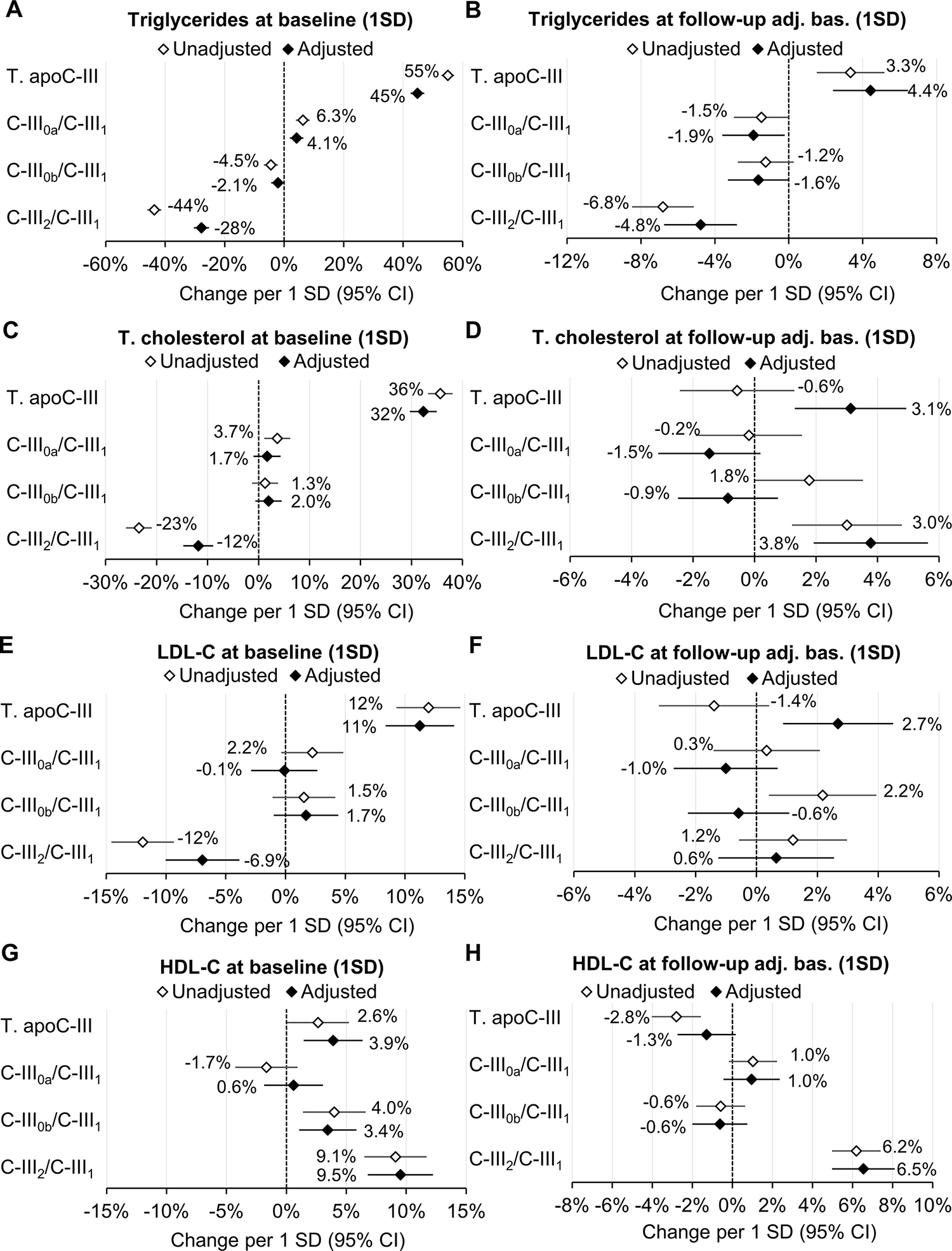
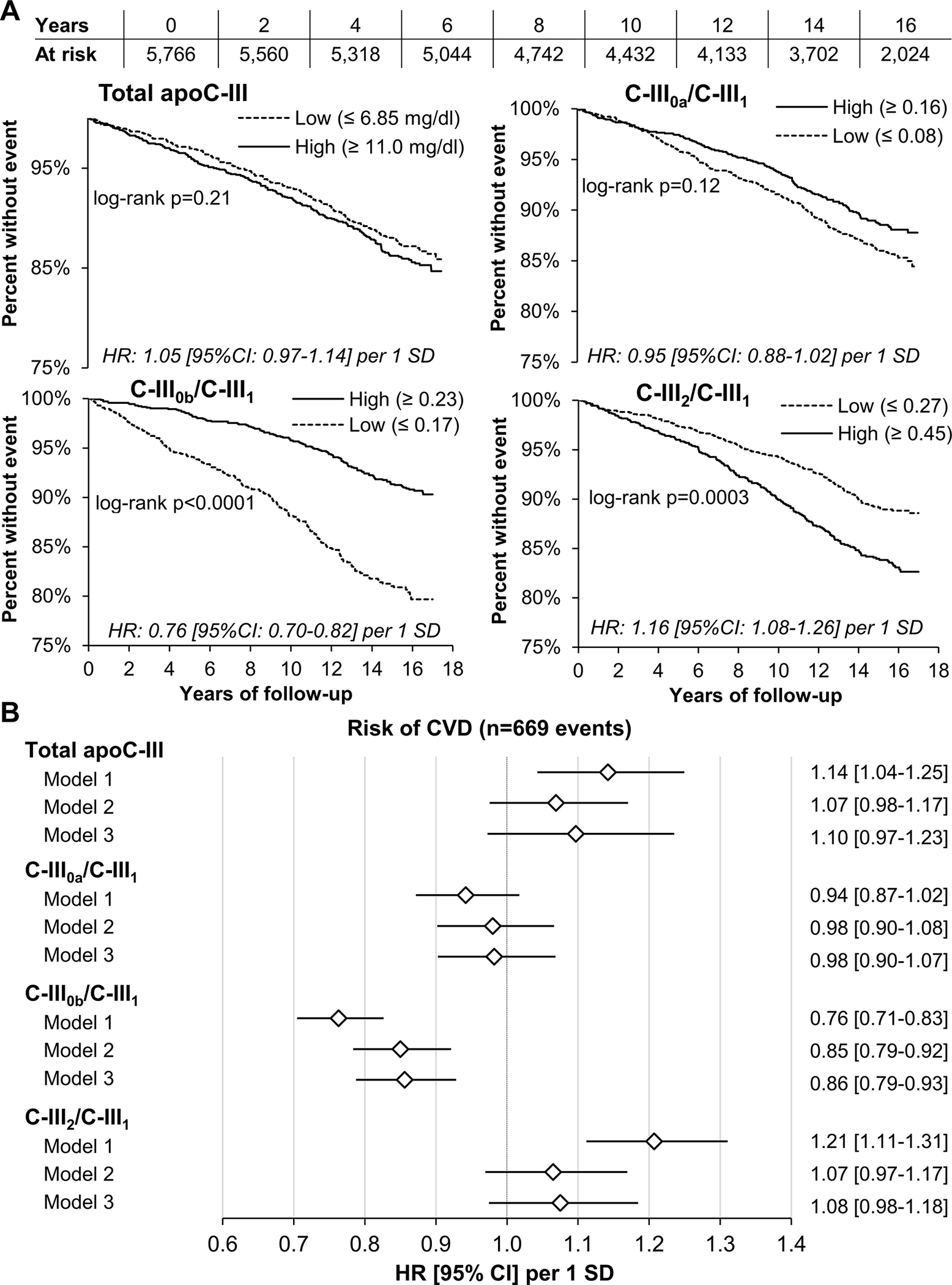
Results: Apo CIII proteoform composition differed by age, sex, race and ethnicity, body mass index, and fasting glucose. Notably, CIII1 was lower in older participants, men and Black and Chinese (versus White) participants, and higher in obesity and diabetes. In contrast, CIII2 was higher in older participants, men, Black, and Chinese persons, and lower in Hispanic individuals and obesity. Higher CIII2 to CIII1 ratio (CIII2/III1) was associated with lower triglycerides and higher HDL (high-density lipoprotein) in cross-sectional and longitudinal models, independently of clinical and demographic risk factors and total apo CIII. The associations of CIII0a/III1 and CIII0b/III1 with plasma lipids were weaker and varied through cross-sectional and longitudinal analyses. Total apo CIII and CIII2/III1 were positively associated with cardiovascular disease risk (n=669 events, hazard ratios, 1.14 [95% CI, 1.04-1.25] and 1.21 [1.11-1.31], respectively); however, the associations were attenuated after adjustment for clinical and demographic characteristics (1.07 [0.98-1.16]; 1.07 [0.97-1.17]). In contrast, CIII0b/III1 was inversely associated with cardiovascular disease risk even after full adjustment including plasma lipids (0.86 [0.79-0.93]).
Conclusions: Our data indicate differences in clinical and demographic relationships of apo CIII proteoforms, and highlight the importance of apo CIII proteoform composition in predicting future lipid patterns and cardiovascular disease risk.
Keywords: apolipoprotein; cardiovascular disease; lipids; risk.
Conflict of interest statement
Figures
References
-
- Brown WV, Baginsky ML. Inhibition of lipoprotein lipase by an apoprotein of human very low density lipoprotein. Biochem Biophys Res Commun. 1972;46:375–382. - PubMed
-
- Windler E, Havel RJ. Inhibitory effects of C apolipoproteins from rats and humans on the uptake of triglyceride-rich lipoproteins and their remnants by the perfused rat liver. J Lipid Res. 1985;26:556–565. - PubMed
Publication types
MeSH terms
Substances
Grants and funding
- N01 HC095168/HL/NHLBI NIH HHS/United States
- P30 ES006694/ES/NIEHS NIH HHS/United States
- 75N92020D00001/HL/NHLBI NIH HHS/United States
- N01 HC095167/HL/NHLBI NIH HHS/United States
- HHSN268201500003I/HL/NHLBI NIH HHS/United States
- R01 HL138969/HL/NHLBI NIH HHS/United States
- UL1 TR000040/TR/NCATS NIH HHS/United States
- N01 HC095166/HL/NHLBI NIH HHS/United States
- N01 HC095160/HL/NHLBI NIH HHS/United States
- 75N92020D00002/HL/NHLBI NIH HHS/United States
- HHSN268201500003C/HL/NHLBI NIH HHS/United States
- N01 HC095161/HL/NHLBI NIH HHS/United States
- 75N92020D00005/HL/NHLBI NIH HHS/United States
- UL1 TR001079/TR/NCATS NIH HHS/United States
- N01 HC095169/HL/NHLBI NIH HHS/United States
- N01 HC095159/HL/NHLBI NIH HHS/United States
- 75N92020D00003/HL/NHLBI NIH HHS/United States
- UL1 TR001420/TR/NCATS NIH HHS/United States
- 75N92020D00004/HL/NHLBI NIH HHS/United States
- N01 HC095163/HL/NHLBI NIH HHS/United States
- 75N92020D00007/HL/NHLBI NIH HHS/United States
- N01 HC095162/HL/NHLBI NIH HHS/United States
- 75N92020D00006/HL/NHLBI NIH HHS/United States
- N01 HC095165/HL/NHLBI NIH HHS/United States
- N01 HC095164/HL/NHLBI NIH HHS/United States
