


Comparative evaluation of different debonding and reconditioning methods for orthodontic ceramic brackets regarding effectiveness for reuse : An in vitro study
- PMID: 37318554
- PMCID: PMC11753313
- DOI: 10.1007/s00056-023-00469-z
Comparative evaluation of different debonding and reconditioning methods for orthodontic ceramic brackets regarding effectiveness for reuse : An in vitro study
Abstract
Purpose: To investigate the reusability of ceramic brackets in terms of shear bond strength, friction behavior, slot dimension, fracture strength, and color stability.
Methods: A total of 90 conventionally debonded and 30 by an Er:YAG laser debonded ceramic brackets were collected. All the used brackets were inspected under a stereomicroscope at 18 × magnification and sorted according to their adhesive remnant index (ARI). Five groups were formed (n = 10): (1) new brackets as a control group, (2) flamed and sandblasted, (3) flamed and acid bathed, (4) laser-reconditioned, and (5) laser-debonded brackets. The bracket groups were tested regarding different properties such as shear bond strength, friction behavior, slot size, fracture strength, and color stability. Analysis of variance (ANOVA) and nonparametric Kruskal-Wallis tests were used for statistical analysis (significance level: p < 0.05).
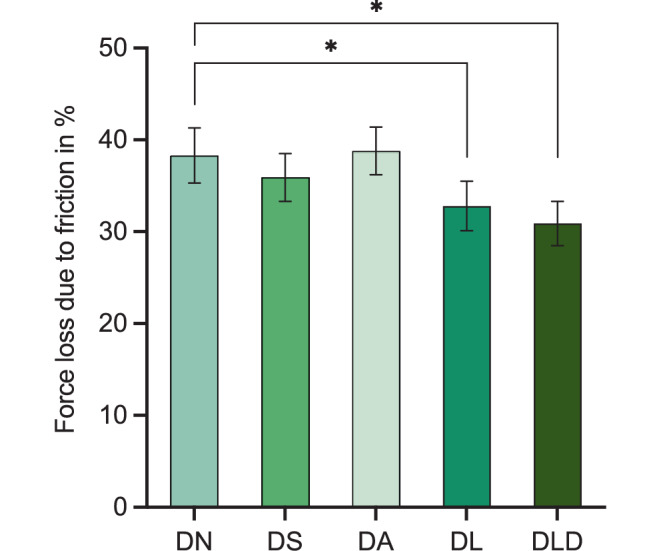
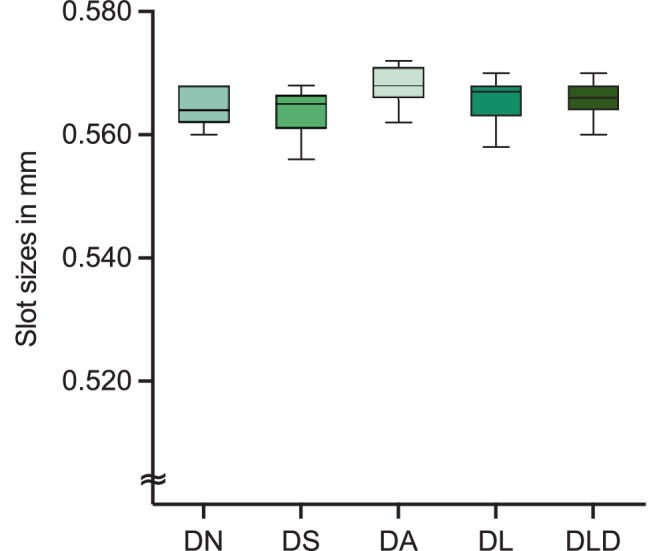
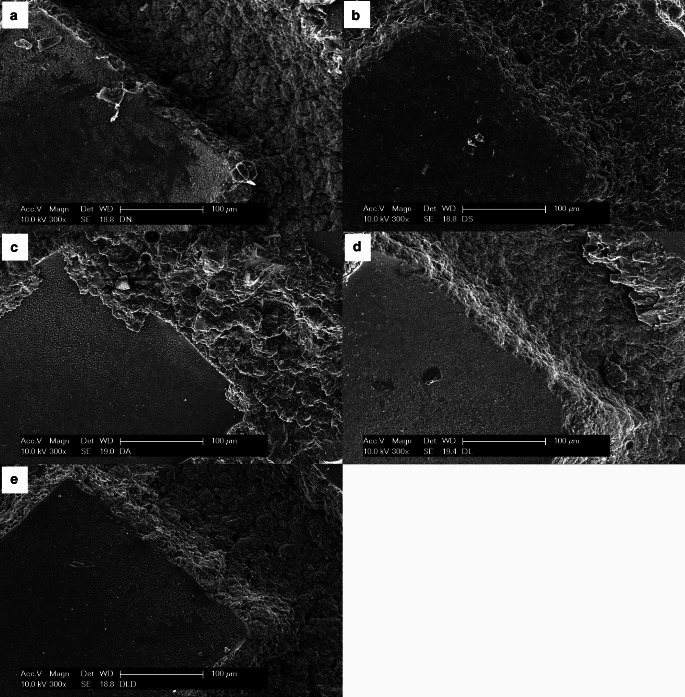
Results: Shear bond strength values of the acid reconditioned brackets were significantly lower (8.0 ± 3.1 MPa) compared to the control group (12.9 ± 2.9 MPa). Laser-reconditioned (32.8 ± 2.7%) and laser-debonded (30.9 ± 2.4%) brackets showed the lowest force loss due to friction (control group 38.3 ± 3.0%). No significant differences were observed between groups regarding slot size and fracture strength. All groups had color differences of < 10. Scanning electron microscope images and ARI scores indicated that most of the residues on the bracket bases were removed.
Conclusion: All reconditioning methods yielded adequate results regarding bracket properties. Yet, focusing on the need to protect the enamel and the bracket base, laser debonding seems to be the most suitable method for reconditioning ceramic brackets.
Zusammenfassung: ZIELSETZUNG: Untersuchung der Wiederverwendbarkeit keramischer Brackets in Bezug auf Scherhaftfestigkeit, Reibungsverhalten, Slotdimension, Bruchfestigkeit und Farbstabilität.
Methoden: Insgesamt wurden 90 konventionell und 30 mit einem Er:YAG-Laser debondete Keramikbrackets gesammelt. Alle verwendeten Brackets wurden unter einem Stereomikroskop bei 18-facher Vergrößerung untersucht und nach ihrem ARI („adhesive remnant index“) sortiert. Es wurden 5 Gruppen gebildet: (1) neue Brackets als Kontrollgruppe, (2) geflammte und sandgestrahlte, (3) geflammte und säuregebadete, (4) Laser-aufbereitete sowie (5) Laser-debondete Brackets. Die Bracketgruppen wurden auf Scherhaftfestigkeit, Reibungsverhalten, Slotdimensionen, Bruchfestigkeit und Farbstabilität getestet. Jede Untersuchung wurde an 10 Brackets durchgeführt. Für die statistische Analyse wurden Varianzanalysen (ANOVA) und nichtparametrische Kruskal-Wallis-Tests verwendet (Signifikanzniveau: p < 0,05).
Ergebnisse: Die Scherhaftfestigkeitswerte der säuregebadeten Brackets waren signifikant niedriger (8,0 ± 3,1 MPa) als die der Kontrollgruppe (12,9 ± 2,9 MPa). Laser-aufbereitete (32,8 ± 2,7 %) und Laser-debondete (30,9 ± 2,4 %) Brackets zeigten den geringsten Reibungsverlust (Kontrollgruppe 38,3 ± 3,0 %). Bei den Messungen von Slotdimension und Bruchfestigkeit wurden keine signifikanten Unterschiede festgestellt. Alle Gruppen hatten einen Farbunterschied von < 10. Rasterelektronenmikroskopische Bilder und ARI-Auswertungen zeigten, dass die meisten Klebereste in den Bracketbasen entfernt wurden.
Schlussfolgerung: Mit allen Aufbereitungsmethoden konnten angemessene Ergebnisse hinsichtlich der Bracketeigenschaften erzielt werden. Unter Berücksichtigung der Notwendigkeit, den Zahnschmelz und die Bracketbasis zu schützen, scheint das Laser-Debonding die am besten geeignete Methode für das Aufbereiten von Keramikbrackets zu sein.
Keywords: Er:YAG laser; Fixed orthodontic appliances; Material properties; Reusability; Shear bond strength.
© 2023. The Author(s).
Conflict of interest statement
Declarations. Conflict of interest: K. Grosch, J. Meister, S.D. Raval, A.M. Fouda and C. Bourauel declare that they have no competing interests. Ethical standards: This article does not contain any studies with animals or human participants by any of the authors. Informed consent: All patients gave informed consent that their anonymized brackets can be used for research purposes.
Figures

References
-
- Singh S, Singla L, Anand T (2021) Esthetic considerations in orthodontics: an overview. Dent J Adv Stud 9:55–60. 10.1055/S-0041-1726473 - DOI
-
- Xavier J, Sarika K, Ghosh P, Varma S (2021) Aesthetic bracket system: a review. Int J Dent Oral Sci 8:5191–5196. 10.19070/2377-8075-210001041 - DOI
-
- Gautam P, Valiathan A (2007) Ceramic brackets: in search of an ideal! Trends Biomater Artif Organs 20:117–122
Publication types
MeSH terms
LinkOut - more resources
Full Text Sources
