


Osteopontin is a prognostic circulating biomarker in patients with neuroendocrine neoplasms
- PMID: 37318593
- PMCID: PMC10423109
- DOI: 10.1007/s00432-023-04979-6
Osteopontin is a prognostic circulating biomarker in patients with neuroendocrine neoplasms
Abstract
Purpose: Osteopontin (OPN), also called secreted phosphoprotein 1 (SPP1) is a matricellular glycoprotein whose expression is elevated in various types of cancer and which has been shown to be involved in tumorigenesis and metastasis in many malignancies. Its role in neuroendocrine neoplasms (NEN) remains to be established. The aim of the study was to analyze plasma concentrations of OPN in patients with NEN and to explore its diagnostic and prognostic value as a clinical biomarker.
Methods: OPN plasma concentrations were measured in a total of 38 patients with histologically proven NEN at three different time points during the course of disease and therapy (at the start of the study, after 3 and 12 months, respectively) as well as in healthy controls. Clinical and imaging data as well as concentrations of Chromogranin A (CgA) and Neuron Specific Enolase (NSE) were assessed.
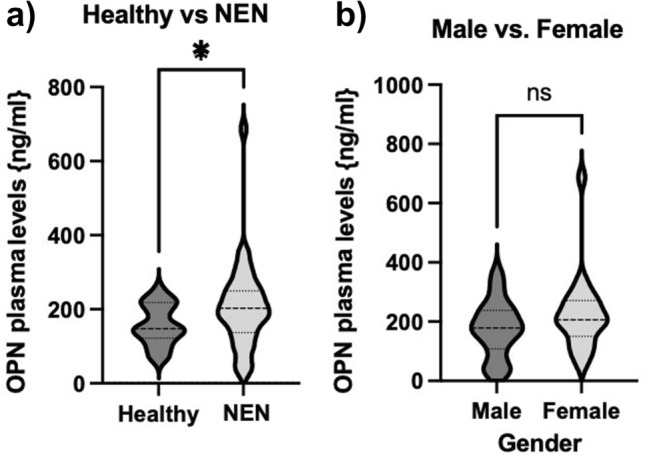
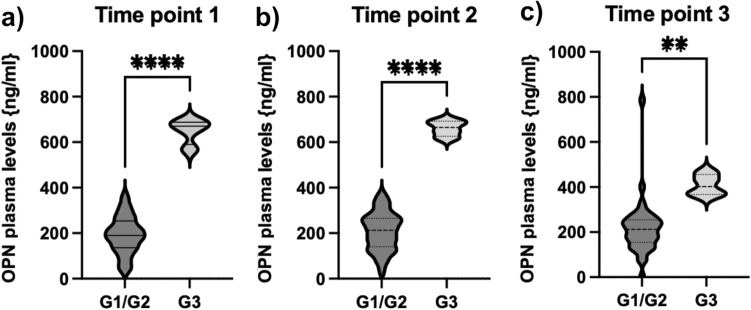
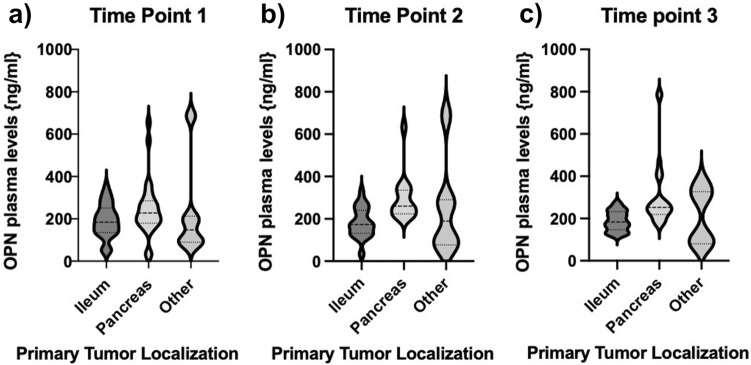
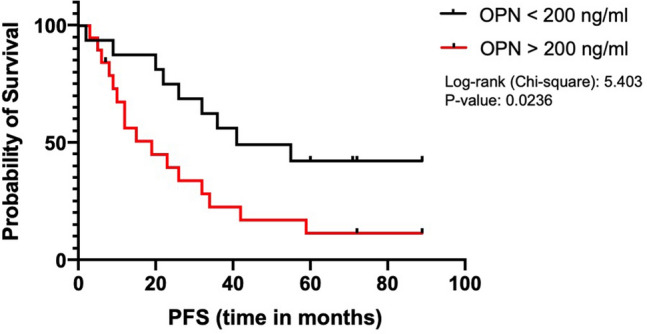
Results: OPN levels were significantly higher in patients with NEN compared to healthy controls. High-grade tumors (grade 3) showed the highest OPN levels. OPN levels were neither different between male and female patients nor between different primary tumor sites. OPN correlated significantly with corresponding NSE levels, while there was no correlation with Chromogranin A. High OPN levels above a cutoff value of 200 ng/ml at initial analysis predicted a worsened prognosis with significantly shorter progression-free survival of patients with NEN, which also held true within the subgroup of well-differentiated G1/G2 tumors.
Conclusion: Our data indicate that high baseline OPN levels in patients with NEN are predictive of an adverse outcome with shorter progression-free survival, even within the group of well differentiated G1/G2 tumors. Therefore, OPN may be used as a surrogate prognostic biomarker in patients with NEN.
Keywords: Biomarker; Chromogranin A; Neuroendocrine neoplasm; Osteopontin; Survival.
© 2023. The Author(s).
Conflict of interest statement
The authors have no relevant financial or non-financial interests to disclose.
Figures



References
-
- Appetecchia M, Lauretta R, Rota F, Carlini M (2018) Neuroendocrine tumors biomarkers. Abdominal neuroendocrine tumors. Springer Milan, Milano, pp 65–78
-
- Baur AD, Pavel M, Prasad V, Denecke T (2016) Diagnostic imaging of pancreatic neuroendocrine neoplasms (pNEN): tumor detection, staging, prognosis, and response to treatment. Acta Radiol 57:260–270 - PubMed
-
- Borges R, Diaz-Vera J, Dominguez N, Arnau MR, Machado JD (2010) Chromogranins as regulators of exocytosis. J Neurochem 114:335–343 - PubMed
-
- Bottoni P, De Michele T, Scatena R (2015) A critical approach to clinical biochemistry of chromogranin A. Adv Exp Med Biol 867:317–323 - PubMed
MeSH terms
Substances
Grants and funding
LinkOut - more resources
Full Text Sources
Research Materials
Miscellaneous
