. 2023 Jul 4;57(26):9653-9663.
doi: 10.1021/acs.est.2c09289. Epub 2023 Jun 15.

Gas and Propane Combustion from Stoves Emits Benzene and Increases Indoor Air Pollution

Affiliations

Gas and Propane Combustion from Stoves Emits Benzene and Increases Indoor Air Pollution

Yannai S Kashtan et al. Environ Sci Technol. .

Abstract

Exposure pathways to the carcinogen benzene are well-established from tobacco smoke, oil and gas development, refining, gasoline pumping, and gasoline and diesel combustion. Combustion has also been linked to the formation of nitrogen dioxide, carbon monoxide, and formaldehyde indoors from gas stoves. To our knowledge, however, no research has quantified the formation of benzene indoors from gas combustion by stoves. Across 87 homes in California and Colorado, natural gas and propane combustion emitted detectable and repeatable levels of benzene that in some homes raised indoor benzene concentrations above well-established health benchmarks. Mean benzene emissions from gas and propane burners on high and ovens set to 350 °F ranged from 2.8 to 6.5 μg min-1, 10 to 25 times higher than emissions from electric coil and radiant alternatives; neither induction stoves nor the food being cooked emitted detectable benzene. Benzene produced by gas and propane stoves also migrated throughout homes, in some cases elevating bedroom benzene concentrations above chronic health benchmarks for hours after the stove was turned off. Combustion of gas and propane from stoves may be a substantial benzene exposure pathway and can reduce indoor air quality.

Keywords: benzene emissions; electric and induction stoves; gas stoves; health; homes and residences.


Conflict of interest statement

The authors declare no competing financial interest.

Figures
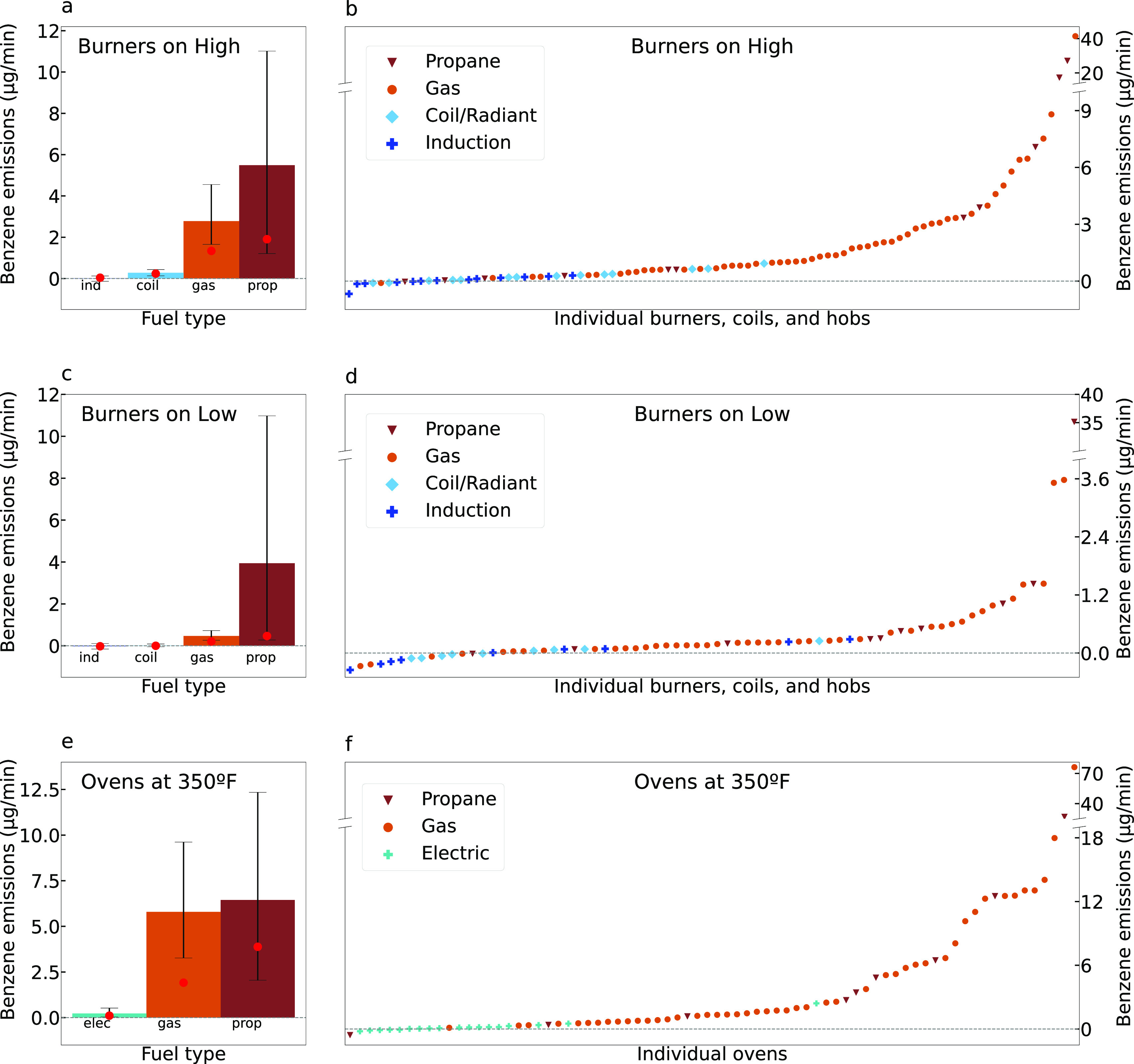
Figure 1
Figure 1
Mean and median benzene emissions by fuel type (left panels; induction, coil, natural gas, and propane) and emissions from individual cooktop elements and ovens (right panels) in μg C6H6 min–1 by appliance type (gas, coil/radiant, or induction) for burners on high (a,b) or on low (c,d) and for ovens set to 350 °F (e,f). The red points inside the bars in plots a, c, and e are the median values. Bar heights are the mean values, and black error bars are the 95% confidence interval of the mean (calculated as described in methods; see Table S1 for p values). Benzene emission rates were measured directly using the AROMA analyzer (see methods). Burners on “High” in panels a and b refer to the highest-power cooktop element on each stove set to its highest setting; “Low” refers to the lowest-power cooktop element on each stove set to its lowest functional setting. Oven emission rates include the oven preheat and oven cycling (to maintain its temperature) over the 45 m sampling interval. Note the y-axis breaks in panels b, d, and f.
Figure 2
Figure 2
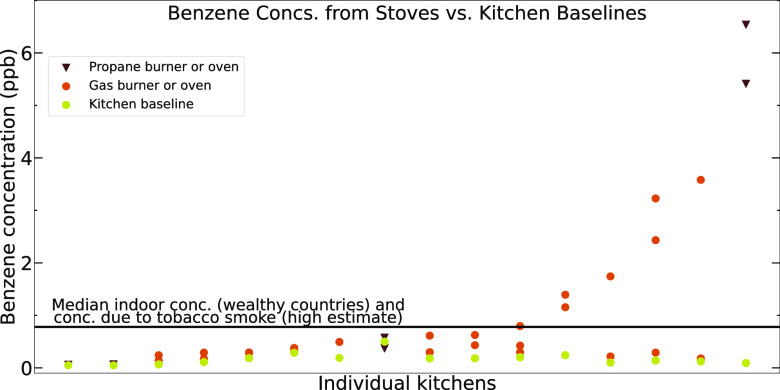
Benzene concentrations in unsealed kitchens as measured immediately after being aired out with outdoor air (mustard circles) and after 45 min with one burner on high or oven set to 350 °F fueled by propane (brown triangles) or gas (orange circles). Each point represents a single measurement; each x-value represents a single kitchen; multiple dots in the same column represent measurements of different burners or ovens in the same kitchen. These measured kitchen concentrations are compared with the upper estimate of benzene concentrations attributable to secondhand tobacco smoke (0.78 ppbv) and the median indoor benzene concentration in the US, Canada, Western Europe, Japan, South Korea, Hong Kong, and Australia derived from a literature survey (0.79 ppbv).
Figure 3
Figure 3
Benzene concentrations (ppbv C6H6) measured in bedrooms furthest from open kitchens with the oven set to 475 °F for 1.5 h and then turned off for 6.5 h. Each point represents a single reading from the AROMA analyzer, and all data points collected are illustrated in the plot. Air-sampling hoses in houses 1, 3, 4, 5, and 6 were placed in bedrooms ∼8 meters down the hall from the kitchen; the sampling hose in house 2 was in a bedroom ∼4 meters down the hall from the kitchen. The solid black line at 1 ppbv benzene represents the California OEHHA 8-h REL for noncancer effects; the solid black line at 8 ppbv benzene represents the California OEEHA acute REL. Several chronic benzene standards are plotted for comparison at the right with dashed black lines for Israel and France at the bottom (0.41 and 0.63 ppbv, respectively), two of the lowest chronic benzene standards globally; the European Union chronic health benchmark (1.56 ppbv), which is the most common chronic health benchmark globally; and, at the top, the chronic standard adopted by the US ATSDR (3.0 ppbv), a department affiliated with the Centers for Disease Control and Prevention. We measured all concentrations in real time using the AROMA VOC analyzer. During the measurements, all interior doors of the houses were open, and no fans were used to mix the air.

References

    1. Chatzis C.; Alexopoulos E.; Linos A. Indoor and Outdoor Personal Exposure to Benzene in Athens, Greece. Sci. Total Environ. 2005, 349, 72–80. 10.1016/j.scitotenv.2005.01.034. - DOI - PubMed
    1. Lebel E. D.; Finnegan C. J.; Ouyang Z.; Jackson R. B. Methane and NOx Emissions from Natural Gas Stoves, Cooktops, and Ovens in Residential Homes. Environ. Sci. Technol. 2022, 56, 2529–2539. 10.1021/acs.est.1c04707. - DOI - PubMed
    1. Mullen N. A.; Li J.; Russell M. L.; Spears M.; Less B. D.; Singer B. C. Results of the California Healthy Homes Indoor Air Quality Study of 2011-2013: Impact of Natural Gas Appliances on Air Pollutant Concentrations. Indoor Air 2016, 26, 231–245. 10.1111/INA.12190. - DOI - PubMed
    1. Singer B. C.; Pass R. Z.; Delp W. W.; Lorenzetti D. M.; Maddalena R. L. Pollutant Concentrations and Emission Rates from Natural Gas Cooking Burners without and with Range Hood Exhaust in Nine California Homes. Build. Environ. 2017, 122, 215–229. 10.1016/J.BUILDENV.2017.06.021. - DOI
    1. Alberts W. M. Indoor Air Pollution: NO, NO2, CO, and CO2. J. Allergy Clin. Immunol. 1994, 94, 289–295. 10.1053/AI.1994.V94.A56007. - DOI - PubMed

Publication types