


Unlocking complex soil systems as carbon sinks: multi-pool management as the key
- PMID: 37322013
- PMCID: PMC10272151
- DOI: 10.1038/s41467-023-38700-5
Unlocking complex soil systems as carbon sinks: multi-pool management as the key
Abstract
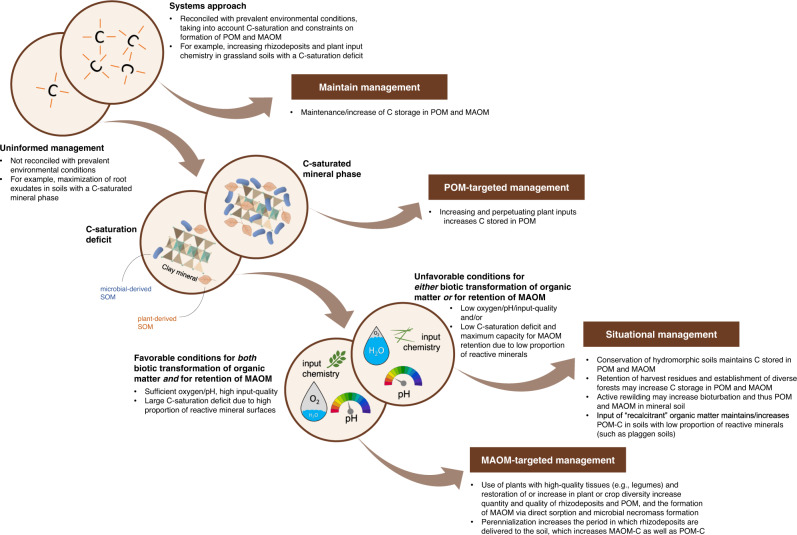
Much research focuses on increasing carbon storage in mineral-associated organic matter (MAOM), in which carbon may persist for centuries to millennia. However, MAOM-targeted management is insufficient because the formation pathways of persistent soil organic matter are diverse and vary with environmental conditions. Effective management must also consider particulate organic matter (POM). In many soils, there is potential for enlarging POM pools, POM can persist over long time scales, and POM can be a direct precursor of MAOM. We present a framework for context-dependent management strategies that recognizes soils as complex systems in which environmental conditions constrain POM and MAOM formation.
© 2023. The Author(s).
Conflict of interest statement
The authors declare no competing interests.
Figures
References
-
- Golchin A, Oades JM, Skjemstad JO, Clarke P. Soil structure and carbon cycling. Aust. J. Soil Res. 1994;32:1043. doi: 10.1071/SR9941043. - DOI
-
- Elliott ET, Cambardella CA. Physical separation of soil organic matter. Agric. Ecosyst. Environ. 1991;34:407–419. doi: 10.1016/0167-8809(91)90124-G. - DOI
-
- Beudert G, Kögel-Knabner I, Zech W. Micromorphological, wet-chemical and 13C NMR spectroscopic characterization of density fractionated forest soils. Sci. Total Environ. 1989;81–82:401–408. doi: 10.1016/0048-9697(89)90148-4. - DOI
Publication types
MeSH terms
Substances
Grants and funding
LinkOut - more resources
Full Text Sources
