Exploring the mycobiota of bromeliads phytotelmata in Brazilian Campos Rupestres
- PMID: 37322328
- PMCID: PMC10485200
- DOI: 10.1007/s42770-023-00977-5
Exploring the mycobiota of bromeliads phytotelmata in Brazilian Campos Rupestres
Abstract
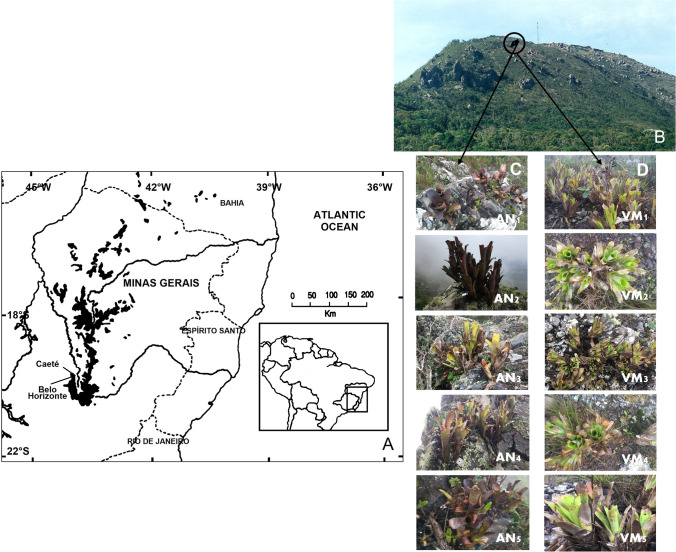
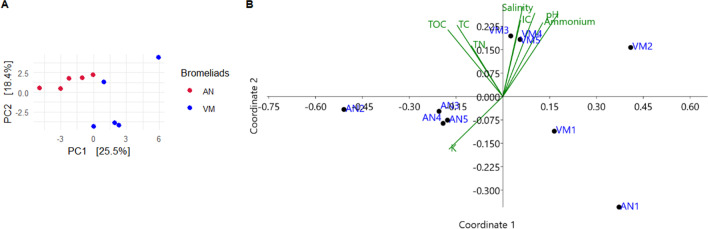
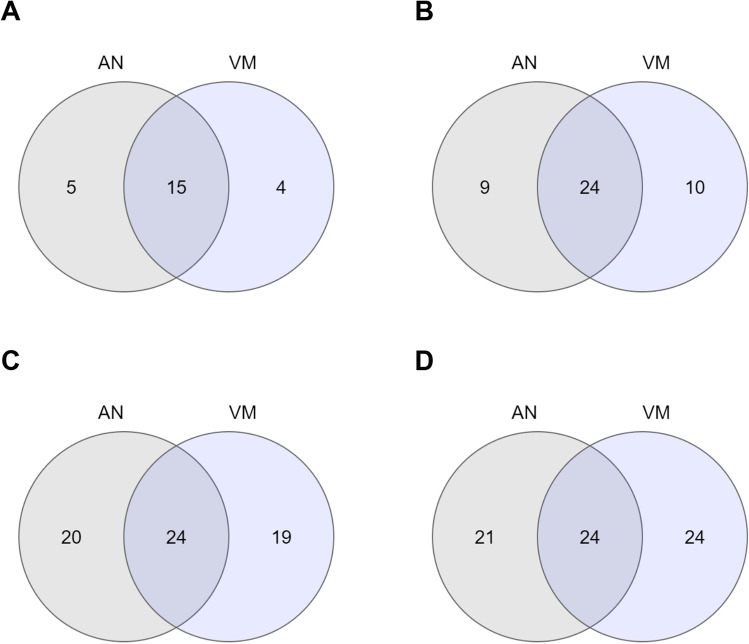
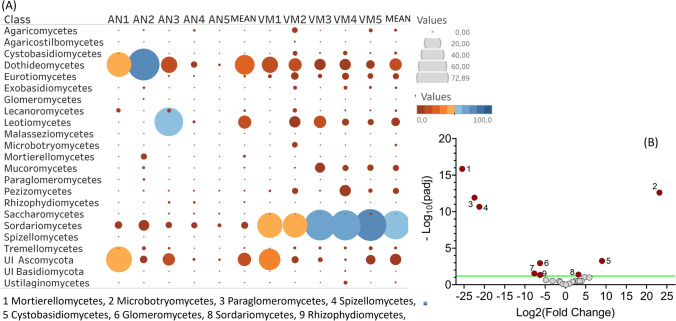
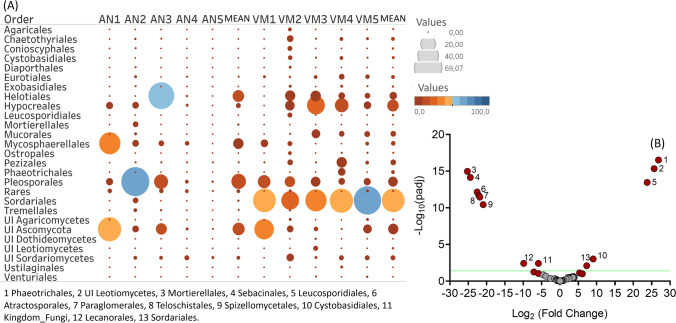
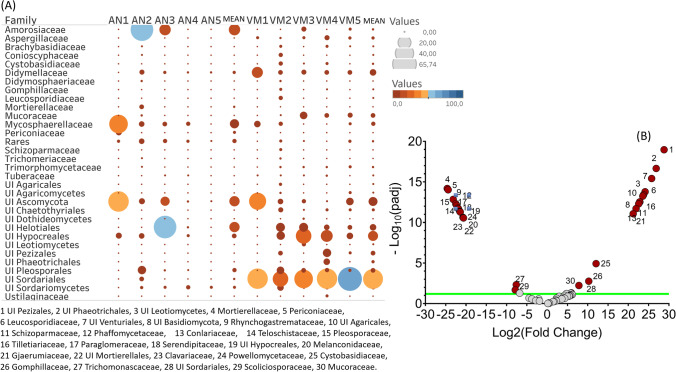
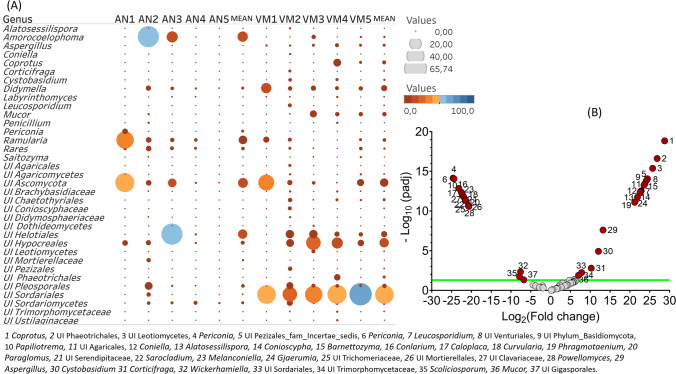
The phytotelmata is a water-filled tank on a terrestrial plant, and it plays an important role in bromeliad growth and ecosystem functioning. Even though previous studies have contributed to elucidate the composition of the prokaryotic component of this aquatic ecosystem, its mycobiota (fungal community) is still poorly known. In the present work, ITS2 amplicon deep sequencing was used to examine the fungal communities inhabiting the phytotelmata of two bromeliads species that coexist in a sun-exposed rupestrian field of Southeastern Brazil, namely Aechmea nudicaulis (AN) and Vriesea minarum (VM). Ascomycota was the most abundant phylum in both bromeliads (57.1 and 89.1% in AN and VM respectively, on average), while the others were present in low abundance (< 2%). Mortierellomycota and Glomeromycota were exclusively observed in AN. Beta-diversity analysis showed that samples from each bromeliad significantly clustered together. In conclusion, despite the considerable within-group variation, the results suggested that each bromeliad harbor a distinct fungi community, what could be associated with the physicochemical characteristics of the phytotelmata (mainly total nitrogen, total organic carbon, and total carbon) and plant morphological features.
Keywords: Aechmea nudicaulis; Bromeliaceae; Fungal community; ITS deep sequencing; Vriesea minarum.
© 2023. The Author(s) under exclusive licence to Sociedade Brasileira de Microbiologia.
Conflict of interest statement
The authors declare no competing interests.
Figures
References
-
- Giongo A, Medina-Silva R, Astarita LV, Borges LGA, Oliveira RR, Simão TLL, Gano KA, Davis-Richardson AG, Brown CT, Fagen JR, Arzivenco PM, Neto CP, Abichequer AD, Lindholz CG, Baptista-Silva A, Mondin CA, Utz LRP, Triplett EW, Eizirik E. Seasonal physiological parameters and phytotelmata bacterial diversity of two bromeliad species (Aechmea gamosepala and Vriesea platynema) from the Atlantic Forest of Southern Brazil. Diversity. 2019;11:111. doi: 10.3390/d11070111. - DOI
-
- Vergne A, Darbot V, Bardot C, Enault F, Le Jeune A-H, et al. Assemblages of anoxygenic phototrophic bacteria in tank bromeliads exhibit a host-specific signature. J Ecol. 2021;109:2550–2565. doi: 10.1111/1365-2745.13657. - DOI
-
- Marques AR, Resende AA, Gomes FCO, Santos ARO, Rosa CA, Duarte AA, de Lemos-Filho JP, Dos Santos VL. Plant growth-promoting traits of yeasts isolated from the tank bromeliad Vriesea minarum L.B. Smith and the effectiveness of Carlosrosaea vrieseae for promoting bromeliad growth. Braz J Microbiol. 2021;52:1417–1429. doi: 10.1007/s42770-021-00496-1. - DOI - PMC - PubMed
-
- Benzing DH. Bromeliaceae: profile of an adaptive radiation. Cambridge: Cambridge University Press; 2000. p. 675.
-
- Brandt FB, Martinson GO, Conrad R. Bromeliad tanks are unique habitats for microbial communities involved in methane turnover. Plant Soil. 2017;410:167–179. doi: 10.1007/s11104-016-2988-9. - DOI
MeSH terms
Substances
LinkOut - more resources
Full Text Sources