


Virtual screening-molecular docking-activity evaluation of Ailanthus altissima (Mill.) swingle bark in the treatment of ulcerative colitis
- PMID: 37322476
- PMCID: PMC10268345
- DOI: 10.1186/s12906-023-03991-0
Virtual screening-molecular docking-activity evaluation of Ailanthus altissima (Mill.) swingle bark in the treatment of ulcerative colitis
Abstract
Background: The dried bark of Ailanthus altissima (Mill.) Swingle is widely used in traditional Chinese medicine for the treatment of ulcerative colitis. The objective of this study was to explore the therapeutic basis of the dried bark of Ailanthus altissima (Mill.) Swingle for the treatment of ulcerative colitis based on Virtual Screening-Molecular Docking-Activity Evaluation technology.
Methods: By searching the Traditional Chinese Medicine Systems Pharmacology TCMSP Database and Analysis Platform, 89 compounds were obtained from the chemical components of the dried bark of Ailanthus altissima (Mill.) Swingle. Then, after preliminarily screening the compounds based on Lipinski's rule of five and other relevant conditions, the AutoDock Vina molecular docking software was used to evaluate the affinity of the compounds to ulcerative colitis-related target proteins and their binding modes through use of the scoring function to identify the best candidate compounds. Further verification of the compound's properties was achieved through in vitro experiments.
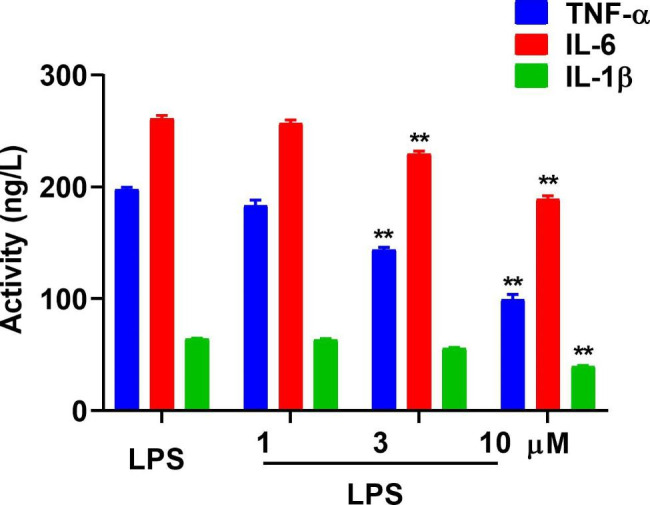
Results: Twenty-two compounds obtained from the secondary screening were molecularly docked with ulcerative colitis-related target proteins (IL-1R, TLR, EGFR, TGFR, and Wnt) using AutoDock Vina. The free energies of the highest scoring compounds binding to the active cavity of human IL-1R, TLR, EGFR, TGFR, and Wnt proteins were - 8.7, - 8.0, - 9.2, - 7.7, and - 8.5 kcal/mol, respectively. The potential compounds, dehydrocrebanine, ailanthone, and kaempferol, were obtained through scoring function and docking mode analysis. Furthermore, the potential compound ailanthone (1, 3, and 10 µM) was found to have no significant effect on cell proliferation, though at 10 µM it reduced the level of pro-inflammatory factors caused by lipopolysaccharide.
Conclusion: Among the active components of the dried bark of Ailanthus altissima (Mill.) Swingle, ailanthone plays a major role in its anti-inflammatory properties. The present study shows that ailanthone has advantages in cell proliferation and in inhibiting of inflammation, but further animal research is needed to confirm its pharmaceutical potential.
Keywords: Ailanthus altissima (Mill.) Swingle Bark; Evaluation; Molecular Docking; Ulcerative Colitis; Virtual screening.
© 2023. The Author(s).
Conflict of interest statement
The authors declare that there are no conflicts of interest regarding the publication of this paper.
Figures


References
-
- Huang YF, Zhou JT, Qu C, Dou YX, Huang QH, Lin ZX, Xian YF, Xie JH, Xie YL, Lai XP, et al. Anti-inflammatory effects of Brucea javanica oil emulsion by suppressing NF-κB activation on dextran sulfate sodium-induced ulcerative colitis in mice. J Ethnopharmacol. 2017;198:389–98. doi: 10.1016/j.jep.2017.01.042. - DOI - PubMed
MeSH terms
Substances
Grants and funding
LinkOut - more resources
Full Text Sources
Medical
Research Materials
Miscellaneous
