


Say it right: measuring the impact of different communication strategies on the decision to get vaccinated
- PMID: 37322477
- PMCID: PMC10273550
- DOI: 10.1186/s12889-023-16047-2
Say it right: measuring the impact of different communication strategies on the decision to get vaccinated
Abstract
Background: Vaccine hesitancy is a concerning menace to the control of vaccine-preventable diseases. Effective health communication could promote an overall understanding of the importance, risks, and benefits of vaccination and reduce vaccine hesitancy.
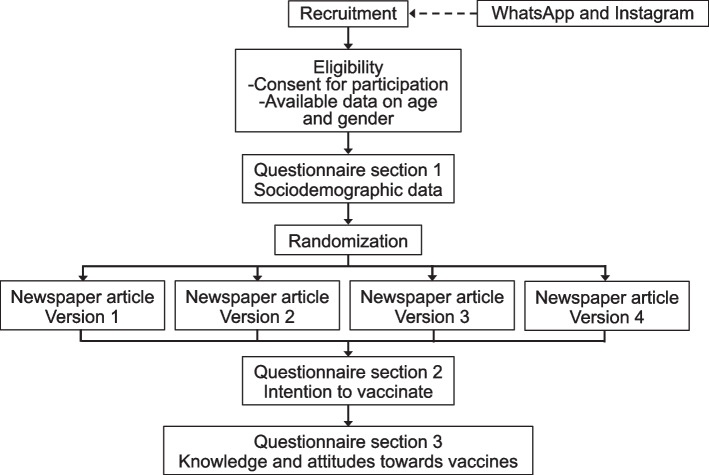
Methods: In this survey, four fictitious newspaper articles addressing an emerging bogus disease and its vaccine were randomly assigned to participants. The first version focused on information about the disease; the second was akin to the first, including a case description and image. The third version focused on vaccine safety/efficacy; the fourth version was like the third, including a case description and image. After reading a single version of the article, participants responded if they would take the vaccine and if they would vaccinate their children. We used chi-squared tests for comparisons and investigated interactions with vaccine-hesitant attitudes.
Results: We included 5233 participants between August/2021 and January/2022; 790 were caregivers of a child ≤ 5 years old, and 15% had prior vaccine hesitancy. Although most declared intention to take the vaccine, the percentage was highest among those exposed to the newspaper article focusing on the vaccine safety/efficacy with the case description and picture (91%; 95% confidence interval 89-92%), and lowest among participants exposed to the article focusing on the disease with no case description (84%; 95% confidence interval 82-86%). Similar trends were observed in the intention of offspring vaccination. We found evidence of effect modification by vaccine-hesitant attitudes, with a higher impact of communication focusing on vaccine safety/efficacy compared to that focusing on disease characteristics among hesitant participants.
Conclusion: Communication strategies focusing on different aspects of the disease-vaccine duet may impact vaccine hesitancy, and storytelling/emotive imagery descriptions may improve risk perception and vaccine uptake. Moreover, the effect of message framing strategies may differ according to previous vaccine hesitant attitudes.
Keywords: Health communication; Random allocation; Surveys and questionnaires; Vaccination hesitancy; Vaccines.
© 2023. The Author(s).
Conflict of interest statement
The authors declare no competing interests.
Figures
References
-
- Greenwood B. The contribution of vaccination to global health: past, present and future. Philos Trans R Soc B Biol Sci. 2014. Available from: https://www.ncbi.nlm.nih.gov/pmc/articles/PMC4024226/. Accessed 6 Nov 2022. - PMC - PubMed
-
- Rodrigues CMC, Plotkin SA. Impact of Vaccines; Health, Economic and Social Perspectives. Front Microbiol. 2020. Available from: https://www.ncbi.nlm.nih.gov/pmc/articles/PMC7371956/. Accessed 6 Nov 2022. - PMC - PubMed
-
- MacDonald NE. Vaccine hesitancy: Definition, scope and determinants. Vaccine. 2015. Available from: https://www.sciencedirect.com/science/article/pii/S0264410X15005009. Accessed 6 Nov 2022. - PubMed
-
- Larson HJ, Jarrett C, Eckersberger E, Smith DMD, Paterson P. Understanding vaccine hesitancy around vaccines and vaccination from a global perspective: A systematic review of published literature, 2007–2012. Vaccine. 2014. Available from: https://www.sciencedirect.com/science/article/pii/S0264410X14001443. Accessed 18 Nov 2022. - PubMed
Publication types
MeSH terms
Substances
LinkOut - more resources
Full Text Sources
Medical
