


Evolution of bioprinting and current applications
- PMID: 37323489
- PMCID: PMC10261138
- DOI: 10.18063/ijb.742
Evolution of bioprinting and current applications
Abstract
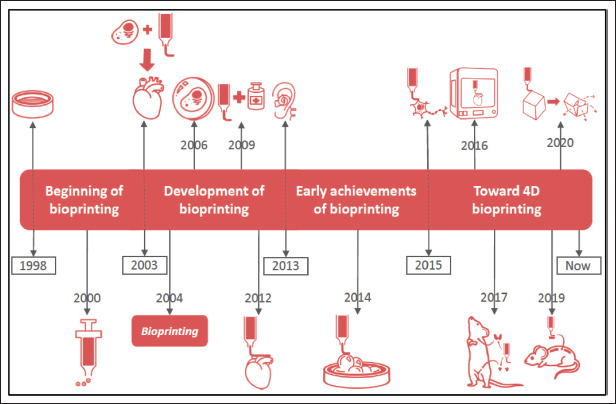
Bioprinting is a very useful tool that has a huge application potential in different fields of science and biotechnology. In medicine, advances in bioprinting are focused on the printing of cells and tissues for skin regeneration and the manufacture of viable human organs, such as hearts, kidneys, and bones. This review provides a chronological overview of some of the most relevant developments of bioprinting technique and its current status. A search was carried out in SCOPUS, Web of Science, and PubMed databases, and a total of 31,603 papers were found, of which 122 were finally chosen for analysis. These articles cover the most important advances in this technique at the medical level, its applications, and current possibilities. Finally, the paper ends with conclusions about the use of bioprinting and our expectations of this technique. This paper presents a review on the tremendous progress of bioprinting from 1998 to the present day, with many promising results indicating that our society is getting closer to achieving the total reconstruction of damaged tissues and organs and thus solving many healthcare-related problems, including the shortage of organ and tissue donors.
Keywords: 3D printing; Bioprinting; Organ culture; Tissue engineering; Tissue regeneration.
Copyright:© 2023, Mendoza-Cerezo L, Rodríguez-Rego JM, Macías- García A, et al.
Conflict of interest statement
The authors declare no conflicts of interest.
Figures


References
-
- Ozbolat IT, Yu Y. Bioprinting toward organ fabrication: Challenges and future trends. IEEE Trans Biomed Eng. 2013;60(3):691–699. http://doi.org/10.1109/TBME.2013.2243912. - PubMed
-
- Park A, Wu B, Griffith LG. Integration of surface modification and 3D fabrication techniques to prepare patterned poly(L-lactide) substrates allowing regionally selective cell adhesion. J Biomater Sci Polym Ed. 1998;9(2):89–110. http://doi.org/10.1163/156856298×00451. - PubMed
-
- Kim SS, Utsunomiya H, Koksi JA, et al. Survival and function of hepatocytes on a novel three-dimensional synthetic biodegradable polymer scaffold with an intrinsic network of channels. Ann Surg. 1998;228(1):8. http://doi.org/10.1097/00000658-199807000-00002. - PMC - PubMed
-
- Bhatia SN, Chen CS. Tissue engineering at the microscale. Biomed Microdevices. 1999;2(2):131–144. http://doi.org/10.1023/A:1009949704750.
-
- Vozzi G, Ahluwalia A, de Rossi D, et al. Microsyringe based fabrication of high resolution organic structures for bioengineering applications. Proceedings of the First Annual International IEEE-EMBS Special Topic Conference on Microtechnologies in Medicine and Biology. 2000:141–145.
Publication types
LinkOut - more resources
Full Text Sources