


Physical processing for decellularized nerve xenograft in peripheral nerve regeneration
- PMID: 37324430
- PMCID: PMC10267830
- DOI: 10.3389/fbioe.2023.1217067
Physical processing for decellularized nerve xenograft in peripheral nerve regeneration
Abstract
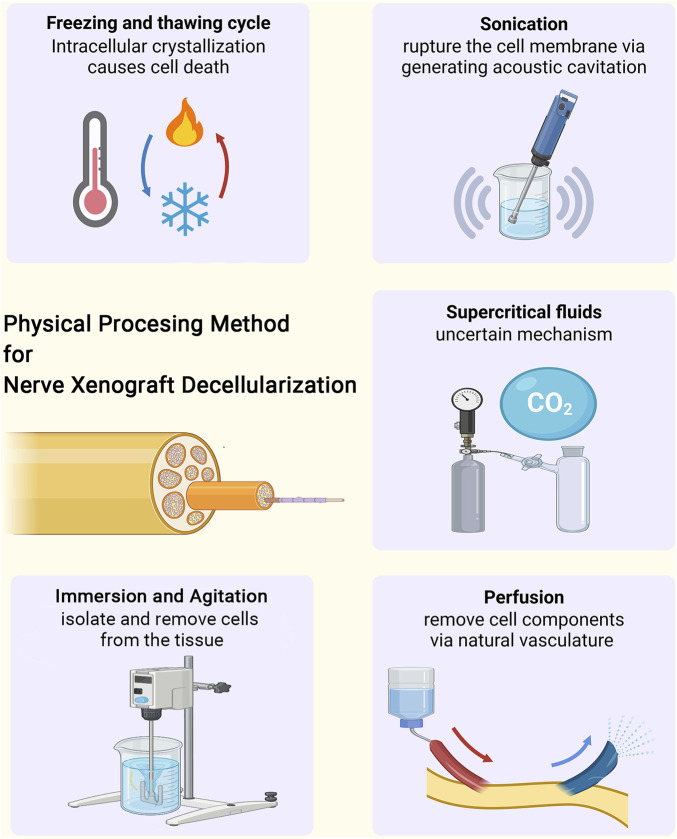
In severe or complex cases of peripheral nerve injuries, autologous nerve grafts are the gold standard yielding promising results, but limited availability and donor site morbidity are some of its disadvantages. Although biological or synthetic substitutes are commonly used, clinical outcomes are inconsistent. Biomimetic alternatives derived from allogenic or xenogenic sources offer an attractive off-the-shelf supply, and the key to successful peripheral nerve regeneration focuses on an effective decellularization process. In addition to chemical and enzymatic decellularization protocols, physical processes might offer identical efficiency. In this comprehensive minireview, we summarize recent advances in the physical methods for decellularized nerve xenograft, focusing on the effects of cellular debris clearance and stability of the native architecture of a xenograft. Furthermore, we compare and summarize the advantages and disadvantages, indicating the future challenges and opportunities in developing multidisciplinary processes for decellularized nerve xenograft.
Keywords: decellularized nerve xenograft; freeze-thaw; immersion and agitation; perfusion; peripheral nerve regeneration; physical processing; sonication; supercritical fluids.
Copyright © 2023 Hsu, Chen, Tseng, Hung, Chung, Lin, Koo and Hsueh.
Conflict of interest statement
The authors declare that the research was conducted in the absence of any commercial or financial relationships that could be construed as a potential conflict of interest.
Figures
References
-
- Accioli De Vaconcellos Z. A., Duchossoy Y., Kassar-Duchossoy L., Mira J. C. (1999). Experimental median nerve repair by fresh or frozen nerve autografts and xenografts. Ann. Chir. Main. Memb. Super. 18 (1), 74–84. - PubMed
-
- Boriani F., Fazio N., Fotia C., Savarino L., Nicoli Aldini N., Martini L., et al. (2017). A novel technique for decellularization of allogenic nerves and in vivo study of their use for peripheral nerve reconstruction. J. Biomed. Mater Res. A 105 (8), 2228–2240. - PubMed
Publication types
LinkOut - more resources
Full Text Sources
