


Chemical tools to study bacterial glycans: a tale from discovery of glycoproteins to disruption of their function
- PMID: 37324574
- PMCID: PMC10266715
- DOI: 10.1002/ijch.202200050
Chemical tools to study bacterial glycans: a tale from discovery of glycoproteins to disruption of their function
Abstract
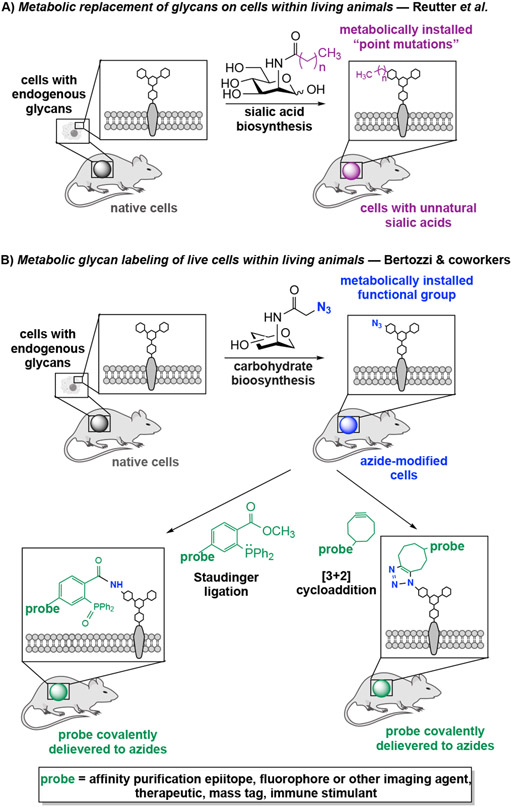
Bacteria coat themselves with a dense array of cell envelope glycans that enhance bacterial fitness and promote survival. Despite the importance of bacterial glycans, their systematic study and perturbation remains challenging. Chemical tools have made important inroads toward understanding and altering bacterial glycans. This review describes how pioneering discoveries from Prof. Carolyn Bertozzi's laboratory inspired our laboratory to develop sugar probes to facilitate the study of bacterial glycans. As described below, we used metabolic glycan labelling to install bioorthogonal reporters into bacterial glycans, ultimately permitting the discovery of a protein glycosylation system, the identification of glycosylation genes, and the development of metabolic glycan inhibitors. Our results have provided an approach to screen bacterial glycans and gain insight into their function, even in the absence of detailed structural information.
Keywords: bacteria; bioorthogonal chemistry; glycan; glycoprotein; metabolic labeling.
Figures



References
-
- National Research Council Committee on Assessing the Impact of Glycosciences, in Transforming Glycoscience: A Roadmap for the Future, National Academies Press (US), National Academy of Sciences., Washington (DC), 2012. - PubMed
-
- Zhou JY, Cobb BA, Annu Rev Immunol 2021, 39, 511–536. - PubMed
-
- Poole J, Day CJ, von Itzstein M, Paton JC, Jennings MP, Nat Rev Microbiol 2018, 16, 440–452. - PubMed
Grants and funding
LinkOut - more resources
Full Text Sources
Research Materials