. 2023 May 31:14:1202235.
doi: 10.3389/fpls.2023.1202235. eCollection 2023.

Agrobacterium-mediated direct transformation of wheat mature embryos through organogenesis

Affiliations

Agrobacterium-mediated direct transformation of wheat mature embryos through organogenesis

Xudong Ye et al. Front Plant Sci. .

Abstract

Transgenic plant production in monocotyledonous species has primarily relied on embryogenic callus induction from both immature and mature embryos as the pathway for plant regeneration. We have efficiently regenerated fertile transgenic wheat plants through organogenesis after Agrobacterium-mediated direct transformation of mechanically isolated mature embryos from field-grown seed. Centrifugation of the mature embryos in the presence of Agrobacterium was found to be essential for efficient T-DNA delivery to the relevant regenerable cells. The inoculated mature embryos formed multiple buds/shoots on high-cytokinin medium, which directly regenerated into transgenic shoots on hormone-free medium containing glyphosate for selection. Rooted transgenic plantlets were obtained within 10-12 weeks after inoculation. Further optimization of this transformation protocol resulted in significant reduction of chimeric plants to below 5%, as indicated by leaf GUS staining and T1 transgene segregation analysis. Direct transformation of wheat mature embryos has substantial advantages over traditional immature embryo-based transformation systems, including long-term storability of the mature dry explants, scalability, and greatly improved flexibility and consistency in transformation experiments.

Keywords: agrobacterium-mediated transformation; centrifugation-assisted Agrobacterium inoculation; mature embryo; multiple buds; multiple shoots; organogenesis; transgenic plant; wheat.


Conflict of interest statement

The research activities in this report were conducted by teams at legacy Monsanto Company, now Bayer Crop Science, a manufacturer of seeds produced by conventional and biotechnology methods. The authors contributed to this research as employees. A relevant US patent application has been filed and assigned to Bayer Crop Science.

Figures
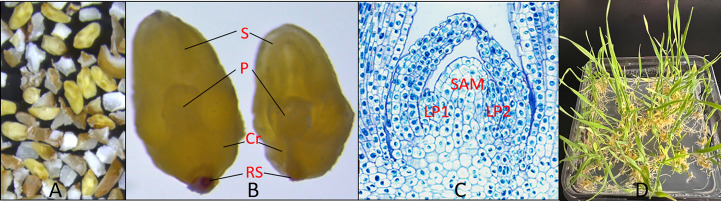
Figure 1
Figure 1
Machine-excised wheat MEs. (A) Wheat embryos (yellow) and starchy endosperm debris (white) after mechanical excision from dry seeds. (B) Enlarged view of two intact wheat MEs. S: Mature scutellum, P: plumule, Cr: coleorhiza, RS: remains of suspensor (Lersten, 1987). (C) Cross-section of a plumule of wheat ME with toluidine blue staining. The SAM region is labeled. LP1 and LP2 are leaf primordia 1 and 2. (D) Plantlets regenerating from wheat MEs after three weeks on a hormone-free medium.
Figure 2
Figure 2
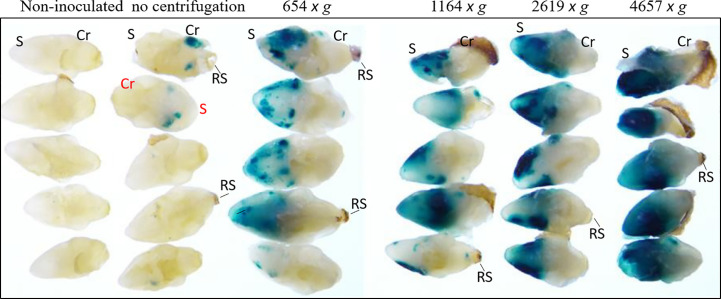
Centrifugation-assisted Agrobacterium inoculation drastically increased transient GUS expression in wheat ME surfaces. Agrobacterium AB32/pMON97367 was used in this experiment. In all treatments, MEs were centrifuged for 30 min at 4 °C. The GUS staining was performed after co-culture. The centrifugation force used is labeled above the picture. The relative centrifugal force (RCF) is marked as x g (g-force). Mature scutellum (S), coleorhiza (Cr) and the remains of suspensor (RS) positions are marked.
Figure 3
Figure 3
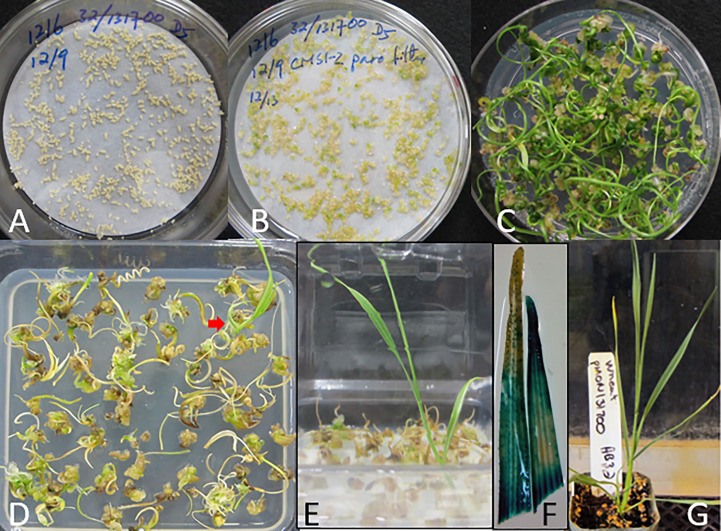
Transgenic plant from direct transformation of wheat MEs with nptII and epsps-cp4 dual selection. (A) After co-culture, filter paper with the inoculated MEs is transferred onto CMSI-2 with 50 mg/L paromomycin. (B) The explants swell and begin to green after 4 to 5 days on the paromomycin medium. (C) Extensive green shoot formation after five weeks on CMSI-2 with paromomycin selection. (D) After an additional three weeks on hormone-free medium (CMSI-63) containing 50 μM glyphosate, a green shoot with a root (indicated by an arrow) was recovered. (E) A well developed shoot with roots after four weeks on a selection medium containing 50 μM glyphosate. (F) GUS staining in the second and third leaves from the plant shown in (E). (G) The first transgenic wheat event in soil.
Figure 4
Figure 4
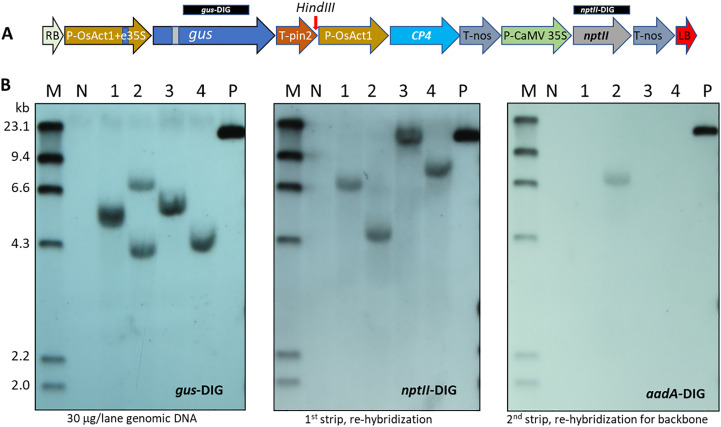
Transgene confirmation of wheat ME-derived events transformed with Agrobacterium AB32/pMON131700. (A) T-DNA structure of pMON131700 for wheat transformation. Vertical arrow indicates HindIII unique site. The DIG labeled 1014 bp gus and 809 bp nptII probes are marked above the T-DNA. The aadA probe is 691 bp, which is in the vector backbone, outside of the T-DNA borders. (B) Southern blot detection for transgene insertion with the gus, nptII and aadA probes, respectively. The same membrane was hybridized with the DIG-labeled probes sequentially after being stripped according to the manufacturer’s instructions. M: DIG-labeled molecular size marker of HindIII digested Λ DNA; N: non-transgenic wheat CA905-752 genomic DNA as a negative control; 1-4: plant samples from four transgenic wheat plants, 30 μg/lane genomic DNA is loaded; P: 20 pg pMON131700 plasmid DNA as a positive control. The DIG labeled probes are indicated in each hybridization.
Figure 5
Figure 5
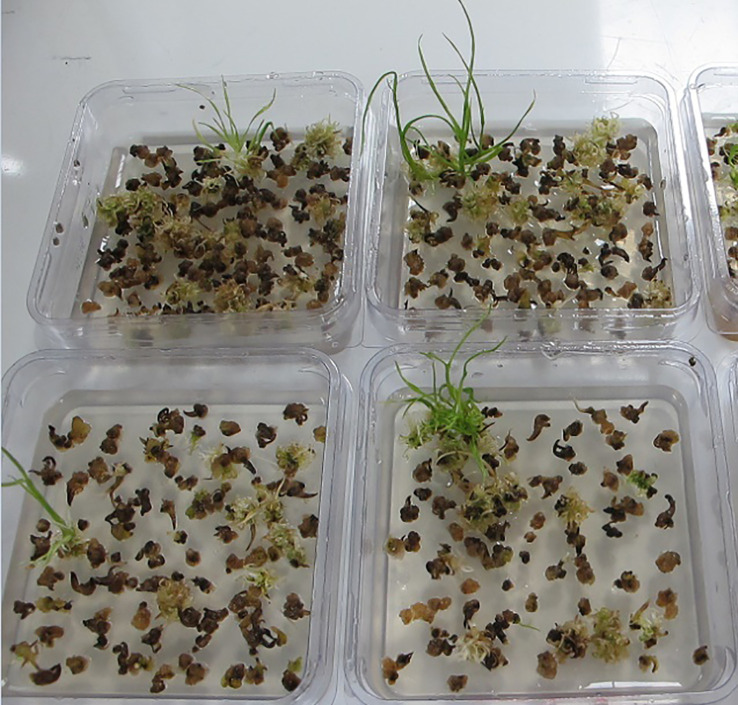
Glyphosate-resistant wheat plantlets derived from MEs using glyphosate direct selection. Explants displayed severe necrosis in about five weeks with immediate glyphosate selection after co-culture with Agrobacterium..
Figure 6
Figure 6
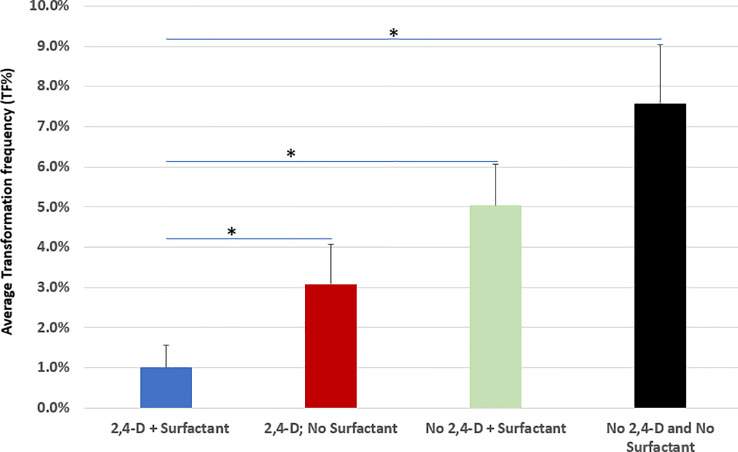
Removal of 2,4-D auxin and Silwet® L-77 surfactant drastically improves transformation frequency. AB32/pMON264386 ( Figure S1 ) was used for all transformation. Bars represent averages of TF% of biological replicates for each treatment. *A paired t-test was used to analyze TF improvement significance (p<0.05). For each treatment, >10,000 explants were used per treatment and each treatment had at least three biological reps.
Figure 7
Figure 7
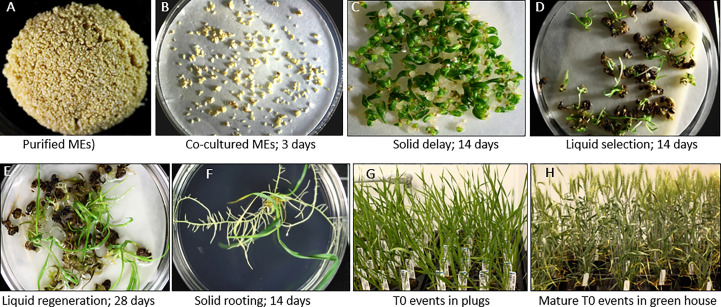
Agrobacterium-mediated direct transformation of wheat mature embryos. (A) Purified wheat MEs ready for transformation. (B) Co-cultured MEs. (C) Solid delay medium # 3996 (The co-culture filter paper containing wheat mature embryos was directly transferred onto the top of the solid delay medium). (D) Selection of multiple buds/shoots on liquid selection medium, (E) Regeneration on liquid regeneration medium. (F) Rooting on solid rooting medium. (G) T0 transgenic events in plugs. (H) Mature T0 transgenic events in the green house.

References

    1. Aadel H., Abdelwahd R., Udupa S. M., Diria G., El Mouhtadi A., Ahansal K., et al. . (2018). Agrobacterium-mediated transformation of mature embryo tissues of bread wheat (Triticum aestivum l.) genotypes. Cereal Res. Commun. 46, 10–20. doi: 10.1556/0806.45.2017.055 - DOI
    1. Borisjuk N., Kishchenko O., Eliby S., Schramm C., Anderson P., Jatayev S., et al. . (2019). Genetic modification for wheat improvement: from transgenesis to genome editing. BioMed. Res. Int. 2019, 6216304. doi: 10.1155/2019/6216304 - DOI - PMC - PubMed
    1. Chen Y., Rivlin A., Lange A., Ye X., Vaghchhipawala Z., Eisinger E., et al. . (2014). High throughput Agrobacterium tumefaciens-mediated germline transformation of mechanically isolated meristem explants of cotton (Gossypium hirsutum l.). Plant Cell Rep. 33, 153–164. doi: 10.1007/s00299-013-1519-x - DOI - PubMed
    1. Cheng M., Fry J. E., Pang S., Zhou H., Hironaka C. M., Duncan D. R., et al. . (1997). Genetic transformation of wheat mediated by Agrobacterium tumefaciens . Plant Physiol. 115, 971–980. doi: 10.1104/pp.115.3.971 - DOI - PMC - PubMed
    1. Dellaporta S. L., Wood J., Hicks J. B. (1983). A plant DNA minipreparation: version II. Plant Mol. Biol. Rep. 1, 19–21. doi: 10.1007/BF02712670 - DOI

LinkOut - more resources