


Effectiveness of non-pharmacological traditional Chinese medicine combined with conventional therapy in treating fibromyalgia: a systematic review and meta-analysis
- PMID: 37325034
- PMCID: PMC10267337
- DOI: 10.3389/fnins.2023.1097475
Effectiveness of non-pharmacological traditional Chinese medicine combined with conventional therapy in treating fibromyalgia: a systematic review and meta-analysis
Abstract
Objective: Fibromyalgia is a chronic musculoskeletal disorder characterized by generalized pain, which is also known as "muscular rheumatism" in Chinese medicine. We undertook this systematic review to evaluate the effectiveness of non-pharmacological traditional Chinese medicine (TCM) combined with conventional therapy on pain, health status, depression, and the quality of life of fibromyalgia patients.
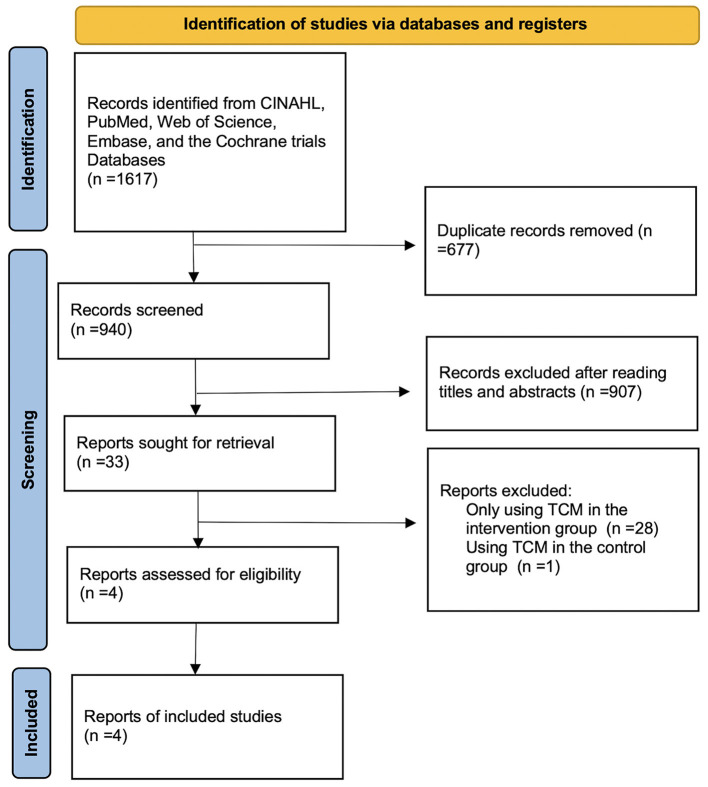
Methods: Studies were retrieved from five electronic databases (PubMed, the Cumulative Index to Nursing and Allied Health, Cochrane Library, Embase, and Web of Science) with publication date up to August 2022. We included randomized controlled trials examining the effects of a combination of non-pharmacological TCM and conventional therapy on pain intensity, health status, depression, and quality of life.
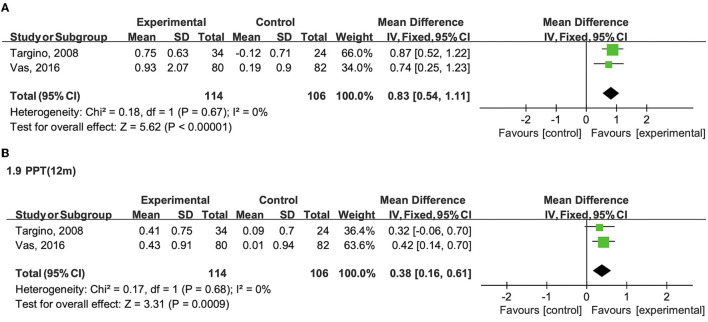
Results: Four randomized controlled trials with 384 fibromyalgia patients met the inclusion criteria. Results of the meta-analysis showed that non-pharmacological TCM combined with conventional therapy exerted significant positive effects on alleviating pain at the post-intervention time point than conventional therapy only (visual analog scale WMD1 = -1.410, P < 0.01; pressure pain threshold WMD2 = 0.830, P < 0.001, respectively). Significant differences in pain assessment were also observed between the two groups after a long-term follow-up (12 months) (WMD1 = -1.040 and WMD2= 0.380, all P < 0.05). The combination therapy group also showed a greater reduction in fibromyalgia impact questionnaire than the control group after a long-term follow-up (WMD = -6.690, P < 0.05). Depression and pain-related quality of life showed no difference between groups (all P > 0.05).
Conclusion: Non-pharmacological TCM combined with conventional therapy may be more effective in alleviating pain and improving health status than conventional therapy only. However, it remains some concerns over the safety and clinic application.
Systematic review registration: Identifier: CRD42022352991.
Keywords: depression; fibromyalgia; pain; quality of life; systematic review; traditional Chinese medicine.
Copyright © 2023 Cai, Chen, Liang, Song, Yu, Zhu, Wu, Zhou and Du.
Conflict of interest statement
The authors declare that the research was conducted in the absence of any commercial or financial relationships that could be construed as a potential conflict of interest.
Figures


References
-
- Ariani A., Bazzichi L., Sarzi-Puttini P., Salaffi F., Manara M., Prevete I., et al. (2021). The italian society for rheumatology clinical practice guidelines for the diagnosis and management of fibromyalgia best practices based on current scientific evidence. Reumatismo. 73, 89–105. 10.4081/reumatismo.2021.1362 - DOI - PubMed
-
- Astin J. A., Berman B. M., Bausell B., Lee W. L., Hochberg M., Forys K. L., et al. (2003). The efficacy of mindfulness meditation plus Qigong movement therapy in the treatment of fibromyalgia: a randomized controlled trial. J. Rheumatol. 30, 2257–2262. - PubMed
Publication types
LinkOut - more resources
Full Text Sources
Miscellaneous
