. 2023 Aug;40(4):321-338.
doi: 10.1007/s10585-023-10216-8. Epub 2023 Jun 16.

Cells in the polyaneuploid cancer cell (PACC) state have increased metastatic potential

Affiliations

Cells in the polyaneuploid cancer cell (PACC) state have increased metastatic potential

Mikaela M Mallin et al. Clin Exp Metastasis. 2023 Aug.

Abstract

Although metastasis is the leading cause of cancer deaths, it is quite rare at the cellular level. Only a rare subset of cancer cells (~ 1 in 1.5 billion) can complete the entire metastatic cascade: invasion, intravasation, survival in the circulation, extravasation, and colonization (i.e. are metastasis competent). We propose that cells engaging a Polyaneuploid Cancer Cell (PACC) phenotype are metastasis competent. Cells in the PACC state are enlarged, endocycling (i.e. non-dividing) cells with increased genomic content that form in response to stress. Single-cell tracking using time lapse microscopy reveals that PACC state cells have increased motility. Additionally, cells in the PACC state exhibit increased capacity for environment-sensing and directional migration in chemotactic environments, predicting successful invasion. Magnetic Twisting Cytometry and Atomic Force Microscopy reveal that cells in the PACC state display hyper-elastic properties like increased peripheral deformability and maintained peri-nuclear cortical integrity that predict successful intravasation and extravasation. Furthermore, four orthogonal methods reveal that cells in the PACC state have increased expression of vimentin, a hyper-elastic biomolecule known to modulate biomechanical properties and induce mesenchymal-like motility. Taken together, these data indicate that cells in the PACC state have increased metastatic potential and are worthy of further in vivo analysis.

Keywords: Chemotaxis; Deformability; Motility; Polyaneuploid cancer cells (PACCs); Polyploid giant cancer cells (PGCCs); Vimentin.


Conflict of interest statement

S.S.A has no disclosures. S.X.S has no disclosures. K.K has no disclosures. K.J.P. discloses that he is a consultant to Cue Biopharma, Inc., an equity holder in PEEL therapeutics, and a founder and equity holder in Keystone Biopharma, Inc. S.R.A. discloses that she is an equity holder in Keystone Biopharma, Inc.

Figures
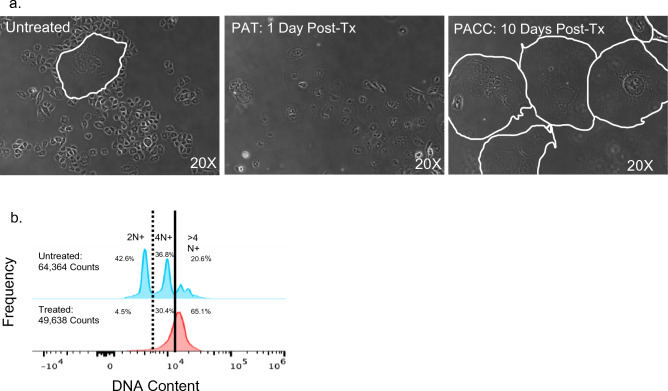
Fig. 1
Fig. 1
Cancer cells undergo a Polyaneuploid Transition in response to applied stress: a 2D morphology of PACC state induction in PC3 cells using a 72 h dose of 6 μM cisplatin. Cell populations are untreated, undergoing a PAT 1 day post-treatment, or have entered a definitive PACC state 10 days post-treatment. Acquired by 20X phase microscopy. PACC cell borders are demarcated in white. b Relative DNA content of untreated cells vs. treated cells 1 day post-treatment. Acquired by flow cytometry
Fig. 2
Fig. 2
Cells in the PACC state are more motile: a, b Quantification of the (A) accumulated distance and (B) Euclidean distance travelled by non-PACC parental cells or PACCs in uniform 20% FBS-supplemented media conditions (+ / +) throughout a 24-h time lapse. c Spider plots depicting the motility tracks of single non-PACC parental cells (n = 50) or PACCs (n = 49) in uniform 20% FBS-supplemented media conditions (+ / +) throughout a 24-h time lapse. d Directness of travel demonstrated by non-PACC parental cells or PACCs in uniform 20% FBS-supplemented media conditions (+ / +) throughout a 24-h time lapse. e Linear regression comparing the Euclidean distance travelled and 2D cell surface area of non-PACC parental cells and PACCs. f Linear regression comparing the Directness and 2D cell surface area of non-PACC parental cells and PACCs
Fig. 3
Fig. 3
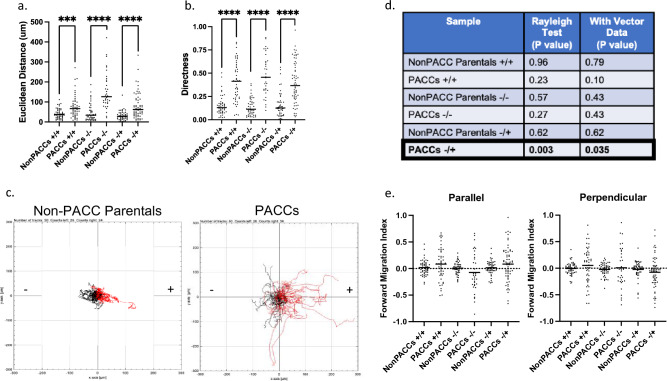
Cells in the PACC state demonstrate a directional response to a chemotactic FBS gradient: a, b Quantification of the (A) Euclidean distance travelled by or (B) directness of movement of non-PACC parental cells or PACCs in either uniform 20% FBS-supplemented media conditions (+ / +), uniform serum-free media conditions (−/−), or a chemotactic gradient of 0–20% FBS-supplemented media (−/ +) throughout a 24-h time lapse. c Spider plots depicting the motility tracks of single non-PACC parental cells (n = 50) or PACCs (n = 60) in a chemotactic gradient of 0–20% FBS-supplemented media (−/ +) throughout a 24-h time lapse. Red tracks indicate cells that had a net migration toward up the FBS gradient. d Results of the Rayleigh Test and Rayleigh Test with Vector Data for approximation of chemotactic behavior in non-PACC parental cells and PACCs. e Parallel (to FBS gradient) and Perpendicular (to FBS gradient) Forward Migration Indices for assessment of chemotactic behavior/chemotaxis in non-PACC parental cells and PACCs
Fig. 4
Fig. 4
Cells in the PACC state have altered cytoskeletal stiffness and increased cytoskeletal dynamics: a Intracellular network cytoskeletal stiffness of non-PACC parental cells PACCs acquired via MTC using ferromagnetic RGD-linked beads. b Young’s Modulus (or cortical stiffness) of the peri-nuclear region of non-PACC parental cells and PACCs acquired using AFM. c Demonstration of functional deformability in PACCs: Evidence of simultaneous migration and deformation of PACCs through 10 μm and 20 μm wide channels of a custom invasion channel microfluidic device throughout a 36-h time lapse. d Schematic of the microfluidic device. e Mean Squared Displacement of spontaneous movement of RGD-linked beads attached to the cytoskeleton of non-PACC parental cells and PACCs throughout a 5-min time lapse
Fig. 5
Fig. 5
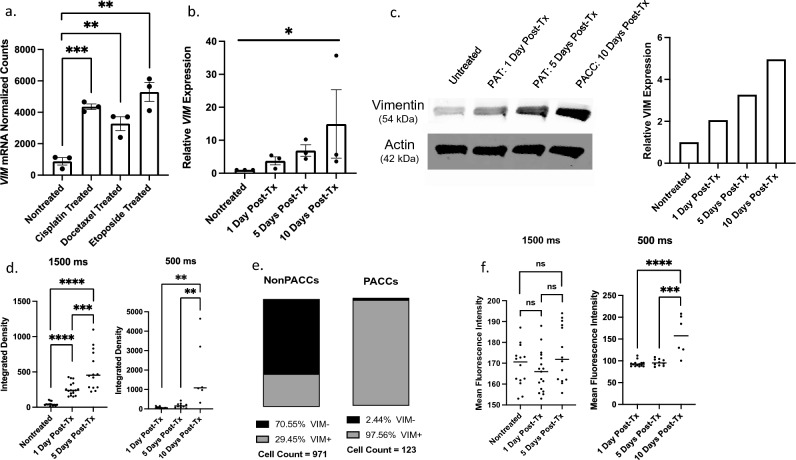
PACCs have increased expression of vimentin at both the RNA and Protein level: a mRNA Nanostring analysis comparing normalized counts of VIM mRNA transcripts in untreated, cisplatin-treated, docetaxel-treated, and etoposide-treated populations. b RT-qPCR analysis of relative VIM expression between untreated cells, cells undergoing a PAT 1 day post-treatment, cells undergoing a PAT 5 days post-treatment, and PACC cells 10 days post-treatment. c Western blot and quantitative densitometry of VIM expression in untreated cells, cells undergoing a PAT 1 day post-treatment, cells undergoing a PAT 5 days post-treatment, and PACC cells 10 days post-treatment. d Integrated density of single-cell VIM signal in untreated cells, cells undergoing a PAT 1 day post-treatment, cells undergoing a PAT 5 days post-treatment, and PACC cells 10 days post-treatment using either a 1500 ms exposure time or a 500 ms exposure time. e Percentage of VIM positive cells by immunofluorescence tiled imaging in non-PACC parental and PACC populations. f Mean Fluorescent Intensity of single-cell VIM signal in untreated cells, cells undergoing a PAT 1 day post-treatment, cells undergoing a PAT 5 days post-treatment, and PACC cells 10 days post-treatment using either a 1500 ms exposure time or a 500 ms exposure time
Fig. 6
Fig. 6
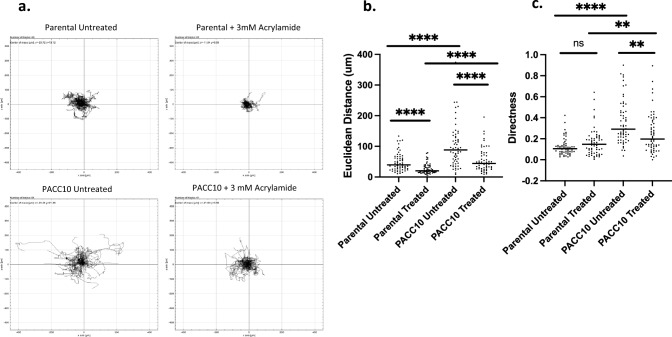
Vimentin ablation causes decreased motility in PACCs: a Spider plots depicting the motility tracks of single untreated non-PACC parental cells (n = 60), 3 mM acrylamide pre-treated non-PACC parental cells (n = 61), untreated PACCs (n = 61), or 3 mM acrylamide pre-treated PACCs (n = 61) throughout a 24-h time lapse. b, c Quantification of the b) Euclidean distance and c) directness travelled by untreated or treated non-PACC parental cells and untreated or treated PACCs throughout a 24-h time lapse

References

    1. Siegel RL, et al. Cancer statistics. CA Cancer J Clin. 2022;72(1):7–33. doi: 10.3322/caac.21708. - DOI - PubMed
    1. Fidler IJ. The pathogenesis of cancer metastasis: the 'seed and soil' hypothesis revisited. Nat Rev Cancer. 2003;3(6):453–458. doi: 10.1038/nrc1098. - DOI - PubMed
    1. de Groot AE, et al. Revisiting seed and soil: examining the primary tumor and cancer cell foraging in metastasis. Mol Cancer Res. 2017;15(4):361–370. doi: 10.1158/1541-7786.MCR-16-0436. - DOI - PMC - PubMed
    1. Jackson SP, Bartek J. The DNA-damage response in human biology and disease. Nature. 2009;461(7267):1071–1078. doi: 10.1038/nature08467. - DOI - PMC - PubMed
    1. Kuczler MD, et al. ROS-induced cell cycle arrest as a mechanism of resistance in polyaneuploid cancer cells (PACCs) Prog Biophys Mol Biol. 2021;165:3–7. doi: 10.1016/j.pbiomolbio.2021.05.002. - DOI - PMC - PubMed

Publication types