


Impact of age-friendly living environment and intrinsic capacity on functional ability in older adults: a cross-sectional study
- PMID: 37328844
- PMCID: PMC10276510
- DOI: 10.1186/s12877-023-04089-5
Impact of age-friendly living environment and intrinsic capacity on functional ability in older adults: a cross-sectional study
Abstract
Background: The World Health Organization (WHO) has proposed healthy aging framework, supposing that intrinsic capacity (IC), environment and their interaction may have influence on functional ability (FA). It was still unclear how the IC level and age-friendly living environment impact on FA. This study aims to confirm the relationship between the IC level and age-friendly living environment with FA, especially in older adults with low IC.
Methods: Four hundred eighty-five community-dwelling residents aged ≥ 60 years were enrolled. IC constructed by locomotion, cognition, psychological, vitality, and sensory domains was assessed using full assessment tools recommended by WHO. Age-friendly living environment was measured with 12 questions adapted from the spatial indicators framework of age-friendly cities. FA was assessed using activities of daily living (ADL) and one question about mobile payment ability. Multivariate logistic regression was used to explore the association between IC, environment and FA. The influence of the environment on electronic payment and ADL under the IC layer was assessed.
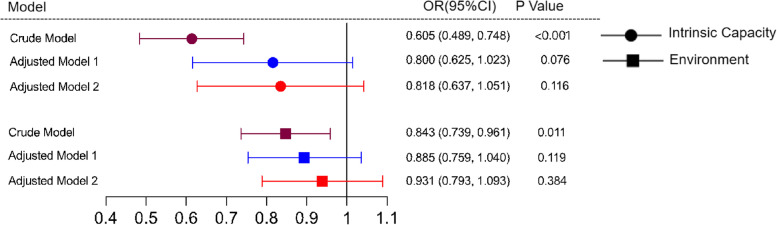
Results: Of 485 respondents, 89 (18.4%) had ADL impairment, and 166 (34.2%) had mobile payment function impairment. Limited IC (odds ratio [OR] = 0.783, 95% confidence interval [CI] = 0.621-0.988) and poor environment (OR = 0.839, 95% CI = 0.733-0.960) were associated with mobile payment ability impairment. Our results suggested that a supportive age-friendly living environment influenced FA was more prominent in older adults with poor IC (OR = 0.650, 95% CI = 0.491-0.861).
Conclusions: Our results confirmed IC and the environment had an impact on mobile payment ability. The relationship between environment and FA showed differences according to IC level. These findings suggest that an age-friendly living environment is important to maintain and enhance elders' FA, especially in those with poor IC.
Keywords: Environment; Functional ability; Healthy aging; Intrinsic capacity.
© 2023. The Author(s).
Conflict of interest statement
The authors have declared that they have no conflict of interests.
Figures

References
-
- World Health Organization. World report on ageing and health. World Health Organization; 2015. https://apps.who.int/iris/handle/10665/186463. Accessed 10 July 2021.
-
- González-Bautista E, de Souto BP, Andrieu S, et al. Screening for intrinsic capacity impairments as markers of increased risk of frailty and disability in the context of integrated care for older people: Secondary analysis of MAPT. Maturitas. 2021;150:1–6. doi: 10.1016/j.maturitas.2021.05.011. - DOI - PubMed
Publication types
MeSH terms
Grants and funding
LinkOut - more resources
Full Text Sources
Medical
