


Developing a framework for evaluation: a Theory of Change for complex workplace mental health interventions
- PMID: 37330460
- PMCID: PMC10276374
- DOI: 10.1186/s12889-023-16092-x
Developing a framework for evaluation: a Theory of Change for complex workplace mental health interventions
Abstract
Background: There is a gap between the necessity of effective mental health interventions in the workplace and the availability of evidence-based information on how to evaluate them. The available evidence outlines that mental health interventions should follow integrated approaches combining multiple components related to different levels of change. However, there is a lack of robust studies on how to evaluate multicomponent workplace interventions which target a variety of outcomes at different levels taking into account the influence of different implementation contexts.
Method: We use the MENTUPP project as a research context to develop a theory-driven approach to facilitate the evaluation of complex mental health interventions in occupational settings and to provide a comprehensive rationale of how these types of interventions are expected to achieve change. We used a participatory approach to develop a ToC involving a large number of the project team representing multiple academic backgrounds exploiting in tandem the knowledge from six systematic reviews and results from a survey among practitioners and academic experts in the field of mental health in SMEs.
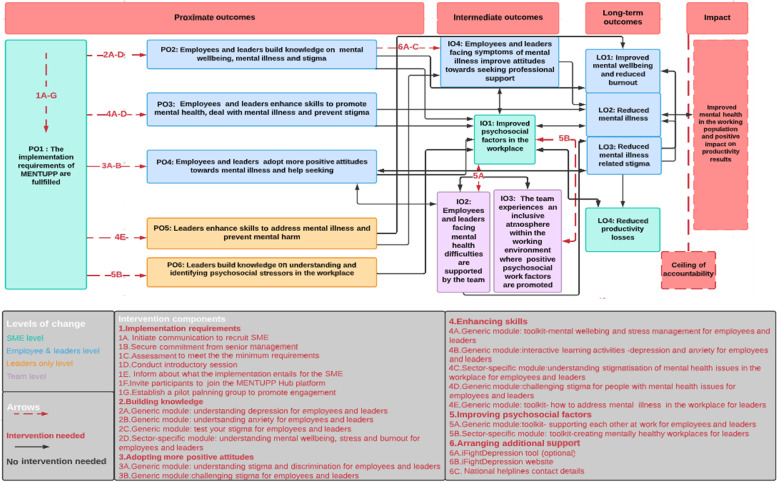
Results: The ToC revealed four long-term outcomes that we assume MENTUPP can achieve in the workplace: 1) improved mental wellbeing and reduced burnout, 2) reduced mental illness, 3) reduced mental illness-related stigma, and 4) reduced productivity losses. They are assumed to be reached through six proximate and four intermediate outcomes according to a specific chronological order. The intervention consists of 23 components that were chosen based on specific rationales to achieve change on four levels (employee, team, leader, and organization).
Conclusions: The ToC map provides a theory of how MENTUPP is expected to achieve its anticipated long-term outcomes through intermediate and proximate outcomes assessing alongside contextual factors which will facilitate the testing of hypotheses. Moreover, it allows for a structured approach to informing the future selection of outcomes and related evaluation measures in either subsequent iterations of complex interventions or other similarly structured programs. Hence, the resulting ToC can be employed by future research as an example for the development of a theoretical framework to evaluate complex mental health interventions in the workplace.
Keywords: Complex interventions; Evaluation; Implementation; Intervention development; MENTUPP; Medical Research Council framework; Organizational interventions; Theory of Change, Small and Medium Enterprises (SMEs); Workplace-based mental health/health interventions.
© 2023. The Author(s).
Conflict of interest statement
The authors declare no conflict of interest.
References
-
- OECD . Promoting mental health in Europe: Why and how? 2018.
-
- Ahola K, Hakanen J, Perhoniemi R, Mutanen P. Relationship between burnout and depressive symptoms: a study using the person-centred approach. Burn Res. 2014;1(1):29–37. doi: 10.1016/j.burn.2014.03.003. - DOI
Publication types
MeSH terms
LinkOut - more resources
Full Text Sources
Medical
Miscellaneous
