. 2023 Aug 8;122(15):3060-3068.
doi: 10.1016/j.bpj.2023.06.008. Epub 2023 Jun 16.

Two-state swimming: Strategy and survival of a model bacterial predator in response to environmental cues

Affiliations

Two-state swimming: Strategy and survival of a model bacterial predator in response to environmental cues

Lance W Q Xu 徐伟青 et al. Biophys J. .

Abstract

Bdellovibrio bacteriovorus is a predatory bacterium preying upon Gram-negative bacteria. As such, B. bacteriovorus has the potential to control antibiotic-resistant pathogens and biofilm populations. To survive and reproduce, B. bacteriovorus must locate and infect a host cell. However, in the temporary absence of prey, it is largely unknown how B. bacteriovorus modulate their motility patterns in response to physical or chemical environmental cues to optimize their energy expenditure. To investigate B. bacteriovorus' predation strategy, we track and quantify their motion by measuring speed distributions as a function of starvation time. While an initial unimodal speed distribution relaxing to one for pure diffusion at long times may be expected, instead we observe a bimodal speed distribution with one mode centered around that expected from diffusion and the other centered at higher speeds. What is more, for an increasing amount of time over which B. bacteriovorus is starved, we observe a progressive reweighting from the active swimming state to an apparent diffusive state in the speed distribution. Distributions of trajectory-averaged speeds for B. bacteriovorus are largely unimodal, indicating switching between a faster swim speed and an apparent diffusive state within individual observed trajectories rather than there being distinct active swimming and apparent diffusive populations. We also find that B. bacteriovorus' apparent diffusive state is not merely caused by the diffusion of inviable bacteria as subsequent spiking experiments show that bacteria can be resuscitated and bimodality restored. Indeed, starved B. bacteriovorus may modulate the frequency and duration of active swimming as a means of balancing energy consumption and procurement. Our results thus point to a reweighting of the swimming frequency on a trajectory basis rather than a population level basis.


Conflict of interest statement

Declaration of interests The authors have no conflicts of interest to declare.

Figures
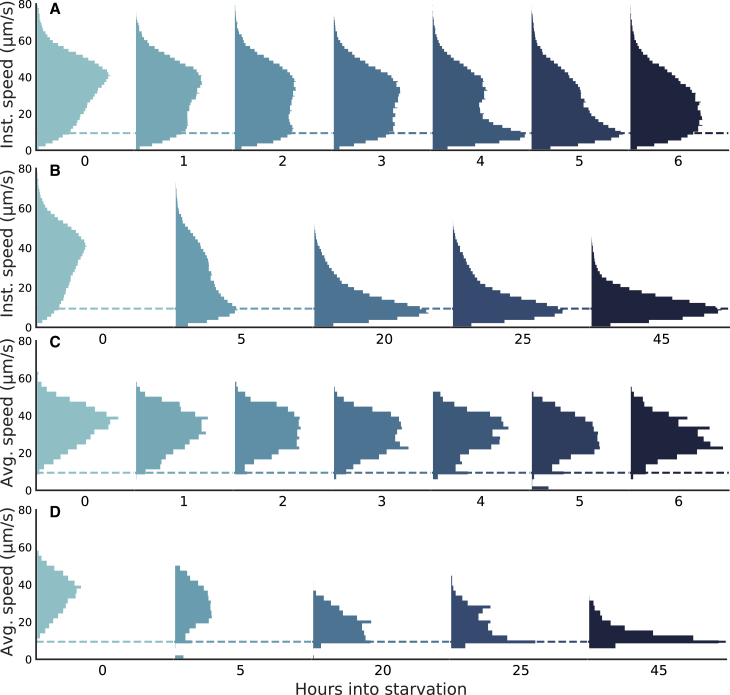
Figure 1
Figure 1
Under starvation conditions, the instantaneous and average speed distributions of B. bacteriovorus shift across time. (A) Instantaneous speed distributions are bimodal with a substantial shift toward an apparent diffusive state over the first 6 h. (B) Beyond hour 6 during starvation, the instantaneous speed distribution relaxes to a unimodal distribution about the expected diffusive speed for a Brownian particle of B. bacteriovorus’ size (9.40 μm s−1, dashed lines). (C) Distributions of speeds averaged over individual trajectories are largely unimodal over the first 6 h. (D) Average speed distributions over 45 h eventually relax to the expected diffusive speed. The sampling statistics for each histogram can be found in supporting material, sampling statistics for main text figures.
Figure 2
Figure 2
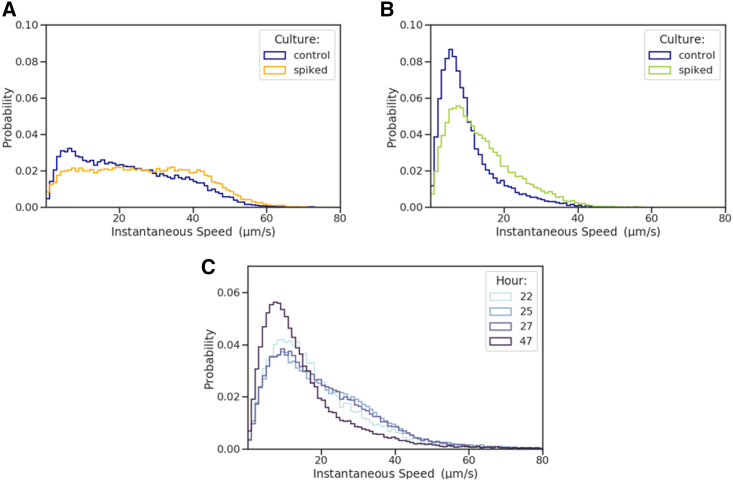
After addition of LB, B. bacteriovorus begins to swim more frequently even after long starvation times. We compare the instantaneous speed distributions of our control, starving B. bacteriovorus (blue), to that of cultures spiked with LB at hour 4 (orange) and hour 20 (green). Both spiked cultures were observed after 2 h of exposure. (A) After 2 h of exposure, the culture spiked at hour 4 (orange) exhibits a small repopulation of the active swimming speed peak. (B) After 2 h of exposure, the culture spiked at hour 20 (green) has faster speeds than the control (blue). (C) The culture spiked at hour 20 can be seen after several hours of exposure with negligible difference (21,22,23,24,25,26), indicating that, after several hours of exposure, the nutrients are in excess. The sampling statistics for each histogram can be found in supporting material, sampling statistics for main text figures.
Figure 3
Figure 3
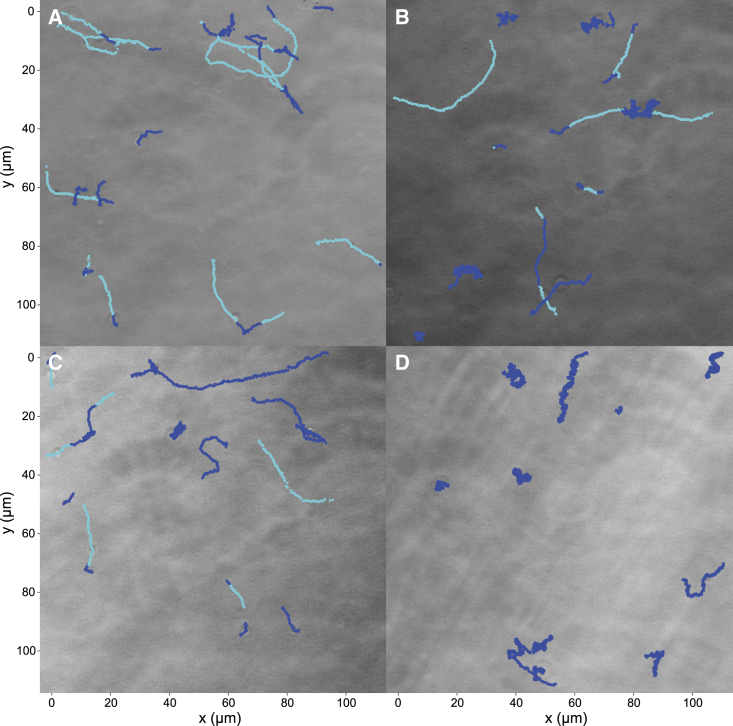
Representative B. bacteriovorus trajectories depicting instantaneous velocities. Bacterial trajectories are obtained for the first 500 frames at hour 0 (A), hour 4 (B), hour 6 (C), and hour 20 (D). Trajectories are colored according to the state at that time level (active swimming is bright and apparent diffusive is dark) determined by thresholding above and below 30 μm/s. This threshold is selected based on the midpoint of the center of both peaks in the bimodal distribution in Fig. 1.

References

    1. Drescher K., Dunkel J., et al. Goldstein R.E. Fluid dynamics and noise in bacterial cell-cell and cell-surface scattering. Proc. Natl. Acad. Sci. USA. 2011;108:10940–10945. - PMC - PubMed
    1. Jashnsaz H., Al Juboori M., et al. Pressé S. Hydrodynamic Hunters. Biophys. J. 2017;112:1282–1289. doi: 10.1016/j.bpj.2017.02.011. - DOI - PMC - PubMed
    1. Meng Y., Li Y., et al. Hoch H.C. Upstream migration of Xylella fastidiosa via pilus-driven twitching motility. J. Bacteriol. 2005;187:5560–5567. - PMC - PubMed
    1. Shen Y., Siryaporn A., et al. Stone H.A. Flow directs surface-attached bacteria to twitch upstream. Biophys. J. 2012;103:146–151. - PMC - PubMed
    1. Kaya T., Koser H. Direct upstream motility in Escherichia coli”. Biophys. J. 2012;102:1514–1523. - PMC - PubMed

Publication types

LinkOut - more resources