


Relationship Between Mechanoreceptors in the Posterior Cruciate Ligament and Patient Age or Osteoarthritis Severity
- PMID: 37332534
- PMCID: PMC10273789
- DOI: 10.1177/23259671231168894
Relationship Between Mechanoreceptors in the Posterior Cruciate Ligament and Patient Age or Osteoarthritis Severity
Abstract
Background: Mechanoreceptors in the posterior cruciate ligament (PCL) can produce proprioception, which is an important reason why patients choose cruciate-retaining total knee arthroplasty (TKA). The number of mechanoreceptors in the PCL of patients with knee osteoarthritis (OA) is unknown.
Purpose: To provide a theoretical basis for estimating the number of mechanoreceptors in the PCL by evaluating the relationship between this number and patient age or OA severity.
Study design: Cross-sectional study; Level of evidence, 3.
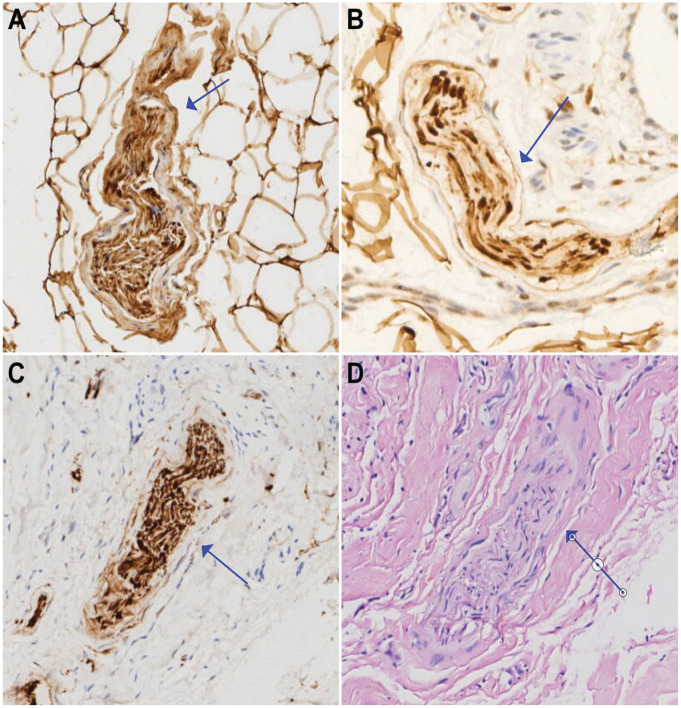
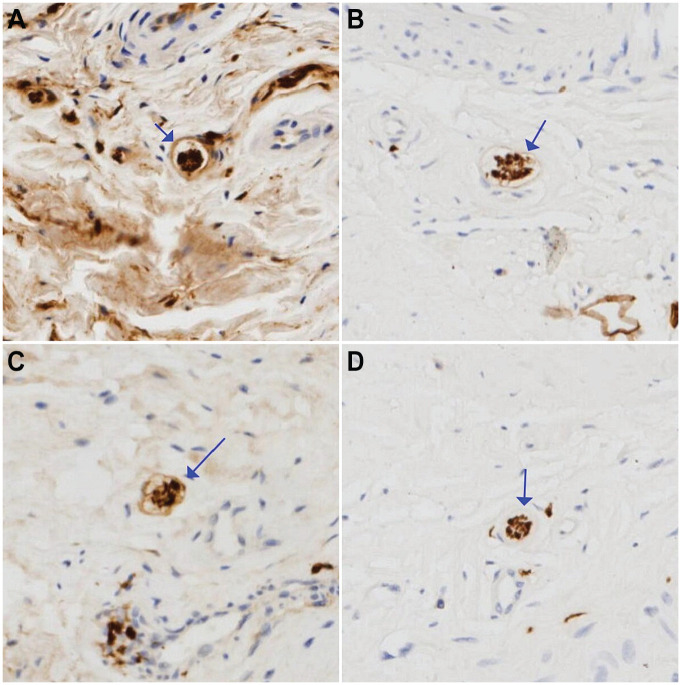
Methods: An overall 28 PCLs from patients with knee OA were collected at the time of TKA and grouped according to patient age (group A, 60-69 years [n = 8]; group B, 70-79 years [n = 12]; group C, ≥80 years [n = 8]) and OA based on Western Ontario and McMaster Universities Osteoarthritis Index (WOMAC) score (group I, ≤80 [n = 8]; group II, 81-120 [n = 10]; group III, >120 [n = 10]). Hematoxylin and eosin and S-100 immunohistochemical staining were performed on the slices near the tibial attachment of the PCL, and the number of mechanoreceptors in each slice was counted. Multifactor analysis of variance was used to evaluate the relationship between the number of mechanoreceptors and patient age or WOMAC score.
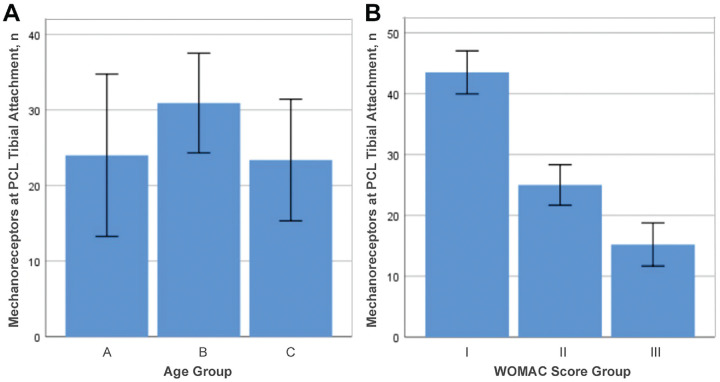
Results: The number of mechanoreceptors (mean ± SD) in groups A, B, and C was 24.00 ± 15.19, 30.92 ± 11.41, and 23.38 ± 11.39, respectively, with no significant between-group differences. The number of mechanoreceptors in groups I, II, and III was 43.50 ± 4.99, 25.00 ± 5.27, and 15.20 ± 5.61, with significant differences between groups I and II, groups I and III, and groups II and III (P < .001 for all).
Conclusion: In patients with knee OA, age had no significant effect on mechanoreceptor count, but the number of mechanoreceptors in the PCL decreased significantly with higher (worse) WOMAC score. These findings suggest that in patients of any age with high WOMAC scores, there may be little value as it relates to knee proprioception in performing a PCL-retaining TKA.
Keywords: PCL; TKA; WOMAC; Western Ontario and McMaster Universities Osteoarthritis Index; age; mechanoreceptor; osteoarthritis; posterior cruciate ligament; total knee arthroplasty.
© The Author(s) 2023.
Conflict of interest statement
The authors declared that there are no conflicts of interest in the authorship and publication of this contribution. AOSSM checks author disclosures against the Open Payments Database (OPD). AOSSM has not conducted an independent investigation on the OPD and disclaims any liability or responsibility relating thereto. Ethical approval for this study was obtained from The Second Affiliated Hospital of Chongqing Medical University (No. 2022-079).
Figures
References
-
- Adachi N, Ochi M, Uchio Y, Iwasa J, Ryoke K, Kuriwaka M. Mechanoreceptors in the anterior cruciate ligament contribute to the joint position sense. Acta Orthop Scand. 2002;73(3):330-334. - PubMed
-
- Çabuk H, Kuşku Çabuk F. Mechanoreceptors of the ligaments and tendons around the knee. Clin Anat. 2016;29(6):789-795. - PubMed
-
- Çabuk H, Kuşku Çabuk F, Tekin AÇ, Dedeoğlu SS, Çakar M, Büyükkurt CD. Lower numbers of mechanoreceptors in the posterior cruciate ligament and anterior capsule of the osteoarthritic knees. Knee Surg Sports Traumatol Arthrosc. 2017;25(10):3146-3154. - PubMed
LinkOut - more resources
Full Text Sources
