[Preprint]. 2023 Jun 5:2023.06.02.23290916.
doi: 10.1101/2023.06.02.23290916.

The associations of long-term physical activity in adulthood with later biological ageing and all-cause mortality - a prospective twin study

Affiliations

The associations of long-term physical activity in adulthood with later biological ageing and all-cause mortality - a prospective twin study

Anna Kankaanpää et al. medRxiv. .

Update in

Abstract

Objectives: The association between leisure-time physical activity (LTPA) and a lower risk of mortality is susceptible to bias from multiple sources. We investigated the potential of biological ageing to mediate the association between long-term LTPA and mortality and whether the methods used to account for reverse causality affect the interpretation of this association.

Methods: Study participants were twins from the older Finnish Twin Cohort (n=22,750; 18-50 years at baseline). LTPA was assessed using questionnaires in 1975, 1981 and 1990. The mortality follow-up lasted until 2020 and biological ageing was assessed using epigenetic clocks in a subsample (n=1,153) with blood samples taken during the follow-up. Using latent profile analysis, we identified classes with distinct longitudinal LTPA patterns and studied differences in biological ageing between these classes. We employed survival models to examine differences in total, short-term and long-term all-cause mortality, and multilevel models for twin data to control for familial factors.

Results: We identified four classes of long-term LTPA: sedentary, moderately active, active and highly active. Although biological ageing was accelerated in sedentary and highly active classes, after adjusting for other lifestyle-related factors, the associations mainly attenuated. Physically active classes had a maximum 7% lower risk of total mortality over the sedentary class, but this association was consistent only in the short term and could largely be accounted for by familial factors. LTPA exhibited less favourable associations when prevalent diseases were exclusion criteria rather than covariate.

Conclusion: Being active may reflect a healthy phenotype instead of causally reducing mortality.


Conflict of interest statement

Competing interests The authors declare no conflicts of interest.

Figures
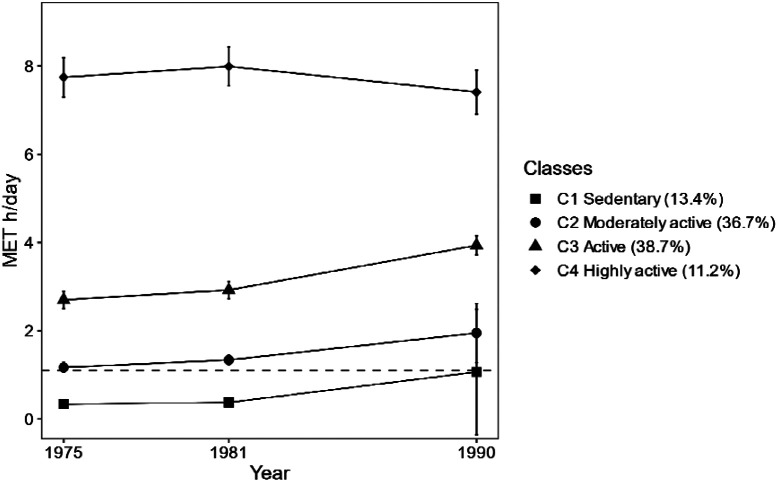
Figure 1.
Figure 1.
Patterns of long-term leisure-time physical activity (n = 22,750). Means of metabolic equivalent (MET) hours (h)/day and 95% confidence intervals are presented. The dashed line denotes World Health Organization guidelines for the recommended minimum amount of physical activity for adults (150 min of moderate intensity physical activity per week ~ 1.1 MET h/day)[31].
Figure 2.
Figure 2.
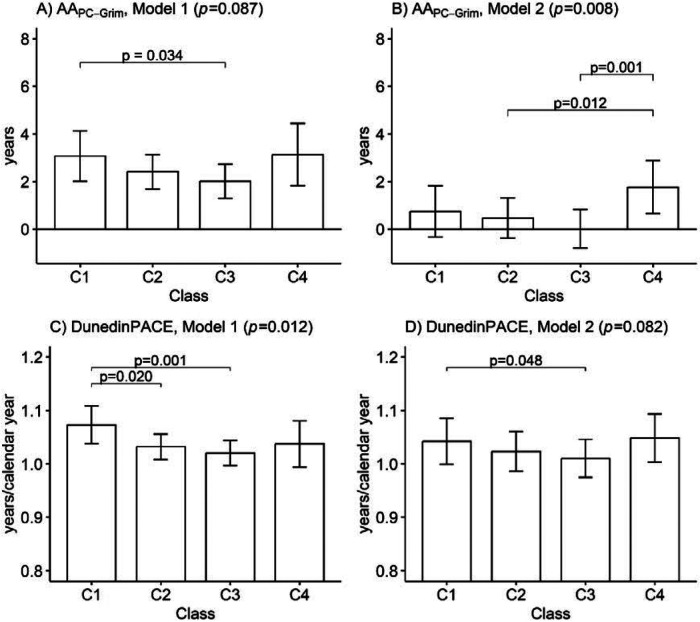
Mean differences between the long-term leisure-time physical activity classes in terms of biological ageing measured using A)–B) PC-based GrimAge and C)–D) DunedinPACE (n = 1,153). Means and 95% confidence intervals are presented. Model 1 was adjusted for sex, age and health status, and Model 2 was additionally adjusted for education, body mass index, smoking and alcohol use. C1: Sedentary (8.8%); C2: Moderately active (38.4%); C3: Active (45.5%); C4: Highly active (7.3%); AA, Age acceleration; p-values from the Wald test.
Figure 3.
Figure 3.
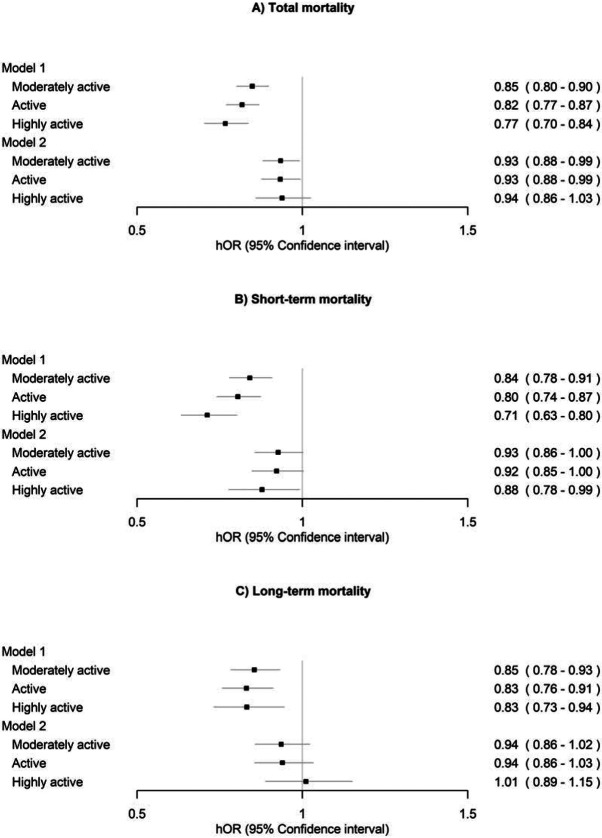
Associations of long-term leisure-time physical activity with A) total mortality, B) short-term mortality (1990–2011) and C) long-term mortality (2012–2020) (n = 22,750). The sedentary class was treated as the reference. Model 1 was adjusted for sex (female), age and health status. Model 2 was additionally adjusted for education, body mass index, smoking and alcohol use. hOR, hazard odds ratio.
Figure 4.
Figure 4.
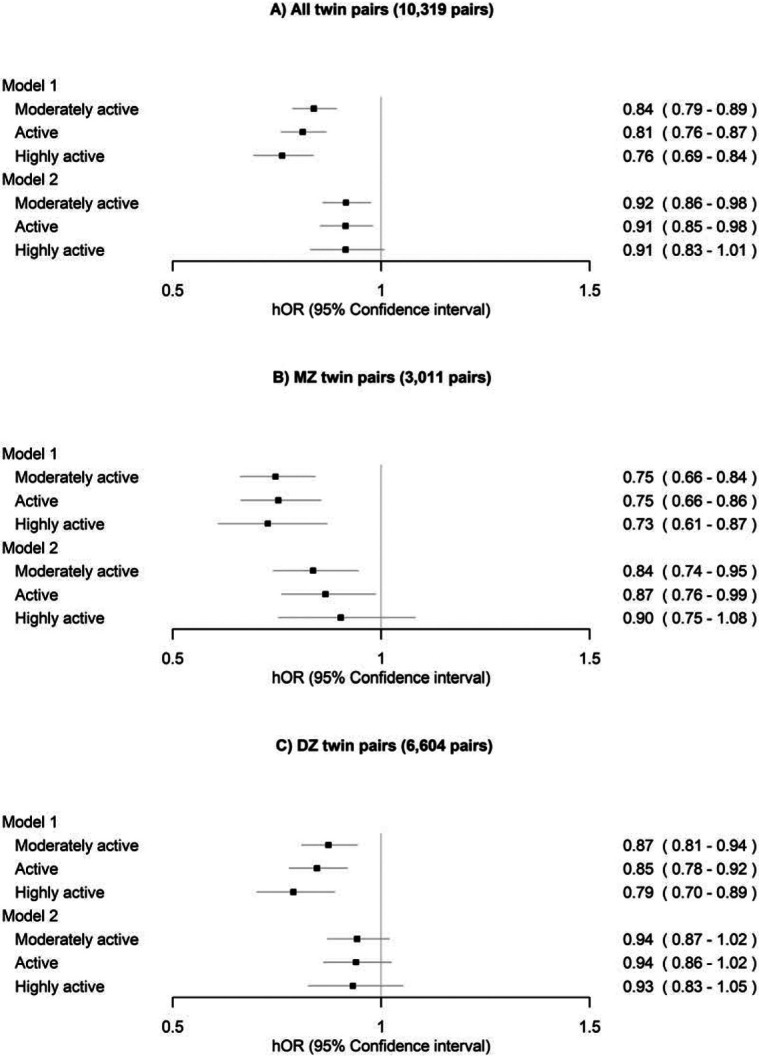
Within-twin-pair differences in all-cause mortality between the long-term leisure-time physical activity classes for A) all twin pairs, B) monozygotic (MZ) pairs and C) dizygotic (DZ) pairs. The sedentary class was treated as the reference. Only twin pairs with information on LTPA and alive in 1990 were included in the analysis. Model 1 was adjusted for sex (female) and age at the between-twin-pair level and health status at the within-twin pair level. Model 2 was additionally adjusted for education, body mass index, smoking and alcohol use at the within-twin pair level. hOR, hazard odds ratio.
Figure 5.
Figure 5.
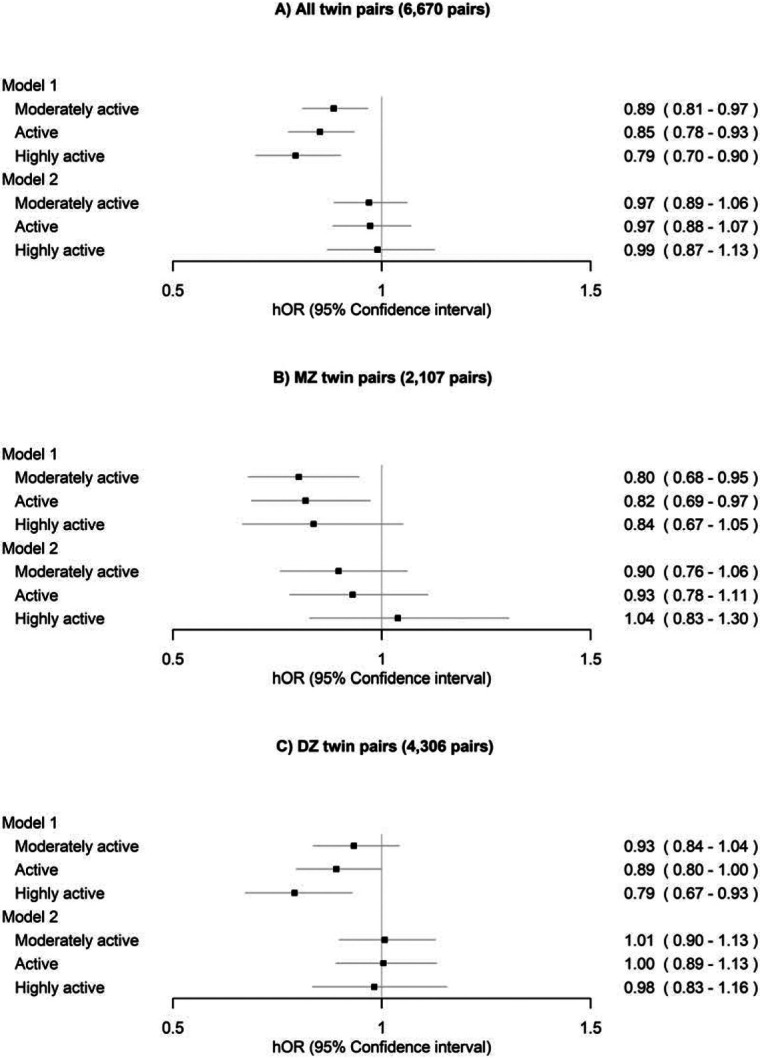
Within-twin-pair differences in all-cause mortality between the long-term leisure-time physical activity classes for A) all twin pairs, B) monozygotic (MZ) pairs and C) dizygotic (DZ) pairs after excluding twin pairs who reported specific diseases. The sedentary class was treated as the reference. Only twin pairs with information on LTPA and alive in 1990 were included in the analysis. Model 1 was adjusted for sex (female) and age at the between-twin-pair level. Model 2 was additionally adjusted for education, body mass index, smoking and alcohol use at the within-twin-pair level.

References

    1. Blond K, Brinkløv CF, Ried-Larsen M, et al. Association of high amounts of physical activity with mortality risk: A systematic review and meta-analysis. Br J Sports Med 2020;54:1195–201. doi: 10.1136/bjsports-2018-100393 - DOI - PubMed
    1. Yang Y, Dixon-Suen SC, Dugué PA, et al. Physical activity and sedentary behaviour over adulthood in relation to all-cause and cause-specific mortality: A systematic review of analytic strategies and study findings. Int J Epidemiol. 2022;51:641–67. doi: 10.1093/ije/dyab181 - DOI - PubMed
    1. Ekelund U, Tarp J, Steene-Johannessen J, et al. Dose-response associations between accelerometry measured physical activity and sedentary time and all cause mortality: Systematic review and harmonised meta-analysis. The BMJ 2019;366:1–10. doi: 10.1136/bmj.l4570 - DOI - PMC - PubMed
    1. Arem H, Moore SC, Patel A, et al. Leisure time physical activity and mortality: A detailed pooled analysis of the dose-response relationship. JAMA Intern Med 2015;175:959–67. doi: 10.1001/jamainternmed.2015.0533 - DOI - PMC - PubMed
    1. Ballin M, Nordström P. Does exercise prevent major non-communicable diseases and premature mortality? A critical review based on results from randomized controlled trials. J Intern Med. 2021;290:1112–29. doi: 10.1111/joim.13353 - DOI - PubMed

Publication types