


The influence of lifestyle changes (diet, exercise and stress reduction) on prostate cancer tumour biology and patient outcomes: A systematic review
- PMID: 37334023
- PMCID: PMC10268595
- DOI: 10.1002/bco2.237
The influence of lifestyle changes (diet, exercise and stress reduction) on prostate cancer tumour biology and patient outcomes: A systematic review
Abstract
Background: The mostly indolent natural history of prostate cancer (PCa) provides an opportunity for men to explore the benefits of lifestyle interventions. Current evidence suggests appropriate changes in lifestyle including diet, physical activity (PA) and stress reduction with or without dietary supplements may improve both disease outcomes and patient's mental health.
Objective: This article aims to review the current evidence on the benefits of all lifestyle programmes for PCa patients including those aimed at reducing obesity and stress, explore their affect on tumour biology and highlight any biomarkers that have clinical utility.
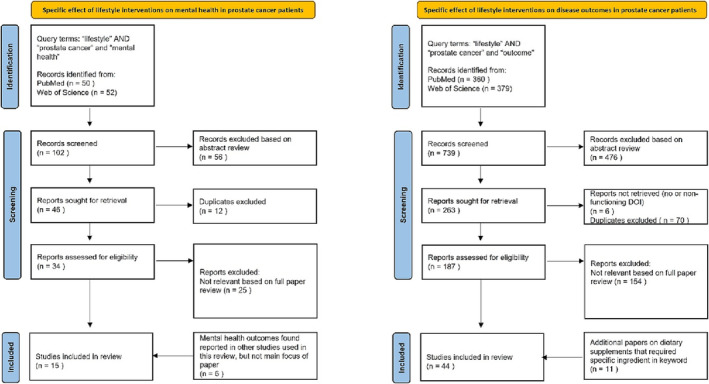
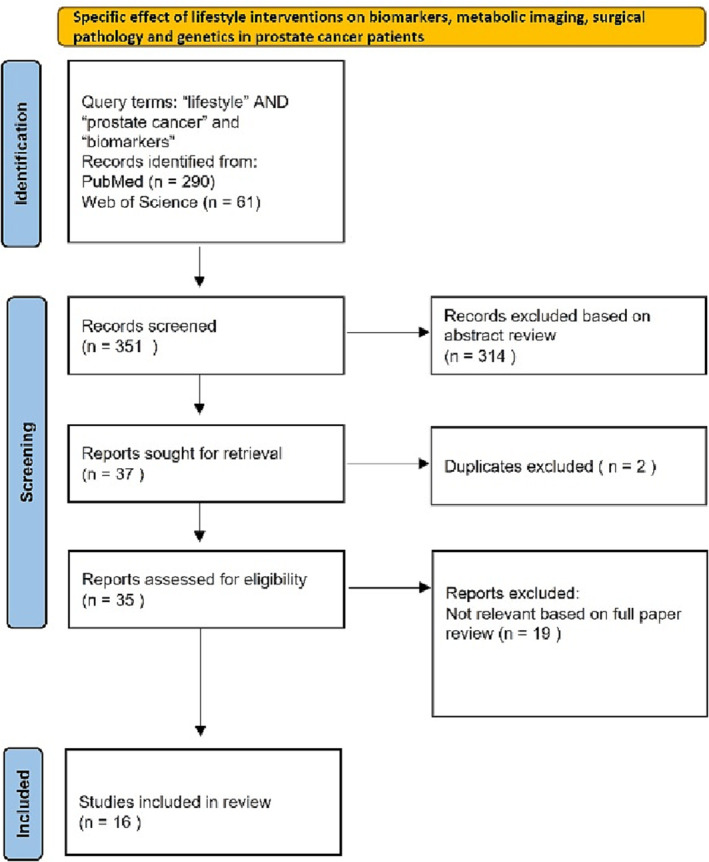
Evidence acquisition: Evidence was obtained from PubMed and Web of Science using keywords for each section on the affects of lifestyle interventions on (a) mental health, (b) disease outcomes and (c) biomarkers in PCa patients. PRISMA guidelines were used to gather the evidence for these three sections (15, 44 and 16 publications, respectively).
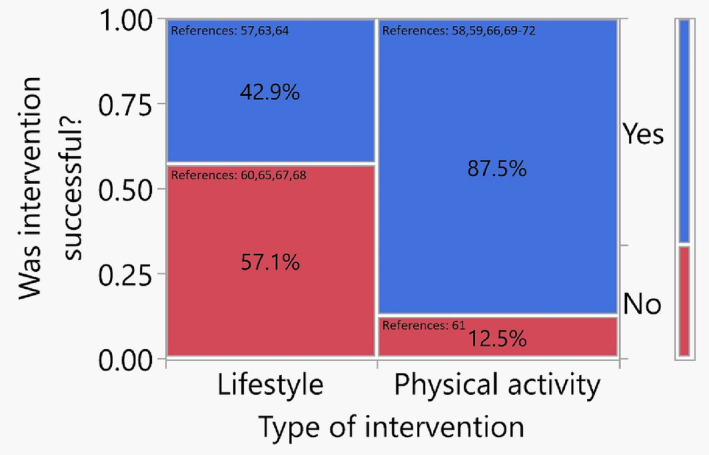
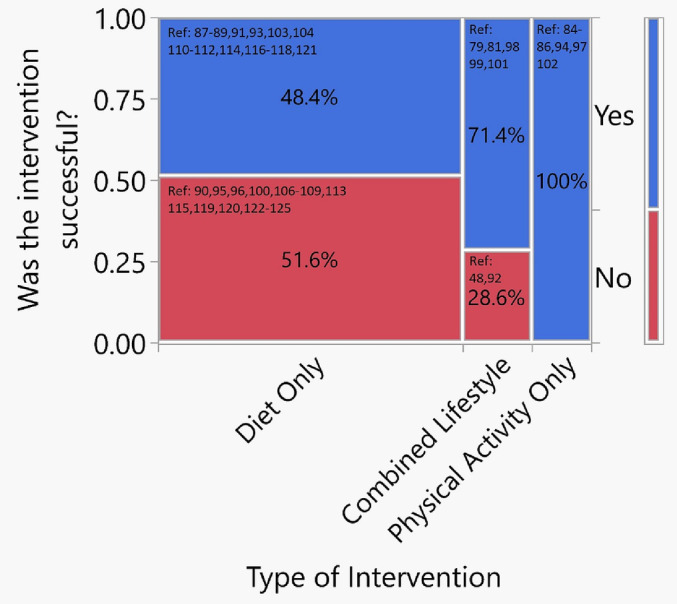
Evidence synthesis: For lifestyle studies focused on mental health, 10/15 demonstrated a positive influence, although for those programmes focused on PA it was 7/8. Similarly for oncological outcomes, 26/44 studies demonstrated a positive influence, although when PA was included or the primary focus, it was 11/13. Complete blood count (CBC)-derived inflammatory biomarkers show promise, as do inflammatory cytokines; however, a deeper understanding of their molecular biology in relation to PCa oncogenesis is required (16 studies reviewed).
Conclusions: Making PCa-specific recommendations on lifestyle interventions is difficult on the current evidence. Nevertheless, notwithstanding the heterogeneity of patient populations and interventions, the evidence that dietary changes and PA may improve both mental health and oncological outcomes is compelling, especially for moderate to vigorous PA. The results for dietary supplements are inconsistent, and although some biomarkers show promise, significantly more research is required before they have clinical utility.
Keywords: biomarkers; cancer outcomes; diet; mental health; physical exercise; prostate cancer; stress reduction.
© 2023 The Authors. BJUI Compass published by John Wiley & Sons Ltd on behalf of BJU International Company.
Conflict of interest statement
Dr. Zach Dovey is Medical Director and stock owner (with certificate of shares) of Medtech Holdings Ltd.
Figures
References
-
- EAU Guidelines ‐ Prostate Cancer [Internet]. 2022. [cited 2022 Nov 8]. Available from: https://uroweb.org/guidelines/prostate-cancer
-
- Blanc‐Lapierre A, Spence A, Karakiewicz PI, Aprikian A, Saad F, Parent M‐É. Metabolic syndrome and prostate cancer risk in a population‐based case–control study in Montreal, Canada. BMC Public Health. 2015;15(1):913. Available from: http://bmcpublichealth.biomedcentral.com/articles/10.1186/s12889-015-2260-x - DOI - PMC - PubMed
-
- Esposito K, Chiodini P, Capuano A, Bellastella G, Maiorino MI, Parretta E, et al. Effect of metabolic syndrome and its components on prostate cancer risk: meta‐analysis. J Endocrinol Invest. 2013;36(2):132–139. Available from: http://link.springer.com/10.1007/BF03346748 - DOI - PubMed
-
- Preston MA, Riis AH, Ehrenstein V, Breau RH, Batista JL, Olumi AF, et al. Metformin use and prostate cancer risk. Eur Urol. 2014;66(6):1012–1020. Available from: https://linkinghub.elsevier.com/retrieve/pii/S0302283814004084 - PubMed
-
- Vidal AC, Howard LE, Moreira DM, Castro‐Santamaria R, Andriole GL, Freedland SJ. Obesity increases the risk for high‐grade prostate cancer: results from the REDUCE study. Cancer Epidemiol Biomarkers Prev. 2014;23(12):2936–2942. Available from: https://aacrjournals.org/cebp/article/23/12/2936/116941/Obesity-Increase... - PMC - PubMed
Publication types
LinkOut - more resources
Full Text Sources