


Diagnostic value of carotid intima-media thickness and clinical risk scores in determining etiology of ischemic stroke
- PMID: 37334932
- PMCID: PMC10472955
- DOI: 10.1177/23969873231182492
Diagnostic value of carotid intima-media thickness and clinical risk scores in determining etiology of ischemic stroke
Abstract
Background: In the general population, carotid intima-media thickness (CIMT) is associated with atherosclerosis as well as atrial fibrillation (AF). However, the extent to which CIMT might be of diagnostic value in clarifying stroke etiology is currently unclear.
Methods: In this retrospective cohort study, we included 800 consecutive patients with acute ischemic stroke. We compared CIMT-values between stroke etiologies. The association between CIMT and cardioembolic stroke was investigated via logistic regression analysis adjusting for vascular risk factors. Receiver operating characteristic analyses were conducted to investigate the diagnostic value of CIMT in comparison to vascular risk factors and clinical AF risk scores (CHA2DS2VASc, HAVOC, and AS5F).
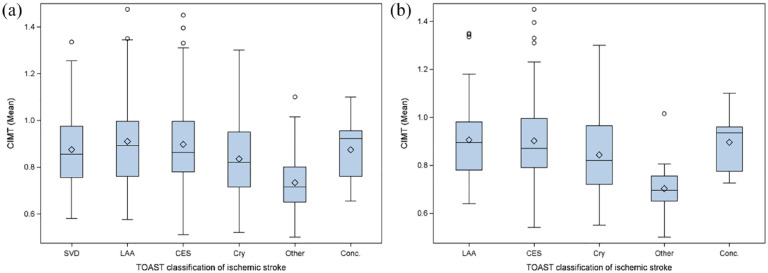
Results: CIMT-values were highest in patients with cardioembolic or atherosclerotic stroke origin. CIMT was associated with newly diagnosed AF compared against cryptogenic strokes (crude odds ratio (OR) per 0.1 mm-increase of CIMT: 1.26 (95% confidence interval (CI): 1.13-1.41)). After adjustment for vascular risk factors, the effect of CIMT on AF-diagnosis, however, was weakened (adjusted OR: 1.10 (95% CI: 0.97-1.25)). The diagnostic value of CIMT for detection of AF (AUC: 0.60, 95% CI: 0.54-0.65) was outperformed by AF risk scores. Among the scores investigated, the AS5F-score yielded best accuracy and calibration to predict newly diagnosed AF (AUC: 0.71, 95% CI: 0.65-0.78).
Conclusions: CIMT may help in the diagnosis of stroke etiology. However, compared with vascular risk factors or clinical AF risk scores, CIMT does not provide substantial additional information on the risk of newly detected AF. Thus, stratification of AF risk based on scores, such as the AS5F, is advisable.
Keywords: Atrial fibrillation; carotid intima-media thickness; diagnosis; embolic stroke of undetermined source; stroke etiology.
Conflict of interest statement
The author(s) declared no potential conflicts of interest with respect to the research, authorship, and/or publication of this article.
Figures


References
-
- Hart RG, Diener HC, Coutts SB, et al.. Embolic strokes of undetermined source: the case for a new clinical construct. Lancet Neurol 2014; 13: 429–438. - PubMed
-
- Diener H-C, Sacco RL, Easton JD, et al.. Dabigatran for prevention of stroke after embolic stroke of undetermined source. N Engl J Med 2019; 380: 1906–1917. - PubMed
-
- Hart RG, Sharma M, Mundl H, et al.. Rivaroxaban for stroke prevention after embolic stroke of undetermined source. N Engl J Med 2018; 378(23): 2191–2201. - PubMed
Publication types
MeSH terms
LinkOut - more resources
Full Text Sources
Medical
