


Neural dissociation between reward and salience prediction errors through the lens of optimistic bias
- PMID: 37334979
- PMCID: PMC10365237
- DOI: 10.1002/hbm.26398
Neural dissociation between reward and salience prediction errors through the lens of optimistic bias
Abstract
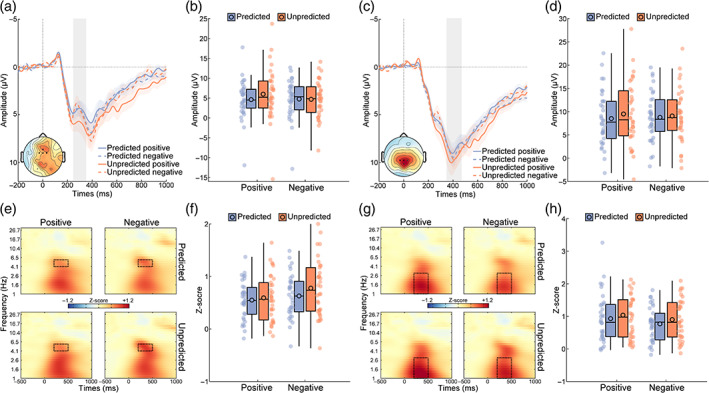
The question of how the brain represents reward prediction errors is central to reinforcement learning and adaptive, goal-directed behavior. Previous studies have revealed prediction error representations in multiple electrophysiological signatures, but it remains elusive whether these electrophysiological correlates underlying prediction errors are sensitive to valence (in a signed form) or to salience (in an unsigned form). One possible reason concerns the loose correspondence between objective probability and subjective prediction resulting from the optimistic bias, that is, the tendency to overestimate the likelihood of encountering positive future events. In the present electroencephalography (EEG) study, we approached this question by directly measuring participants' idiosyncratic, trial-to-trial prediction errors elicited by subjective and objective probabilities across two experiments. We adopted monetary gain and loss feedback in Experiment 1 and positive and negative feedback as communicated by the same zero-value feedback in Experiment 2. We provided electrophysiological evidence in time and time-frequency domains supporting both reward and salience prediction error signals. Moreover, we showed that these electrophysiological signatures were highly flexible and sensitive to an optimistic bias and various forms of salience. Our findings shed new light on multiple presentations of prediction error in the human brain, which differ in format and functional role.
Keywords: EEG dynamics; optimistic bias; reward prediction error; salience prediction error.
© 2023 The Authors. Human Brain Mapping published by Wiley Periodicals LLC.
Conflict of interest statement
The authors declare no conflicts of interest.
Figures


References
-
- Bates, D. , Kliegl, R. , Vasishth, S. , & Baayen, H. (2015). Parsimonious mixed models. arXiv, 1506. https://arxiv.org/abs/1506.04967.
-
- Bates, D. , Maechler, M. , Bolker, B. , & Walker, S. (2015). Fitting linear mixed‐effects models using lme4. Journal of Statistical Software, 67(1), 1–48. 10.18637/jss.v067.i01 - DOI
Publication types
MeSH terms
LinkOut - more resources
Full Text Sources
