. 2023 Sep 1;83(17):2889-2907.
doi: 10.1158/0008-5472.CAN-22-1622.

Targeting CaMKK2 Inhibits Actin Cytoskeletal Assembly to Suppress Cancer Metastasis

Affiliations

Targeting CaMKK2 Inhibits Actin Cytoskeletal Assembly to Suppress Cancer Metastasis

Debarati Mukherjee et al. Cancer Res. .

Abstract

Triple-negative breast cancers (TNBC) tend to become invasive and metastatic at early stages in their development. Despite some treatment successes in early-stage localized TNBC, the rate of distant recurrence remains high, and long-term survival outcomes remain poor. In a search for new therapeutic targets for this disease, we observed that elevated expression of the serine/threonine kinase calcium/calmodulin (CaM)-dependent protein kinase kinase 2 (CaMKK2) is highly correlated with tumor invasiveness. In validation studies, genetic disruption of CaMKK2 expression or inhibition of its activity with small molecule inhibitors disrupted spontaneous metastatic outgrowth from primary tumors in murine xenograft models of TNBC. High-grade serous ovarian cancer (HGSOC), a high-risk, poor prognosis ovarian cancer subtype, shares many features with TNBC, and CaMKK2 inhibition effectively blocked metastatic progression in a validated xenograft model of this disease. Mechanistically, CaMKK2 increased the expression of the phosphodiesterase PDE1A, which hydrolyzed cyclic guanosine monophosphate (cGMP) to decrease the cGMP-dependent activity of protein kinase G1 (PKG1). Inhibition of PKG1 resulted in decreased phosphorylation of vasodilator-stimulated phosphoprotein (VASP), which in its hypophosphorylated state binds to and regulates F-actin assembly to facilitate cell movement. Together, these findings establish a targetable CaMKK2-PDE1A-PKG1-VASP signaling pathway that controls cancer cell motility and metastasis by impacting the actin cytoskeleton. Furthermore, it identifies CaMKK2 as a potential therapeutic target that can be exploited to restrict tumor invasiveness in patients diagnosed with early-stage TNBC or localized HGSOC.

Significance: CaMKK2 regulates actin cytoskeletal dynamics to promote tumor invasiveness and can be inhibited to suppress metastasis of breast and ovarian cancer, indicating CaMKK2 inhibition as a therapeutic strategy to arrest disease progression.


Figures

Figure 1. Clinical relevance of CaMKK2 in metastatic TNBC. A, Kaplan–Meier plots showing the association between CaMKK2 level and the overall survival of patients with basal (n = 431), luminal A (n = 592), luminal B (n = 439), or Her2+ (n = 361) tumor subtypes. Patients were grouped into CaMMK2-high or -low by upper quartile (lower or higher than 75th percentile). The x-axis shows time in months, and the y-axis shows the overall survival probability. Plots were generated using KM-plotter (https://kmplot.com), B–E, Violin plots depicting the score for the gene signatures published in the indicated articles (36, 40, 41, 42). Samples were grouped into CaMMK2-high or -low by quartiles (equal or less than 25th percentile and equal or greater than 75th percentile). The x-axis shows breast cancer subtypes, and the y-axis shows the score between −1 and 1. Data, mean ± SEM. *, P < 0.05; **, P < 0.01; ***, P < 0.005; ns, nonsignificant; by Student t test (B–E) and log-rank test (A).
Figure 1.
Clinical relevance of CaMKK2 in metastatic TNBC. A, Kaplan–Meier plots showing the association between CaMKK2 level and the overall survival of patients with basal (n = 431), luminal A (n = 592), luminal B (n = 439), or Her2+ (n = 361) tumor subtypes. Patients were grouped into CaMMK2-high or -low by upper quartile (lower or higher than 75th percentile). The x-axis shows time in months, and the y-axis shows the overall survival probability. Plots were generated using KM-plotter (https://kmplot.com), B–E, Violin plots depicting the score for the gene signatures published in the indicated articles (36, 40, 41, 42). Samples were grouped into CaMMK2-high or -low by quartiles (equal or less than 25th percentile and equal or greater than 75th percentile). The x-axis shows breast cancer subtypes, and the y-axis shows the score between −1 and 1. Data, mean ± SEM. *, P < 0.05; **, P < 0.01; ***, P < 0.005; ns, nonsignificant; by Student t test (BE) and log-rank test (A).
Figure 2. Ablation of CaMKK2 impairs migration in invasive breast cancer cells. A and B, Representative blots showing knockdown of CaMKK2 in MDA-MB-231-4175 (A) and BT-20 cells (B). MDA-MB-231-4175 and BT-20 cells were transfected with either control siRNAs (siCtrl #1, siCtrl #2) or siRNAs targeting CaMKK2 (siKK2 #1, siKK2 #2). Forty-eight hours posttransfection, cells were harvested and immunoblots were used to analyze CaMKK2 and phospho-AMPKα (T172) expression. C and D, CaMKK2 knockdown impaired migration of MDA-MB-231-4175 cells (C) and BT-20 cells (D) in vitro. Data plotted as mean ± SEM; n = 6 random fields measurements from four individual experiments. E and F, Treatment with STO-609 (10 μmol/L; 48 hours) and GSKi (1 μmol/L; 48 hours) reduced migration of MDA-MB-231–4175 cells (E) and BT20 cells (F). Data plotted as mean ± SEM; n = 9 random fields measurements from two individual experiments done in triplicate. G and H, STO-609 (10 μmol/L; 48 hours) and GSKi (1 μmol/L; 48 hours) treatment reduced invasiveness in MDA-MB-231-4175 cells (G) and BT20 cells (H) in vitro. Data plotted as mean ± SEM; n  = 4–5 random fields measurements from three individual experiments done in duplicate, I, Representative blots confirming CRISPR-mediated knockout of CaMKK2 in MDA-MB-231-4175 cells (see also Supplementary Fig. S1H), J, CRISPR-mediated ablation of CaMKK2 reduced migration in CaMKK2-KO clones in vitro, Data plotted as mean ± SEM; n = 4–5 random fields measurements from three individual experiments done in duplicate. K, Depletion of CaMKK2 reduced cellular movement in MDA-MB-231-4175 cells cultured with fresh human breast tissue. Fluorescence microscopy and brightfield images were captured every 5 minutes over 6 hours to track cellular movement (see also Supplementary Videos S1–S4). L, Representative blots confirming addback of CaMKK2 expression in CaMKK2-KO clones #1 and #2. M and N, Overexpression of CaMKK2 rescues migratory capability in both CaMKK2 KO clones. Data are plotted as mean ± SEM; n = 4–5 random fields measurements from three individual experiments done in duplicate. *, P < 0.05; **, P < 0.01; ***, P < 0.005; ****, P < 0.001. P values were calculated using unpaired Student t test.
Figure 2.
Ablation of CaMKK2 impairs migration in invasive breast cancer cells. A and B, Representative blots showing knockdown of CaMKK2 in MDA-MB-231-4175 (A) and BT-20 cells (B). MDA-MB-231-4175 and BT-20 cells were transfected with either control siRNAs (siCtrl #1, siCtrl #2) or siRNAs targeting CaMKK2 (siKK2 #1, siKK2 #2). Forty-eight hours posttransfection, cells were harvested and immunoblots were used to analyze CaMKK2 and phospho-AMPKα (T172) expression. C and D, CaMKK2 knockdown impaired migration of MDA-MB-231-4175 cells (C) and BT-20 cells (D) in vitro. Data plotted as mean ± SEM; n = 6 random fields measurements from four individual experiments. E and F, Treatment with STO-609 (10 μmol/L; 48 hours) and GSKi (1 μmol/L; 48 hours) reduced migration of MDA-MB-231–4175 cells (E) and BT20 cells (F). Data plotted as mean ± SEM; n = 9 random fields measurements from two individual experiments done in triplicate. G and H, STO-609 (10 μmol/L; 48 hours) and GSKi (1 μmol/L; 48 hours) treatment reduced invasiveness in MDA-MB-231-4175 cells (G) and BT20 cells (H) in vitro. Data plotted as mean ± SEM; n  = 4–5 random fields measurements from three individual experiments done in duplicate, I, Representative blots confirming CRISPR-mediated knockout of CaMKK2 in MDA-MB-231-4175 cells (see also Supplementary Fig. S1H), J, CRISPR-mediated ablation of CaMKK2 reduced migration in CaMKK2-KO clones in vitro, Data plotted as mean ± SEM; n = 4–5 random fields measurements from three individual experiments done in duplicate. K, Depletion of CaMKK2 reduced cellular movement in MDA-MB-231-4175 cells cultured with fresh human breast tissue. Fluorescence microscopy and brightfield images were captured every 5 minutes over 6 hours to track cellular movement (see also Supplementary Videos S1–S4). L, Representative blots confirming addback of CaMKK2 expression in CaMKK2-KO clones #1 and #2. M and N, Overexpression of CaMKK2 rescues migratory capability in both CaMKK2 KO clones. Data are plotted as mean ± SEM; n = 4–5 random fields measurements from three individual experiments done in duplicate. *, P < 0.05; **, P < 0.01; ***, P < 0.005; ****, P < 0.001. P values were calculated using unpaired Student t test.
Figure 3. Genetic ablation of CaMKK2 impairs metastasis from the primary tumor in vivo. A, Six-week-old female nude mice were orthotopically injected in the mammary fat pad with two control cell clones, Ctrl #1 (n = 9), Ctrl #3 (n = 8); two CaMKK2-KO cell clones, KK2-KO #1 (n = 9), KK2-KO #2 (n = 6); and the CaMKK2 KO cell clones with reexpression of CaMKK2, KO #1-KK2 (n = 8) and KO #2-KK2 (n = 7). All clones were derived from the parental MDA-MB-231–4175 cell line. The mice were sacrificed after tumors reached approximately 2,500 mm3, and the lung and liver metastatic burden was analyzed ex vivo. Representative BLI images showing lung metastatic foci were visualized. B–D, Quantitation of the number of metastatic foci in the lung (B) and liver (C), and total metastatic burden (includes metastatic foci in the liver and lung taken together for each animal; D). Data, mean ± SEM. *, P < 0.05; **, P < 0.01; ns, nonsignificant; by Student t test.
Figure 3.
Genetic ablation of CaMKK2 impairs metastasis from the primary tumor in vivo.A, Six-week-old female nude mice were orthotopically injected in the mammary fat pad with two control cell clones, Ctrl #1 (n = 9), Ctrl #3 (n = 8); two CaMKK2-KO cell clones, KK2-KO #1 (n = 9), KK2-KO #2 (n = 6); and the CaMKK2 KO cell clones with reexpression of CaMKK2, KO #1-KK2 (n = 8) and KO #2-KK2 (n = 7). All clones were derived from the parental MDA-MB-231–4175 cell line. The mice were sacrificed after tumors reached approximately 2,500 mm3, and the lung and liver metastatic burden was analyzed ex vivo. Representative BLI images showing lung metastatic foci were visualized. B–D, Quantitation of the number of metastatic foci in the lung (B) and liver (C), and total metastatic burden (includes metastatic foci in the liver and lung taken together for each animal; D). Data, mean ± SEM. *, P < 0.05; **, P < 0.01; ns, nonsignificant; by Student t test.
Figure 4. Pharmacologic inhibition of CaMKK2 impairs metastasis from the primary tumor in vivo. A, MDA-MB-231-4175 cells were orthotopically injected into the mammary fat pad of 6-week-old female nude mice. Five days postinjection, the animals were dosed with vehicle (n = 10), STO-609 (30 mg/kg; n = 8), or GSKi (10 mg/kg; n = 9) by intraperitoneal injections every third day. Tumor growth rate was monitored until the tumors reached a volume of 2,000 mm3. B–D, Quantitative analysis of metastatic foci in the lung (B), liver (C), and the total metastatic burden (includes metastatic foci in the liver and lung taken together; D). The mice were sacrificed after the primary tumor reached approximately 2000 mm3, and the metastatic foci were analyzed ex vivo. E, Subcutaneous tumor growth in 6-week-old female nude mice orthotopically injected with murine 4T1 cells. The mice were randomized (five days after tumor cell injection in the mammary fat pad) and dosed with vehicle (n = 7) or STO-609 (30 mg/kg; n = 9) by intraperitoneal injections every third day. Tumor growth rate was monitored until the tumors reached a volume of 2,000 mm3. F, Quantitative analysis of metastatic nodules in the lung. Data, mean ± SEM. *, P < 0.05; **, P < 0.01; by two-way ANOVA followed by Bonferroni multiple-correction test (A and E) or unpaired Student t test (B–D and F).
Figure 4.
Pharmacologic inhibition of CaMKK2 impairs metastasis from the primary tumor in vivo.A, MDA-MB-231-4175 cells were orthotopically injected into the mammary fat pad of 6-week-old female nude mice. Five days postinjection, the animals were dosed with vehicle (n = 10), STO-609 (30 mg/kg; n = 8), or GSKi (10 mg/kg; n = 9) by intraperitoneal injections every third day. Tumor growth rate was monitored until the tumors reached a volume of 2,000 mm3. B–D, Quantitative analysis of metastatic foci in the lung (B), liver (C), and the total metastatic burden (includes metastatic foci in the liver and lung taken together; D). The mice were sacrificed after the primary tumor reached approximately 2000 mm3, and the metastatic foci were analyzed ex vivo. E, Subcutaneous tumor growth in 6-week-old female nude mice orthotopically injected with murine 4T1 cells. The mice were randomized (five days after tumor cell injection in the mammary fat pad) and dosed with vehicle (n = 7) or STO-609 (30 mg/kg; n = 9) by intraperitoneal injections every third day. Tumor growth rate was monitored until the tumors reached a volume of 2,000 mm3. F, Quantitative analysis of metastatic nodules in the lung. Data, mean ± SEM. *, P < 0.05; **, P < 0.01; by two-way ANOVA followed by Bonferroni multiple-correction test (A and E) or unpaired Student t test (B–D and F).
Figure 5. Depletion of CaMKK2 leads to increased phosphorylation of VASP at the Serine 239 residue, which leads to impaired cytoskeletal assembly and cell motility. A, Representative images showing impaired cytoskeletal assembly in CaMKK2-KO cells. Visualization of F-actin by phalloidin staining in CaMKK2-WT (Ctrl #1) and CaMKK2-KO (KK2-KO #1) cells revealed almost complete loss of ventral stress fibers in cells lacking CaMKK2 expression. Yellow arrows, dorsal stress fibers; white arrows, ventral stress fibers; yellow bracket, transverse arcs; green arrowhead, leading edge; yellow arrowhead, contractile rear of the cell. Scale bar, 10 μm. B, Representative blot showing increased phosphorylation of VASP at Serine 239 in CaMMK2 KO cell clones. C, Representative blot showing VASP phosphorylation at Serine 239 is enhanced in CaMKK2-KO cells in response to ionomycin (1 μmol). Cells were treated with either DMSO or ionomycin (1 μmol/L) with CaCL2 (1 mmol/L) for varying time periods (as indicated). D and E, Inhibition of CaMKK2 (STO-609, 10 μmol) increases phosphorylation of VASP [especially with ionomycin (1 μmol; 2 hours)] in metastatic MDA-MB-231-4175 cells (D) and BT-20 cells (E). DMSO or STO-609–treated cells were exposed to either DMSO or ionomycin (1 μmol/L) with CaCL2 (1 mmol/L) for 2 hours before immunoblotting. F and G, CaMKK2 inhibition decreases migration of MDA-MB-231-4175 cells (F) and BT20 cells (G) in vitro. DMSO or STO-609–treated cells were exposed to either DMSO or ionomycin with CaCL2 (see D and E) before migration assays were performed. Data are plotted as mean ± SEM; n = 4–5 random fields measurements from four individual experiments done in duplicate. *, P < 0.05; **, P < 0.01; ***, P < 0.001. P values were calculated using unpaired Student t test.
Figure 5.
Depletion of CaMKK2 leads to increased phosphorylation of VASP at the Serine 239 residue, which leads to impaired cytoskeletal assembly and cell motility. A, Representative images showing impaired cytoskeletal assembly in CaMKK2-KO cells. Visualization of F-actin by phalloidin staining in CaMKK2-WT (Ctrl #1) and CaMKK2-KO (KK2-KO #1) cells revealed almost complete loss of ventral stress fibers in cells lacking CaMKK2 expression. Yellow arrows, dorsal stress fibers; white arrows, ventral stress fibers; yellow bracket, transverse arcs; green arrowhead, leading edge; yellow arrowhead, contractile rear of the cell. Scale bar, 10 μm. B, Representative blot showing increased phosphorylation of VASP at Serine 239 in CaMMK2 KO cell clones. C, Representative blot showing VASP phosphorylation at Serine 239 is enhanced in CaMKK2-KO cells in response to ionomycin (1 μmol). Cells were treated with either DMSO or ionomycin (1 μmol/L) with CaCL2 (1 mmol/L) for varying time periods (as indicated). D and E, Inhibition of CaMKK2 (STO-609, 10 μmol) increases phosphorylation of VASP [especially with ionomycin (1 μmol; 2 hours)] in metastatic MDA-MB-231-4175 cells (D) and BT-20 cells (E). DMSO or STO-609–treated cells were exposed to either DMSO or ionomycin (1 μmol/L) with CaCL2 (1 mmol/L) for 2 hours before immunoblotting. F and G, CaMKK2 inhibition decreases migration of MDA-MB-231-4175 cells (F) and BT20 cells (G) in vitro. DMSO or STO-609–treated cells were exposed to either DMSO or ionomycin with CaCL2 (see D and E) before migration assays were performed. Data are plotted as mean ± SEM; n = 4–5 random fields measurements from four individual experiments done in duplicate. *, P < 0.05; **, P < 0.01; ***, P < 0.001. P values were calculated using unpaired Student t test.
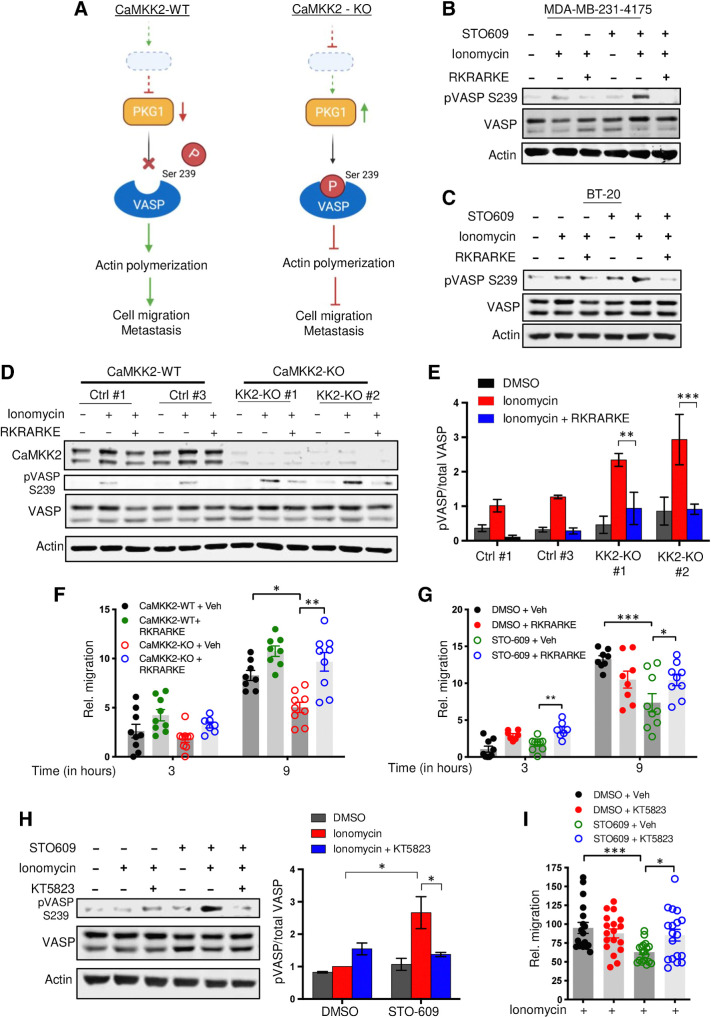
Figure 6. Inhibition of PKG1 blocks phosphorylation of VASP in CaMKK2-depleted cells and restores cellular migration in vitro. A, Schematic representation of working hypothesis of the mechanism by which CaMKK2 drives cell migration and metastasis B and C, RKRARKE treatment (100 μmol; 2.5 hours) decreased VASP phosphorylation in CaMKK2-inhibited MDA-MB-231-4175 cells (B) and BT-20 cells (C). Vehicle or STO-609–treated cells were dosed with RKRARKE for 30 minutes before exposure to DMSO or ionomycin (1 μmol/L) with CaCL2 (1 mmol/L) for 2 hours. Representative immunoblots from three independent experiments (B) and one experiment (C) are shown. D and E, Inhibition of PKG1 with RKRARKE blocks VASP phosphorylation at Serine 239 in CaMKK2-KO cells. CaMKK2-WT (Ctrl #1) and CaMKK2-KO (KK2-KO #1) cells were pretreated with RKRARKE (100 μmol) for 30 minutes before exposure to DMSO or ionomycin (1 μmol/L) with CaCL2 (1 mmol/L) for 2 hours. Representative blots from two independent experiments (D) and quantitative results for the band intensities of phospho-VASP versus total VASP (E) are shown. F and G, RKRARKE (100 μmol; 2.5 hours) pretreatment restores the migratory phenotype in CaMKK2-KO cells (F) and STO-609-treated MDA-MB-231-4175 cells (G). Cells were pretreated with RKRARKE before exposure to ionomycin (1 μmol/L) with CaCL2 (1 mmol/L) for 2 hours prior to migration assays. Data plotted as mean ± SEM; n = 4–5 random fields measurements from two individual experiments. H, Pretreatment with KT5823 (5 μmol; 16 hours) in CaMKK2-inhibited cells decreased VASP phosphorylation. MDA-MB-231-4175 cells were pretreated with either vehicle or KT5823 overnight before exposure to DMSO or ionomycin. Representative blots (left) and quantitative analysis (right) of band intensities from two independent experiments are shown. I, KT5823 pretreatment (5 μmol; 16 hours) of CaMKK2-inhibited cells restores the migratory phenotype of STO-609–treated MDA-MB-231-4175 cells. Data are plotted as mean ± SEM; n = 4–5 random fields measurements from four individual transwells. *, P < 0.05; **, P < 0.01; ***, P < 0.001. P values were calculated using unpaired Student t test.
Figure 6.
Inhibition of PKG1 blocks phosphorylation of VASP in CaMKK2-depleted cells and restores cellular migration in vitro. A, Schematic representation of working hypothesis of the mechanism by which CaMKK2 drives cell migration and metastasis B and C, RKRARKE treatment (100 μmol; 2.5 hours) decreased VASP phosphorylation in CaMKK2-inhibited MDA-MB-231-4175 cells (B) and BT-20 cells (C). Vehicle or STO-609–treated cells were dosed with RKRARKE for 30 minutes before exposure to DMSO or ionomycin (1 μmol/L) with CaCL2 (1 mmol/L) for 2 hours. Representative immunoblots from three independent experiments (B) and one experiment (C) are shown. D and E, Inhibition of PKG1 with RKRARKE blocks VASP phosphorylation at Serine 239 in CaMKK2-KO cells. CaMKK2-WT (Ctrl #1) and CaMKK2-KO (KK2-KO #1) cells were pretreated with RKRARKE (100 μmol) for 30 minutes before exposure to DMSO or ionomycin (1 μmol/L) with CaCL2 (1 mmol/L) for 2 hours. Representative blots from two independent experiments (D) and quantitative results for the band intensities of phospho-VASP versus total VASP (E) are shown. F and G, RKRARKE (100 μmol; 2.5 hours) pretreatment restores the migratory phenotype in CaMKK2-KO cells (F) and STO-609-treated MDA-MB-231-4175 cells (G). Cells were pretreated with RKRARKE before exposure to ionomycin (1 μmol/L) with CaCL2 (1 mmol/L) for 2 hours prior to migration assays. Data plotted as mean ± SEM; n = 4–5 random fields measurements from two individual experiments. H, Pretreatment with KT5823 (5 μmol; 16 hours) in CaMKK2-inhibited cells decreased VASP phosphorylation. MDA-MB-231-4175 cells were pretreated with either vehicle or KT5823 overnight before exposure to DMSO or ionomycin. Representative blots (left) and quantitative analysis (right) of band intensities from two independent experiments are shown. I, KT5823 pretreatment (5 μmol; 16 hours) of CaMKK2-inhibited cells restores the migratory phenotype of STO-609–treated MDA-MB-231-4175 cells. Data are plotted as mean ± SEM; n = 4–5 random fields measurements from four individual transwells. *, P < 0.05; **, P < 0.01; ***, P < 0.001. P values were calculated using unpaired Student t test.
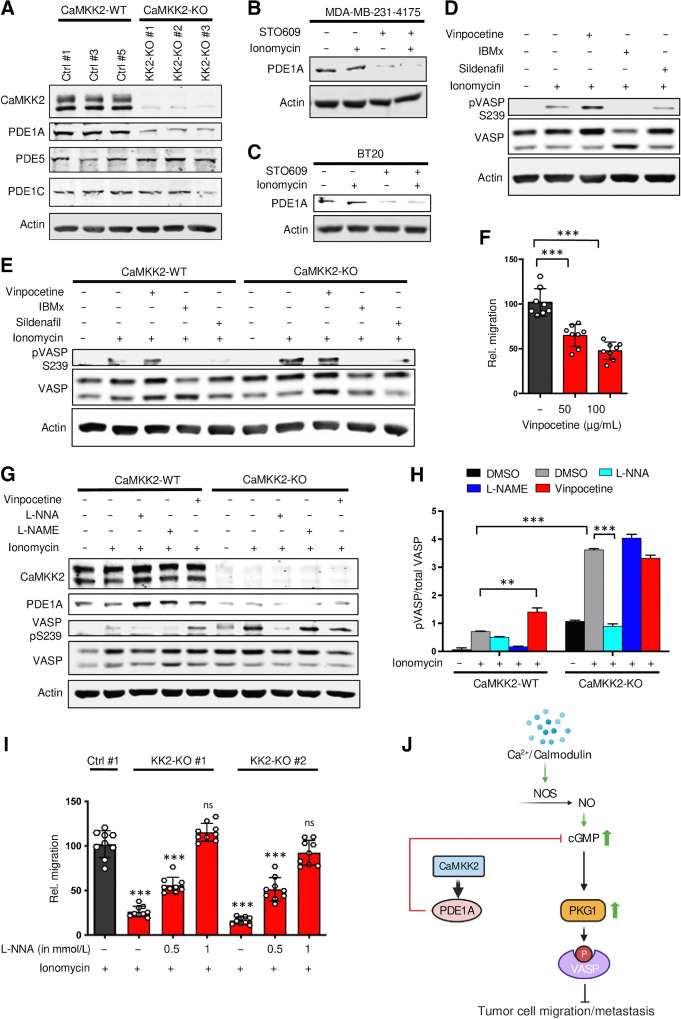
Figure 7. Depletion of CaMKK2 causes reduced expression of PDE1A, an upstream negative regulator of PKG1. A, CaMKK2 depletion decreased PDE1A protein levels in MDA-MB-231-4175 cells. B and C, Inhibition of CaMKK2 (STO-609, 10 μmol/L) reduced PDE1A expression in MDA-MB-231-4175 cells (B) and BT20 cells (C). D, PDE1 inhibition with vinpocetine increased VASP phosphorylation at Serine 239 in MDA-MB-231-4175 cells. Cells were pretreated with vinpocetine (50 μg/mL; 16 hours), IBMx (100 μmol/L; 16 hours), or sildenafil (10 μmol/L; 1 hour) before exposure to either DMSO or ionomycin (1 μmol/L) with CaCL2 (1 mmol/L) for 2 hours E, Vinpocetine pretreatment enhances phosphorylation of VASP at Serine 239 in CaMKK2-WT cells, phenocopying CaMKK2-KO cells. F, PDE1 inhibition impairs migration of MDA-MB-231-4175 cells in a dose-dependent manner. Following pretreatment with vinpocetine, MDA-MB-231-4175 cells were exposed to ionomycin (1 μmol/L) with CaCL2 (1 mmol/L) for 2 hours before assaying for migration. Data plotted as mean ± SEM; n = 4–5 random fields measurements from two individual experiments. G and H, Treatment with L-NNA blocked VASP phosphorylation in ionomycin-treated CaMKK2-KO cells. CaMKK2-WT and CaMKK2-KO cells were cultured with NOS inhibitors (16 hours) or vinpocetine, as indicated, before exposure to either DMSO or ionomycin (1 μmol/L) with CaCL2 (1 mmol/L) for 2 hours. Representative blots (G) and quantitative results (H) for the band intensities of phospho-VASP versus total VASP are shown. Data plotted as mean ± SEM from two independent experiments. I, Pretreatment of CaMKK2-KO cell lines with L-NNA rescued migratory ability in a dose-dependent manner. CaMKK2-KO cells were cultured with or without L-NNA (1 mmol/L; 16 hours) before exposure to ionomycin (1 μmol/L) with CaCL2 (1 mmol/L) for 2 hours and assayed for migration. Data plotted as mean ± SEM; n = 4–5 random fields measurements from two individual experiments. Significance calculated relative to Ctrl#1. J, Schematic model of the mechanism by which CaMKK2 drives tumor cell migration and metastasis. **, P < 0.01; ***, P < 0.005; ns, nonsignificant. P values were calculated using unpaired Student t test.
Figure 7.
Depletion of CaMKK2 causes reduced expression of PDE1A, an upstream negative regulator of PKG1. A, CaMKK2 depletion decreased PDE1A protein levels in MDA-MB-231-4175 cells. B and C, Inhibition of CaMKK2 (STO-609, 10 μmol/L) reduced PDE1A expression in MDA-MB-231-4175 cells (B) and BT20 cells (C). D, PDE1 inhibition with vinpocetine increased VASP phosphorylation at Serine 239 in MDA-MB-231-4175 cells. Cells were pretreated with vinpocetine (50 μg/mL; 16 hours), IBMx (100 μmol/L; 16 hours), or sildenafil (10 μmol/L; 1 hour) before exposure to either DMSO or ionomycin (1 μmol/L) with CaCL2 (1 mmol/L) for 2 hours E, Vinpocetine pretreatment enhances phosphorylation of VASP at Serine 239 in CaMKK2-WT cells, phenocopying CaMKK2-KO cells. F, PDE1 inhibition impairs migration of MDA-MB-231-4175 cells in a dose-dependent manner. Following pretreatment with vinpocetine, MDA-MB-231-4175 cells were exposed to ionomycin (1 μmol/L) with CaCL2 (1 mmol/L) for 2 hours before assaying for migration. Data plotted as mean ± SEM; n = 4–5 random fields measurements from two individual experiments. G and H, Treatment with L-NNA blocked VASP phosphorylation in ionomycin-treated CaMKK2-KO cells. CaMKK2-WT and CaMKK2-KO cells were cultured with NOS inhibitors (16 hours) or vinpocetine, as indicated, before exposure to either DMSO or ionomycin (1 μmol/L) with CaCL2 (1 mmol/L) for 2 hours. Representative blots (G) and quantitative results (H) for the band intensities of phospho-VASP versus total VASP are shown. Data plotted as mean ± SEM from two independent experiments. I, Pretreatment of CaMKK2-KO cell lines with L-NNA rescued migratory ability in a dose-dependent manner. CaMKK2-KO cells were cultured with or without L-NNA (1 mmol/L; 16 hours) before exposure to ionomycin (1 μmol/L) with CaCL2 (1 mmol/L) for 2 hours and assayed for migration. Data plotted as mean ± SEM; n = 4–5 random fields measurements from two individual experiments. Significance calculated relative to Ctrl#1. J, Schematic model of the mechanism by which CaMKK2 drives tumor cell migration and metastasis. **, P < 0.01; ***, P < 0.005; ns, nonsignificant. P values were calculated using unpaired Student t test.
Figure 8. CaMKK2 expression is associated with lower survival rates in patients with HGSOC. A, Representative photomicrographs of tumor microarray sections stained for CaMKK2 by immunohistochemistry, with corresponding intensity scores (×10 magnification). B and C, PFS (B) and OS (C) of patients with stage III HGSOC were evaluated and demonstrated that low CaMKK2 expression (intensity score < 3) correlated with longer median PFS (19.1 months vs. 6.2 months, P = 0.0242) and OS (60.6 vs. 17.1 months, P = 0.0180) than patients with high expression. D, PFS of patients with stage II to IV HGSOC were evaluated, which demonstrated that low CaMKK2 expression correlated with longer median PFS than patients with high expression (14.7 months vs. 14.5 months, P = 0.0453). E, OS of patients with stage II to IV were evaluated and showed a trend toward higher median OS in patients with low expression (58.0 months vs. 32 months, P = 0.2745). F, Eight-week-old female nude mice were inoculated with SKOV3ip1 cells (intraperitoneally) and received vehicle (control) or STO-609. Representative images (F), weight of metastatic tumor burden (G), and weight of non-pelvic metastasis (H) are shown (n = 15 per group). Data, mean ± SEM. *, P < 0.05; **, P < 0.01; by Student t test (G and H) and log-rank test (B–E).
Figure 8.
CaMKK2 expression is associated with lower survival rates in patients with HGSOC. A, Representative photomicrographs of tumor microarray sections stained for CaMKK2 by immunohistochemistry, with corresponding intensity scores (×10 magnification). B and C, PFS (B) and OS (C) of patients with stage III HGSOC were evaluated and demonstrated that low CaMKK2 expression (intensity score < 3) correlated with longer median PFS (19.1 months vs. 6.2 months, P = 0.0242) and OS (60.6 vs. 17.1 months, P = 0.0180) than patients with high expression. D, PFS of patients with stage II to IV HGSOC were evaluated, which demonstrated that low CaMKK2 expression correlated with longer median PFS than patients with high expression (14.7 months vs. 14.5 months, P = 0.0453). E, OS of patients with stage II to IV were evaluated and showed a trend toward higher median OS in patients with low expression (58.0 months vs. 32 months, P = 0.2745). F, Eight-week-old female nude mice were inoculated with SKOV3ip1 cells (intraperitoneally) and received vehicle (control) or STO-609. Representative images (F), weight of metastatic tumor burden (G), and weight of non-pelvic metastasis (H) are shown (n = 15 per group). Data, mean ± SEM. *, P < 0.05; **, P < 0.01; by Student t test (G and H) and log-rank test (BE).

References

    1. Sung H, Ferlay J, Siegel RL, Laversanne M, Soerjomataram I, Jemal A, et al. Global cancer statistics 2020: GLOBOCAN estimates of incidence and mortality worldwide for 36 cancers in 185 countries. CA Cancer J Clin 2021;71:209–49. - PubMed
    1. Siegel RL, Miller KD, Jemal A. Cancer statistics, 2017. CA Cancer J Clin 2017;67:7–30. - PubMed
    1. The Cancer Genome Atlas Network. Comprehensive molecular portraits of human breast tumours. Nature 2012;490:61–70. - PMC - PubMed
    1. Allemani C, Matsuda T, Di Carlo V, Harewood R, Matz M, Niksic M, et al. Global surveillance of trends in cancer survival 2000–14 (CONCORD-3): analysis of individual records for 37 513 025 patients diagnosed with one of 18 cancers from 322 population-based registries in 71 countries. Lancet 2018;391:1023–75. - PMC - PubMed
    1. Valastyan S, Weinberg RA. Tumor metastasis: molecular insights and evolving paradigms. Cell 2011;147:275–92. - PMC - PubMed

Publication types