


Worry and Mindfulness Differentially Impact Symptom Burden Following Treatment Among Breast Cancer Survivors: Findings From a Randomized Crossover Trial
- PMID: 37335884
- PMCID: PMC10498820
- DOI: 10.1093/abm/kaad032
Worry and Mindfulness Differentially Impact Symptom Burden Following Treatment Among Breast Cancer Survivors: Findings From a Randomized Crossover Trial
Abstract
Background: Breast cancer survivors often experience many somatic and cognitive side effects resulting from their cancer diagnosis and treatment, including higher rates of pain, fatigue, and memory/concentration problems. Emotion regulation offers opportunities to either enhance or dampen physical health.
Purpose: In a secondary analysis of a double-blind randomized controlled trial (RCT) using a typhoid vaccine to assess factors associated with breast cancer survivors' inflammatory responses, we assessed how two specific aspects of emotion regulation, mindfulness, and worry, corresponded to acute changes in focus problems, memory problems, and fatigue along with performance on pain sensitivity and cognitive tasks across two visits among breast cancer survivors.
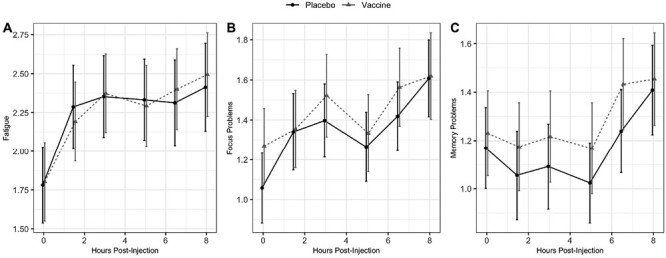
Methods: Breast cancer survivors (N = 149) completed two 8.5-hr visits at a clinical research center. Survivors were randomized to either the vaccine/saline placebo or a placebo/vaccine sequence. Worry and mindfulness questionnaires provided data on trait-level emotion regulation abilities. Fatigue, memory problems, and focus difficulties were assessed via Likert scales six times-once before the injections and then every 90 min for 7.5 hr thereafter. Women also completed a pain sensitivity task and several cognitive tasks at each visit.
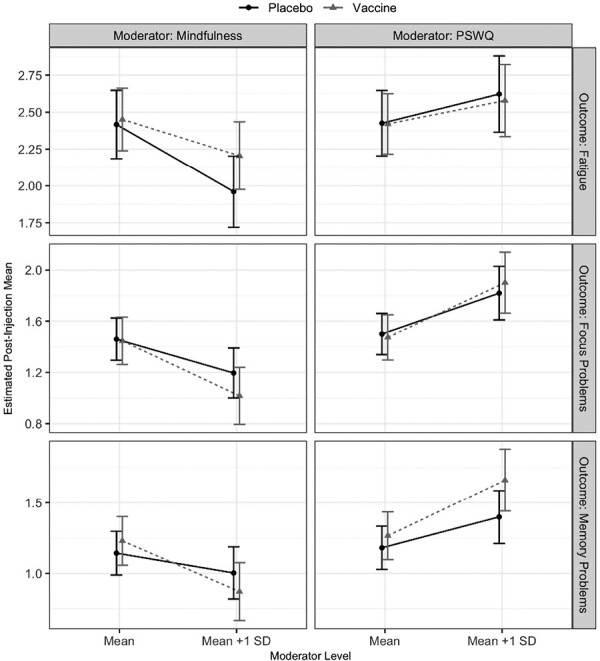
Results: Findings from this study showed that breast cancer survivors who worried more and were less mindful experienced subjective memory problems, focus problems, and cold pain sensitivity across two visits and irrespective of injection type. Lower mindfulness also corresponded to higher subjective fatigue and hot pain sensitivity and objective ratings. Emotion regulation skills did not predict objective pain sensitivity or cognitive problems.
Conclusion: Results from this study highlight the benefits of adaptive emotion regulation in helping mitigate symptoms associated with breast cancer survivorship.
Keywords: Breast cancer; Fatigue; Mindfulness; Pain; Worry.
Plain language summary
Breast cancer survivors experience side effects resulting from their cancer diagnosis and treatment, including higher rates of pain, fatigue, and memory/concentration problems. Emotion regulation offers the possibility to either better or worse physical health. This study assessed how two emotion regulation strategies, mindfulness and worry, corresponded to changes in focus problems, memory problems, and fatigue along with performance on pain sensitivity and cognitive tasks across two visits among breast cancer survivors. A total of 149 survivors completed 2 day-long visits in the laboratory where they rated their fatigue and memory problems six times across the day, completed cognitive tests, and a pain sensitivity test. Findings from this study showed that breast cancer survivors who worried more and were less mindful experienced subjective memory problems, focus problems, and cold pain sensitivity across two visits. Emotion regulation skills did not predict objective pain sensitivity or cognitive problems. Results from this study highlight the benefits of adaptive emotion regulation skills like mindfulness in helping improve the cognitive and physical symptoms commonly experienced by breast cancer survivorship.
© Society of Behavioral Medicine 2023. All rights reserved. For permissions, please e-mail: journals.permissions@oup.com.
Figures
References
-
- Maajani K, Jalali A, Alipour S, Khodadost M, Tohidinik HR, Yazdani K.. The global and regional survival rate of women with breast cancer: A systematic review and meta-analysis. Clin Breast Cancer. 2019; 19(3): 165–177. - PubMed
-
- Hewitt, M, Rowland JH, Yancik R.. Cancer survivors in the United States: Age, health, and disability. J Gerontol Med Sci. 2003; 58(1):82–91. - PubMed
-
- Sheridan D, Foo I, O'Shea H, et al. . Long-term follow-up of pain and emotional characteristics of women after surgery for breast cancer. J Pain Symptom Manage. 2012; 44(4): 608–614. - PubMed
-
- Laird BJ, Scott AC, Colvin LA, et al. . Pain, depression, and fatigue as a symptom cluster in advanced cancer. J Pain Symptom Manage. 2011; 42(1): 1–11. - PubMed
-
- Werner MU, et al. . Prediction of postoperative pain: A systematic review of predictive experimental pain studies. J Am Soc Anesthesiol. 2010; 112(6): 1494–1502. - PubMed
Publication types
MeSH terms
Grants and funding
LinkOut - more resources
Full Text Sources
Medical
