


Pulsed field ablation using focal contact force-sensing catheters for treatment of atrial fibrillation: acute and 90-day invasive remapping results
- PMID: 37335976
- PMCID: PMC10279421
- DOI: 10.1093/europace/euad147
Pulsed field ablation using focal contact force-sensing catheters for treatment of atrial fibrillation: acute and 90-day invasive remapping results
Abstract
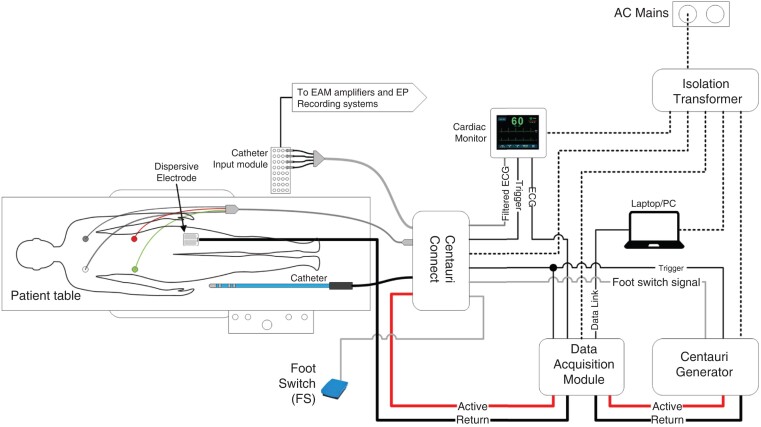
Aims: Pulsed field ablation (PFA) has emerged as a promising alternative to thermal ablation for treatment of atrial fibrillation (AF). We report performance and safety using the CENTAURI™ System (Galvanize Therapeutics) with three commercial, focal ablation catheters.
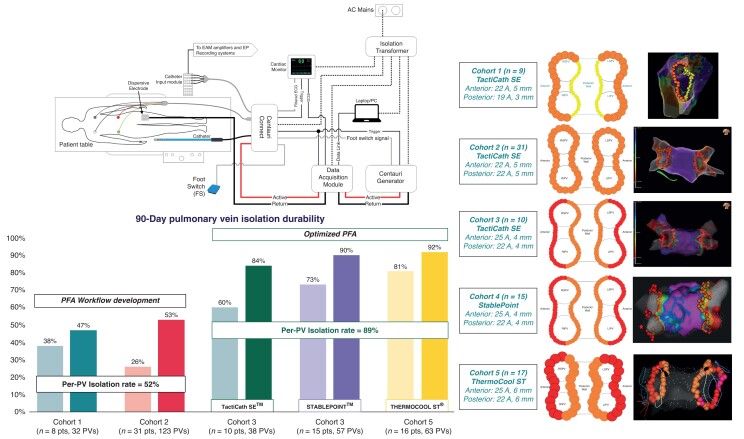
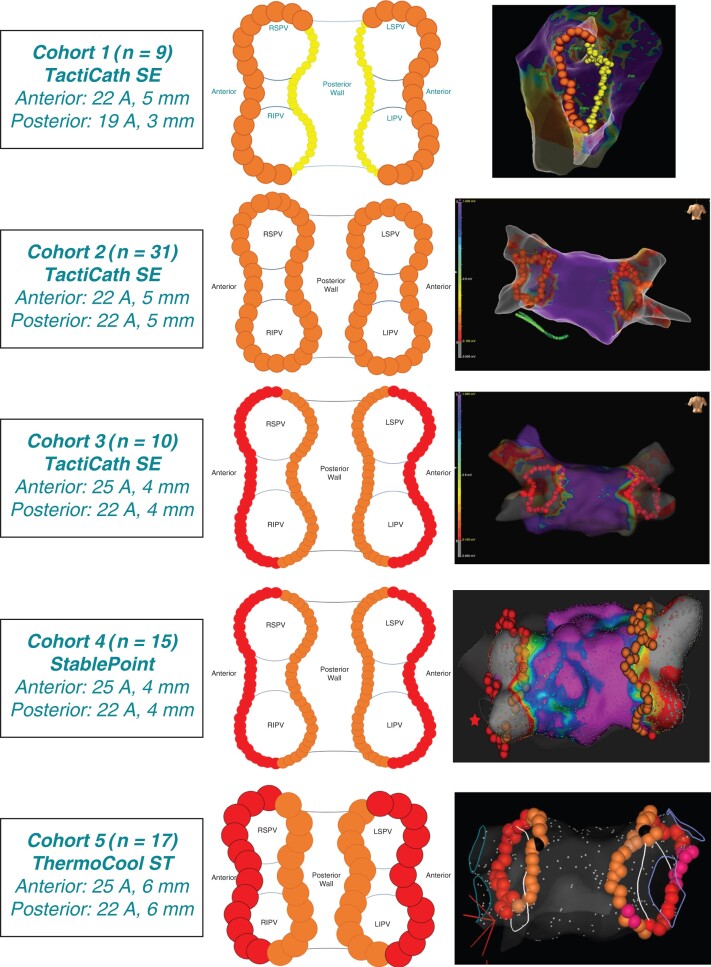
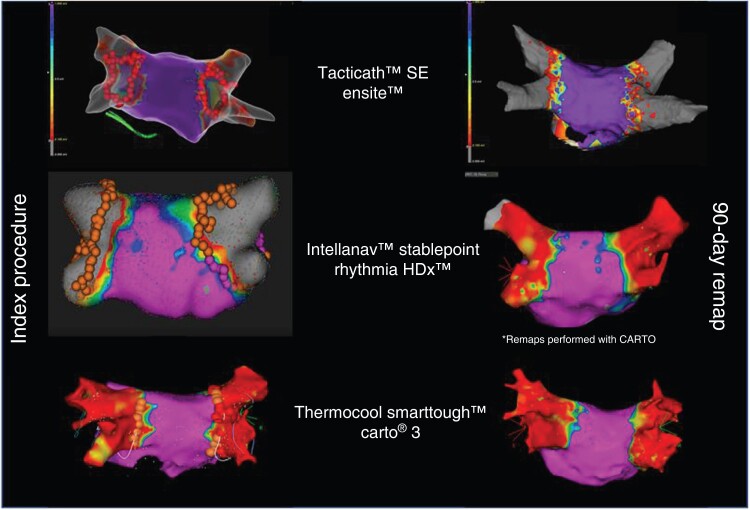
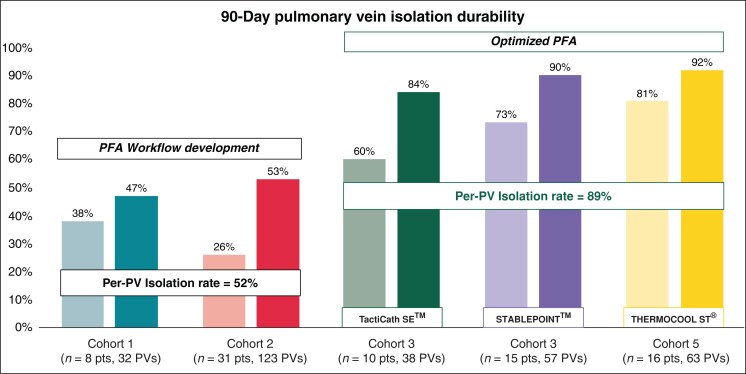
Methods and results: ECLIPSE AF (NCT04523545) was a prospective, single-arm, multi-centre study evaluating safety and acute and chronic pulmonary vein isolation (PVI) durability using the CENTAURI System in conjunction with the TactiCath SE, StablePoint, and ThermoCool ST ablation catheters. Patients with paroxysmal or persistent AF were treated at two centres. Patients were analysed in five cohorts based upon ablation settings, catheter, and mapping system. Pulsed field ablation was performed in 82 patients (74% male, 42 paroxysmal AF). Pulmonary vein isolation was achieved in 100% of pulmonary veins (322/322) with first-pass isolation in 92.2% (297/322). There were four serious adverse events of interest (three vascular access complications and one lacunar stroke). Eighty patients (98%) underwent invasive remapping. Pulsed field ablation development Cohorts 1 and 2 showed a per-patient isolation rate of 38% and 26% and a per-PV isolation rate of 47% and 53%, respectively. Optimized PFA Cohorts 3-5 showed a per-patient isolation rate of 60%, 73%, and 81% and a per-PV isolation rate of 84%, 90%, and 92%, respectively.
Conclusion: ECLIPSE AF demonstrated that optimized PFA using the CENTAURI System with three commercial, contact force-sensing, solid-tip focal ablation catheters resulted in transmural lesion formation and high proportion of durable PVI with a favourable safety profile, thus providing a viable treatment option for AF that integrates with contemporary focal ablation workflows.
Keywords: Atrial fibrillation; Focal catheter; Pulmonary vein isolation; Pulsed electric fields; Pulsed field ablation; Remapping.
© The Author(s) 2023. Published by Oxford University Press on behalf of the European Society of Cardiology.
Conflict of interest statement
Conflict of interest: A.A. serves as a consultant for Galvanize Therapeutics, Boston Scientific, Farapulse, and Biosense Webster; has received grant support from Galvanize Therapeutics, Boston Scientific, Farapulse, and Biosense Webster; and owns equity in Agra MedTech, Bolt, and Future Cardia. J.V., T.P., and P.K. have received grant support from Medtronic, Boston Scientific, Biotronik, Abbott, Pfizer, Bayer, and Daiichi Sankyo. V.M. is an employee of Galvanize Therapeutics. S.G. serves as a consultant for Galvanize Therapeutics. T.B., Z.J., I.S., and L.L. have no conflicts of interest to disclose.
Figures
Comment in
-
Analysis of pulsed field ablation using focal contact force-sensing catheters for treatment of atrial fibrillation: acute and 90-day invasive remapping results.Europace. 2023 Aug 2;25(9):euad287. doi: 10.1093/europace/euad287. Europace. 2023. PMID: 37725509 Free PMC article. No abstract available.
References
-
- Waldo AL. Management of atrial fibrillation: the need for AFFIRMative action. Atrial fibrillation follow-up investigation of rhythm management. Am J Cardiol 1999;84:698–700. - PubMed
-
- Jones DG, Haldar SK, Hussain W, Sharma R, Francis DP, Rahman-Haley SLet al. . A randomized trial to assess catheter ablation versus rate control in the management of persistent atrial fibrillation in heart failure. J Am Coll Cardiol 2013;61:1894–903. - PubMed
-
- Falk RH. Atrial fibrillation. N Engl J Med 2001;344:1067–78. - PubMed
-
- Calkins H, Reynolds MR, Spector P, Sondhi M, Xu Y, Martin Aet al. . Treatment of atrial fibrillation with antiarrhythmic drugs or radiofrequency ablation: two systematic literature reviews and meta-analyses. Circ Arrhythm Electrophysiol 2009;2:349–61. - PubMed
Publication types
MeSH terms
Grants and funding
LinkOut - more resources
Full Text Sources
Medical
