


The role of transcription factors in shaping regulatory T cell identity
- PMID: 37336954
- PMCID: PMC10893967
- DOI: 10.1038/s41577-023-00893-7
The role of transcription factors in shaping regulatory T cell identity
Abstract
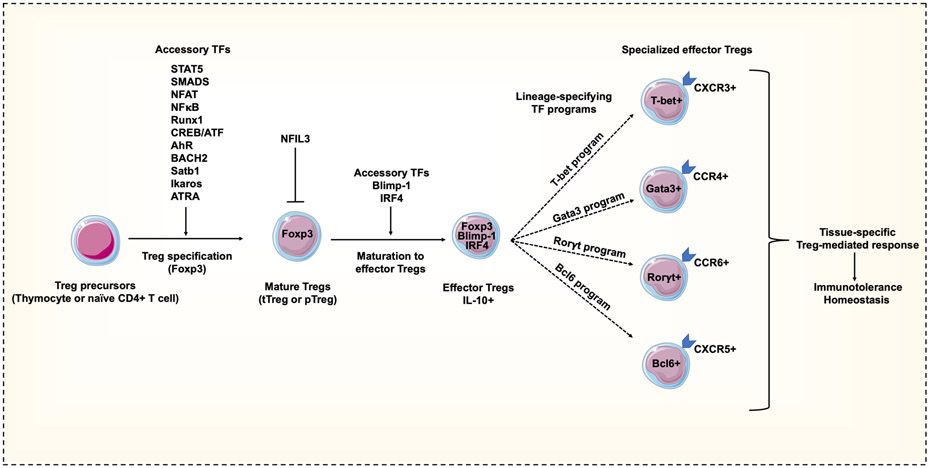
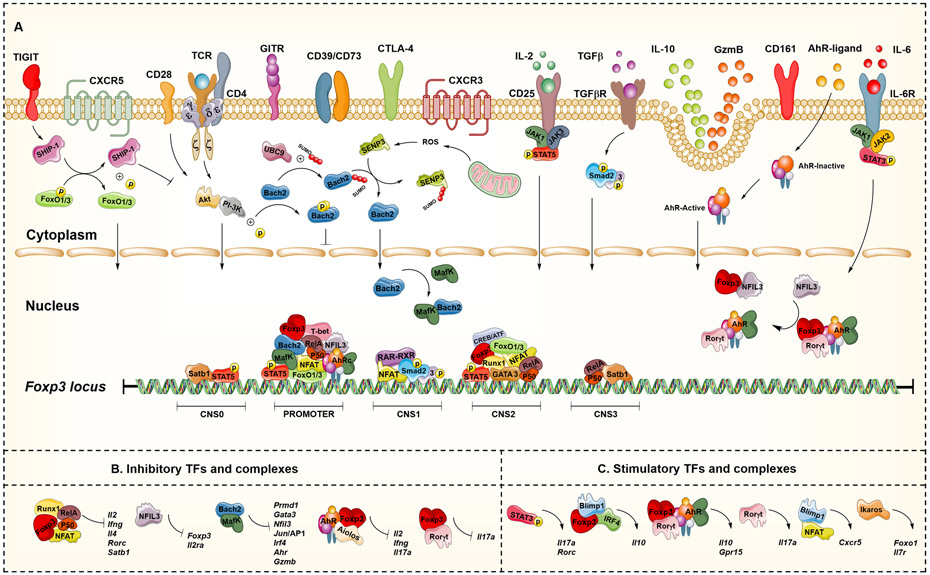
Forkhead box protein 3-expressing (FOXP3+) regulatory T cells (Treg cells) suppress conventional T cells and are essential for immunological tolerance. FOXP3, the master transcription factor of Treg cells, controls the expression of multiples genes to guide Treg cell differentiation and function. However, only a small fraction (<10%) of Treg cell-associated genes are directly bound by FOXP3, and FOXP3 alone is insufficient to fully specify the Treg cell programme, indicating a role for other accessory transcription factors operating upstream, downstream and/or concurrently with FOXP3 to direct Treg cell specification and specialized functions. Indeed, the heterogeneity of Treg cells can be at least partially attributed to differential expression of transcription factors that fine-tune their trafficking, survival and functional properties, some of which are niche-specific. In this Review, we discuss the emerging roles of accessory transcription factors in controlling Treg cell identity. We specifically focus on members of the basic helix-loop-helix family (AHR), basic leucine zipper family (BACH2, NFIL3 and BATF), CUT homeobox family (SATB1), zinc-finger domain family (BLIMP1, Ikaros and BCL-11B) and interferon regulatory factor family (IRF4), as well as lineage-defining transcription factors (T-bet, GATA3, RORγt and BCL-6). Understanding the imprinting of Treg cell identity and specialized function will be key to unravelling basic mechanisms of autoimmunity and identifying novel targets for drug development.
© 2023. This is a U.S. Government work and not under copyright protection in the US; foreign copyright protection may apply.
Figures
References
-
- Sakaguchi S, Fukuma K, Kuribayashi K & Masuda T Organ-specific autoimmune diseases induced in mice by elimination of T cell subset. I. Evidence for the active participation of T cells in natural self-tolerance; deficit of a T cell subset as a possible cause of autoimmune disease. J Exp Med 161, 72–87 (1985). - PMC - PubMed
-
- Sakaguchi S, Sakaguchi N, Asano M, Itoh M & Toda M Immunologic self-tolerance maintained by activated T cells expressing IL-2 receptor alpha-chains (CD25). Breakdown of a single mechanism of self-tolerance causes various autoimmune diseases. J Immunol 155, 1151–1164 (1995). - PubMed
-
- Hori S, Nomura T & Sakaguchi S Control of regulatory T cell development by the transcription factor Foxp3. Science 299, 1057–1061 (2003). - PubMed
-
- Fontenot JD, Gavin MA & Rudensky AY Foxp3 programs the development and function of CD4+CD25+ regulatory T cells. Nat Immunol 4, 330–336 (2003). - PubMed
-
- Bennett CL et al. The immune dysregulation, polyendocrinopathy, enteropathy, X-linked syndrome (IPEX) is caused by mutations of FOXP3. Nat Genet 27, 20–21 (2001). - PubMed
Publication types
MeSH terms
Substances
Grants and funding
LinkOut - more resources
Full Text Sources
Research Materials
