


Ready, set, go! The role of organizational readiness to predict adoption of a family caregiver training program using the Rogers' diffusion of innovation theory
- PMID: 37337208
- PMCID: PMC10278362
- DOI: 10.1186/s43058-023-00447-x
Ready, set, go! The role of organizational readiness to predict adoption of a family caregiver training program using the Rogers' diffusion of innovation theory
Abstract
Background: Caregivers FIRST is an evidence-based program addressing gaps in caregivers' skills. In 2020, the Veterans Health Administration Caregiver Support Program (CSP) nationally endorsed Caregivers FIRST, offering credit in leadership performance plans to encourage all VA medical centers (VAMCs) to implement locally. This study examines the association of organizational readiness with VAMC adoption of Caregivers FIRST.
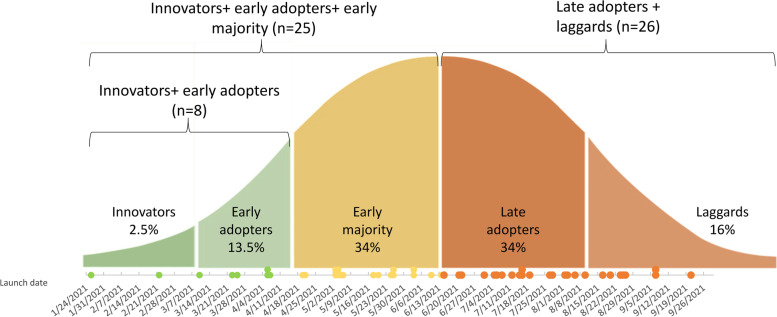
Methods: In a cohort observational study, we surveyed CSP managers about their facilities' readiness to implement using the Organizational Readiness for Implementing Change (ORIC) instrument and compared change commitment and change efficacy domains among VAMCs "adopters" defined as delivering Caregivers FIRST within 1 year of the national announcement to those that did not ("non-adopters"). Within "adopters," we categorized time to adoption based on Rogers' diffusion of innovation theory including "innovators," "early adopters," "early majority," "late adopters," and "laggards." Organizational readiness and site characteristics (facility complexity, staffing levels, volume of applications for caregiver assistance services) were compared between "adopters," "non-adopters," and between time to adoption subcategories. Separate logistic regression models were used to assess whether ORIC and site characteristics were associated with early adoption among "adopters."
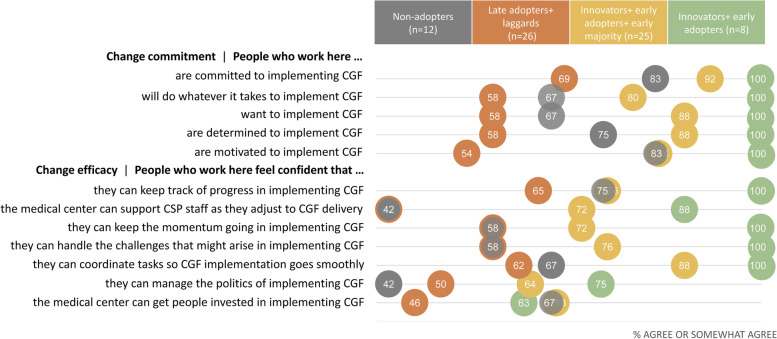
Results: Fifty-one of 63 (81%) VAMCs with CSP manager survey respondents adopted Caregivers FIRST during the first year. ORIC change commitment and efficacy were similar for "adopters" and "non-adopters." However, sites that adopted earlier (innovators and early adopters) had higher ORIC change commitment and efficacy scores than the rest of the "adopters." Logistic regression results indicated that higher ORIC change commitment (odds ratio [OR] = 2.57; 95% confidence interval [CI], 1.11-5.95) and ORIC change efficacy (OR = 2.60; 95% CI, 1.12-6.03) scores were associated with increased odds that a VAMC was an early adopter (categorized as an "innovator," "early adopter", or "early majority"). Site-level characteristics were not associated with Caregivers FIRST early adoption.
Conclusions: To our knowledge, this study is the first to prospectively assess organizational readiness and the timing of subsequent program adoption. Early adoption was associated with higher ORIC change commitment and change efficacy and not site-level characteristics. These findings yield insights into the role of organizational readiness to accelerate program adoption.
Trial registration: ClinicalTrials.gov, NCT03474380. Registered on March 22, 2018.
Keywords: Family caregivers; Implementation science; Informal care; Skills training; Veterans.
© 2023. This is a U.S. Government work and not under copyright protection in the US; foreign copyright protection may apply.
Conflict of interest statement
The authors declare that they have no competing interests.
Figures

References
-
- Freedman VA, Wolff JL. The changing landscape of family caregiving in the United States. Washington, DC: Brookings Institution; 2020.
-
- Caregiving for family and friends — a public health issue. Centers for Disease Control and Prevention Data Brief, 2018. Centers for Disease Control and Prevention; 2021. Available from: https://www.cdc.gov/aging/agingdata/docs/caregiver-brief-508.pdf.
-
- Committee on Family Caregiving for Older A, Board on Health Care S, Health, Medicine D, National Academies of Sciences E, Medicine. In: Schulz R, Eden J, editors. Families caring for an aging America. Washington (DC): National Academies Press (US) Copyright 2016 by the National Academy of Sciences. All rights reserved; 2016. - PubMed
-
- RAISE Family Caregivers Act Initial Report to Congress. 2021 ACL Administration for Community Living. 2021 [Cited 2023 Apr 26]: Available from: https://acl.gov/sites/default/files/RAISE-InitialReportToCongress2021_Fi....
Associated data
Grants and funding
LinkOut - more resources
Full Text Sources
Medical
