


The impact of high versus standard enteral protein provision on functional recovery following intensive care admission (PRECISE trial): study protocol for a randomized controlled, quadruple blinded, multicenter, parallel group trial in mechanically ventilated patients
- PMID: 37337234
- PMCID: PMC10280915
- DOI: 10.1186/s13063-023-07380-3
The impact of high versus standard enteral protein provision on functional recovery following intensive care admission (PRECISE trial): study protocol for a randomized controlled, quadruple blinded, multicenter, parallel group trial in mechanically ventilated patients
Abstract
Background: Critically ill patients are subject to severe skeletal muscle wasting during intensive care unit (ICU) stay, resulting in impaired short- and long-term functional outcomes and health-related quality of life. Increased protein provision may improve functional outcomes in ICU patients by attenuating skeletal muscle breakdown. Supporting evidence is limited however and results in great variety in recommended protein targets.
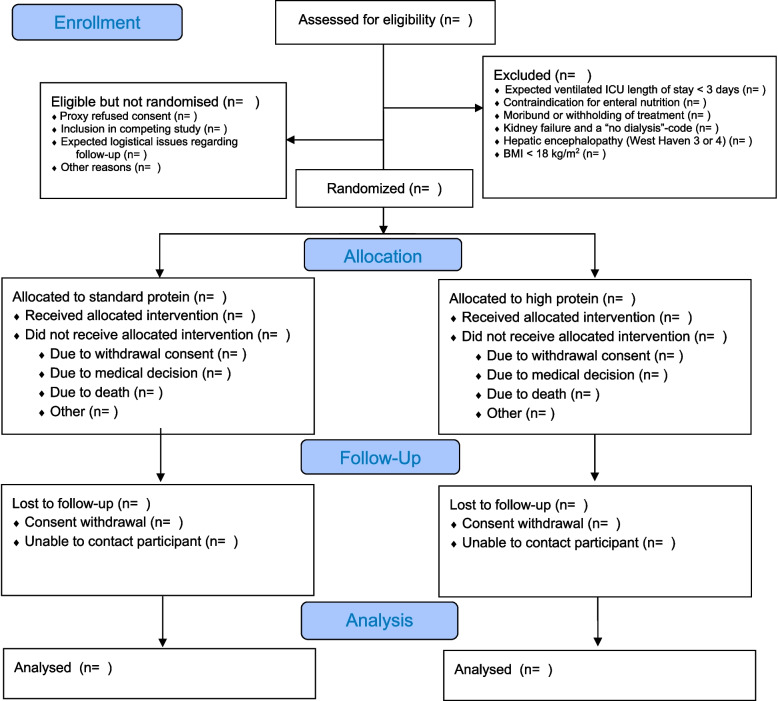
Methods: The PRECISe trial is an investigator-initiated, bi-national, multi-center, quadruple-blinded randomized controlled trial with a parallel group design. In 935 patients, we will compare provision of isocaloric enteral nutrition with either a standard or high protein content, providing 1.3 or 2.0 g of protein/kg/day, respectively, when fed on target. All unplanned ICU admissions with initiation of invasive mechanical ventilation within 24 h of admission and an expected stay on ventilator support of at least 3 days are eligible. The study is designed to assess the effect of the intervention on functional recovery at 1, 3, and 6 months following ICU admission, including health-related quality of life, measures of muscle strength, physical function, and mental health. The primary endpoint of the trial is health-related quality of life as measured by the Euro-QoL-5D-5-level questionnaire Health Utility Score. Overall between-group differences will be assessed over the three time points using linear mixed-effects models.
Discussion: The PRECISe trial will evaluate the effect of protein on functional recovery including both patient-centered and muscle-related outcomes.
Trial registration: ClinicalTrials.gov Identifier: NCT04633421 . Registered on November 18, 2020. First patient in (FPI) on November 19, 2020. Expected last patient last visit (LPLV) in October 2023.
Keywords: Critical illness; Dietary protein; Enteral nutrition; Functional outcomes; Nutrition therapy.
© 2023. The Author(s).
Conflict of interest statement
Model consent forms for study participation for patient and for patient’s proxy, both in Dutch and in French, will be made available on request.
ZP has received honoraria for consultancy from Nestle, Nutricia, Faraday Pharmaceuticals, and Fresenius-Kabi and speaker fees from Baxter, Fresenius-Kabi, Nutricia, and Nestle. No other potential competing interest was reported by the authors.
Figures
References
-
- Hermans G, Van Mechelen H, Clerckx B, Vanhullebusch T, Mesotten D, Wilmer A, et al. Acute outcomes and 1-year mortality of intensive care unit-acquired weakness. A cohort study and propensity-matched analysis. Am J Respir Crit Care Med. 2014;190(4):410–20. doi: 10.1164/rccm.201312-2257OC. - DOI - PubMed
Publication types
MeSH terms
Associated data
LinkOut - more resources
Full Text Sources
Medical
