Impact of Medication-Based Treatment on Health Care Utilization Among Individuals With Opioid Use Disorder
- PMID: 37337675
- PMCID: PMC10730760
- DOI: 10.1176/appi.ps.20220549
Impact of Medication-Based Treatment on Health Care Utilization Among Individuals With Opioid Use Disorder
Abstract
Objective: This study evaluated the association between medication for opioid use disorder (MOUD) and health care utilization over time among a sample of treatment-seeking individuals with opioid use disorder. In contrast to previous studies, this study used a novel measure of MOUD adherence, more comprehensive utilization data, and analyses that controlled for detailed individual and social determinants of health.
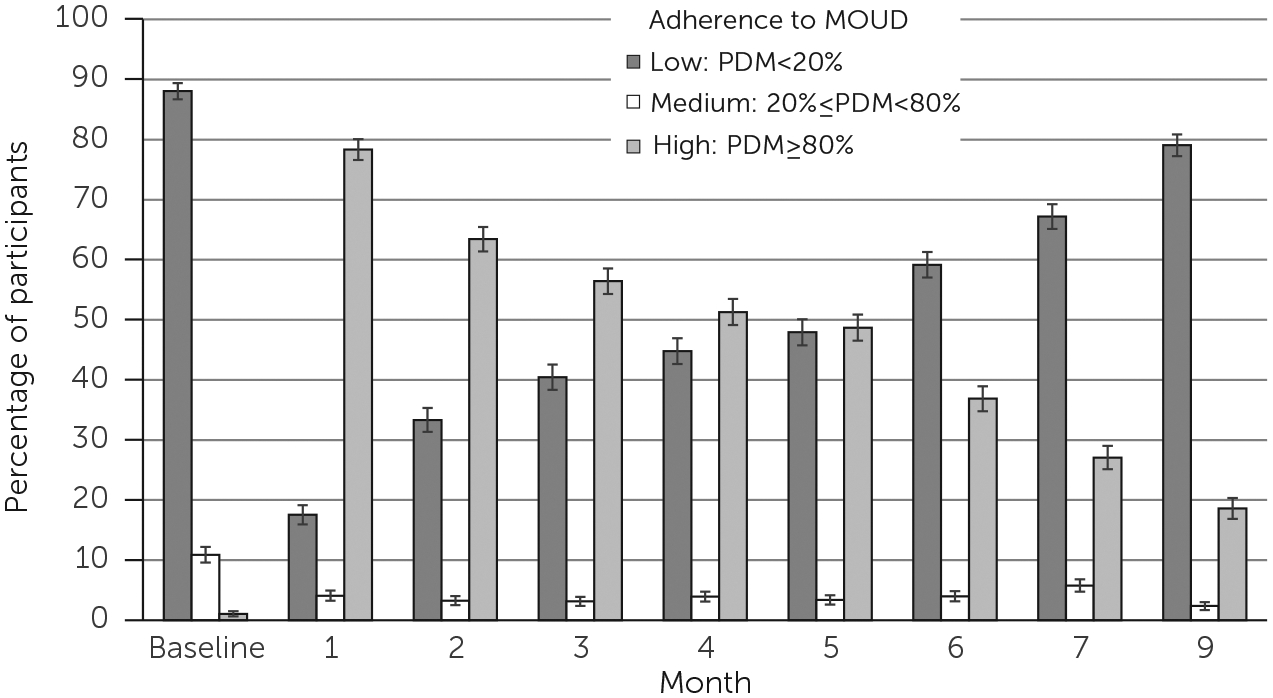
Methods: This study was a secondary analysis of a comparative effectiveness trial (N=570) of extended-release naltrexone versus buprenorphine-naloxone. The outcome of interest was usage of nonstudy acute care, inpatient and outpatient addiction services, and other outpatient services across 36 weeks of assessment. Adherence (percentage of days taking MOUD) was defined as low (<20%), medium (≥20% but <80%), or high (≥80%). A two-part model evaluated the probability of utilizing a resource and the quantity (utilization days) of the resource consumed. A time-varying approach was used to examine the effect of adherence in a given month on utilization in the same month, with analyses controlling for a wide range of person-level characteristics.
Results: Participants with high adherence (vs. low) were significantly less likely to use inpatient addiction (p<0.001) and acute care (p<0.001) services and significantly more likely to engage in outpatient addiction (p=0.045) and other outpatient (p=0.042) services.
Conclusions: These findings reinforce the understanding that greater MOUD adherence is associated with reduced usage of high-cost health services and increased usage of outpatient care. The results further suggest the need for enhanced access to MOUD and for interventions that improve adherence.
Keywords: Adherence; Health care utilization; Medication for opioid use disorder (MOUD); Person-level characteristics.
Conflict of interest statement
Dr. Fishman has served as a consultant for Alkermes, Drug Delivery LLC, Indivior, and Verily Life Sciences and has received research support from Alkermes. Dr. Rotrosen has received indirect research support from Alkermes, Braeburn, CHESS Health, Datacubed Health, Indivior, and Pear Therapeutics; he serves as a principal investigator for the New York Node of the NIDA CTN and as chair of the data and safety monitoring board for a U.S. Department of Veterans Affairs study; and he has served as chair of the data and safety monitoring board for a trial conducted by the Canadian Research Initiative in Substance Misuse. Dr. Nunes has received research support from Alkermes, Braeburn, Camurus, CHESS Health, Indivior, and Pear Therapeutics; he has served as a nonpaid consultant for Alkermes, Camurus, Indivior, and Pear Therapeutics; and he serves as a principal investigator for the New York Node of the NIDA CTN. Dr. Murphy has served on an advisory board for Indivior. The other authors report no financial relationships with commercial interests.
Figures
References
-
- Ahmad FB, Cisewski JA, Rossen LM, et al.: Provisional Drug Overdose Death Counts. Hyattsville, MD, Centers for Disease Control and Prevention, National Center for Health Statistics, 2023. www.cdc.gov/nchs/nvss/vsrr/drug-overdose-data.htm. Accessed April 27, 2023
-
- HCUP Fast Stats—Opioids Hospital Use Map. Rockville, MD, Agency for Healthcare Research and Quality, 2022. https://datatools.ahrq.gov/hcup-fast-stats. Accessed April 27, 2023
-
- Facing Addiction in America: The Surgeon General’s Report on Alcohol, Drugs, and Health. Washington, DC, Department of Health and Human Services, 2016. https://www.ncbi.nlm.nih.gov/books/n/surgaddict/pdf - PubMed
-
- Amato L, Davoli M, Perucci CA, et al.: An overview of systematic reviews of the effectiveness of opiate maintenance therapies: available evidence to inform clinical practice and research. J Subst Abuse Treat 2005; 28:321–329 - PubMed
MeSH terms
Substances
Grants and funding
LinkOut - more resources
Full Text Sources
Medical