


Positive Childhood Experiences and Adult Health Outcomes
- PMID: 37337829
- PMCID: PMC10312234
- DOI: 10.1542/peds.2022-060951
Positive Childhood Experiences and Adult Health Outcomes
Abstract
Objectives: Adverse childhood experiences (ACEs) can drive poor adult mental and physical health, but the impact of early life protective factors should not be overlooked. Positive childhood experiences (PCEs) measures quantify protective factors, but evidence is lacking on their link to health conditions independent of ACEs in nationally representative studies. This study examines associations between composite PCE score and adult health, adjusting for ACEs.
Methods: The most recent 2017 wave of the Panel Study of Income Dynamics, a nationally representative study and its 2014 Childhood Retrospective Circumstances supplement (n = 7496) collected adult health outcomes, PCEs, and ACEs. Multivariable logistic regression assessed associations between PCE score and adult self-rated health or condition diagnosis, with and without ACEs adjustment. Cox proportional hazards models examined relationships between PCEs, ACEs, and annual risk of diagnosis.
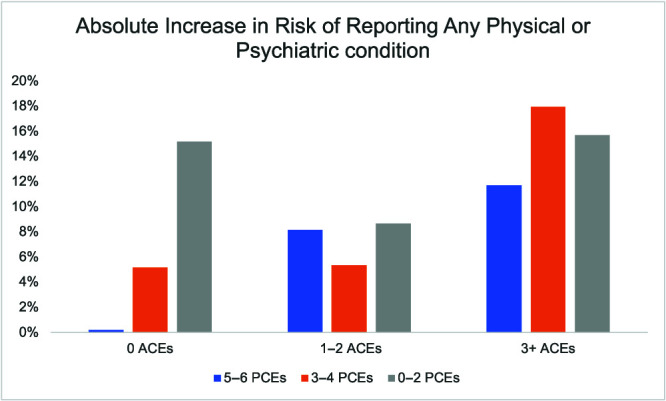
Results: Adults with 5 to 6 PCEs had 75% (95% confidence interval [CI], 0.58-0.93) of the risk of fair/poor overall health and 74% of the risk of any psychiatric diagnosis (CI, 0.59-0.89) compared with those with 0 to 2 PCEs, independent of ACEs. In survival analysis models accounting for PCEs and ACEs, reporting 5 to 6 PCEs was associated with a 16% lower annual hazard of developing any adult psychiatric or physical condition (hazard ratio, 0.84; CI, 0.75-0.94); reporting 3+ ACEs was associated with a 42% higher annual hazard (CI, 1.27-1.59).
Conclusions: PCEs were independently associated with lower risks of fair or poor adult health, adult mental health problems, and developing any physical or mental health condition at any given age after adjusting for ACEs.
Copyright © 2023 by the American Academy of Pediatrics.
Conflict of interest statement
Figures
Comment in
-
Encouraging Strengths in Parents and Youth to Promote Positive Childhood Experiences.Pediatrics. 2023 Jul 1;152(1):e2023061264. doi: 10.1542/peds.2023-061264. Pediatrics. 2023. PMID: 37337840 No abstract available.
References
-
- Hughes K, Bellis MA, Hardcastle KA, et al. The effect of multiple adverse childhood experiences on health: a systematic review and meta-analysis. Lancet Public Health. 2017;2(8):e356–e366 - PubMed
-
- Felitti VJ, Anda RF, Nordenberg D, et al. Relationship of childhood abuse and household dysfunction to many of the leading causes of death in adults. The Adverse Childhood Experiences (ACE) Study. Am J Prev Med. 1998;14(4):245–258 - PubMed
-
- Brown DW, Anda RF, Tiemeier H, et al. Adverse childhood experiences and the risk of premature mortality. Am J Prev Med. 2009;37(5):389–396 - PubMed
-
- Felitti VJ, Anda R. The Relationship of Adverse Childhood Experiences to Adult Medical Disease, Psychiatric Disorders, and Sexual Behavior: Implications for Healthcare. In The Impact of Early Life Trauma on Health and Disease: The Hidden Epidemic (pp.77–87). Cambridge, UK: Cambridge University Press; 2010
Publication types
MeSH terms
Grants and funding
LinkOut - more resources
Full Text Sources
Medical
