Review
. 2023 Nov;50(6):1318-1335.
doi: 10.1017/S0305000923000260. Epub 2023 Jun 20.

Neurocomputational modeling of speech motor development

Affiliations
Review

Neurocomputational modeling of speech motor development

Andrew M Meier et al. J Child Lang. 2023 Nov.

Abstract

This review describes a computational approach for modeling the development of speech motor control in infants. We address the development of two levels of control: articulation of individual speech sounds (defined here as phonemes, syllables, or words for which there is an optimized motor program) and production of sound sequences such as phrases or sentences. We describe the DIVA model of speech motor control and its application to the problem of learning individual sounds in the infant's native language. Then we describe the GODIVA model, an extension of DIVA, and how chunking of frequently produced phoneme sequences is implemented within it.

Keywords: Speech motor control; computational neural modeling; motor-sequence learning; speech development; speech production.


Conflict of interest statement

No competing interests to disclose.

Figures
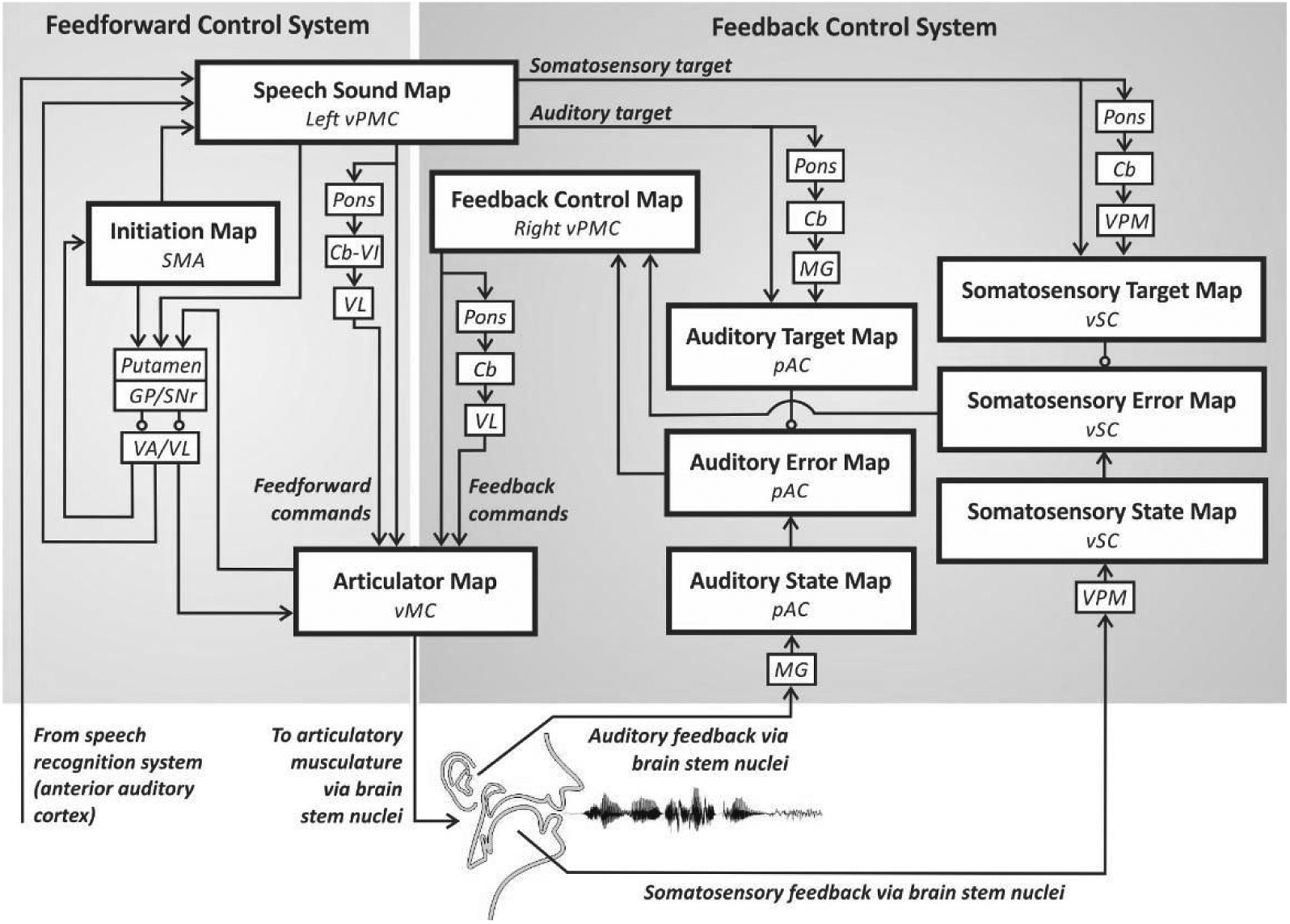
Figure 1.
Figure 1.
Neural correlates of the DIVA model. The main neural output of the model is provided by the vMC Articulator Map, which integrates feedforward commands from VL and the Speech Sound Map with feedback commands from VL and the Feedback Control Map. [Abbreviations: Cb=cerebellum (specific lobule unknown); Cb-VI=cerebellum lobule VI; GP=globus pallidus; MG=medial geniculate nucleus of the thalamus; pAC=posterior auditory cortex; SMA=supplementary motor area; SNr=substantia nigra pars reticula; VA=ventral anterior nucleus of the thalamus; VL=ventral lateral nucleus of the thalamus; vMC=ventral motor cortex; VPM=ventral posterior medial nucleus of the thalamus; vPMC=ventral premotor cortex; vSC=ventral somatosensory cortex.]
Figure 2.
Figure 2.
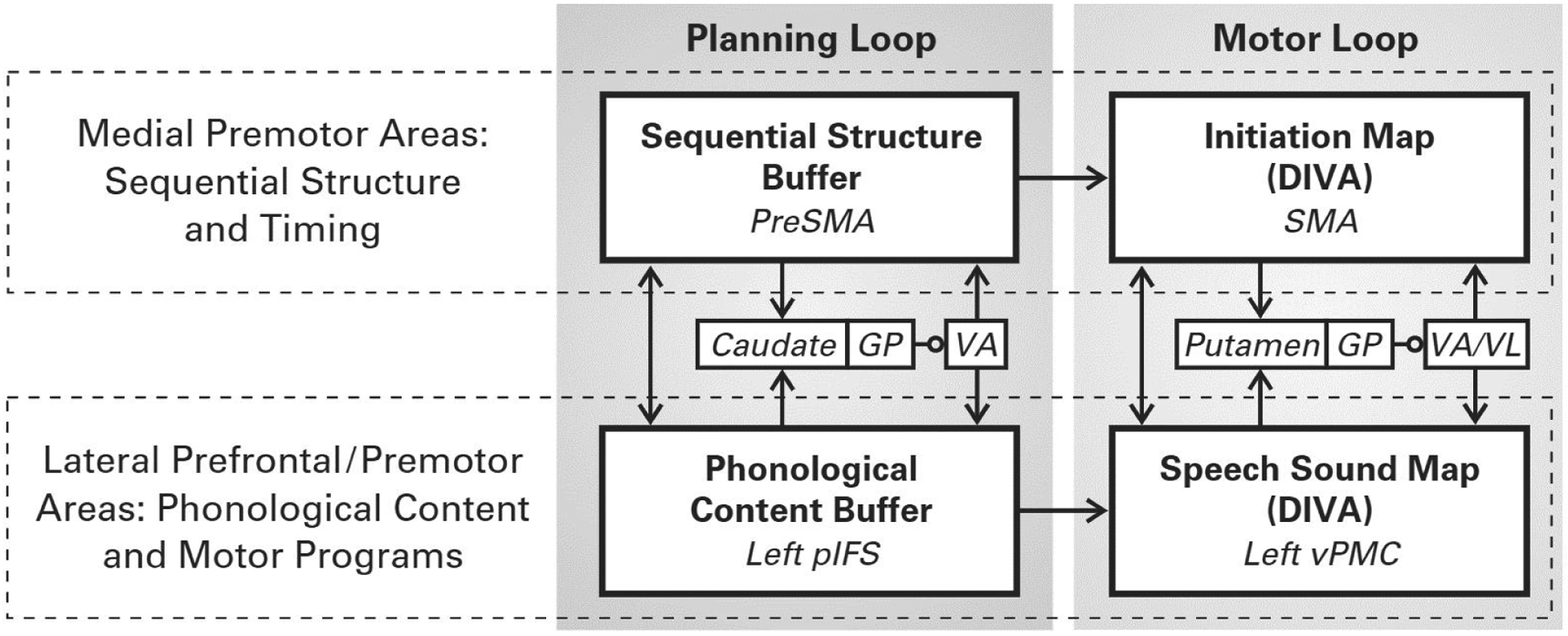
Simplified schematic of the GODIVA network model for speech sequence production. [Abbreviations: GP, globus pallidus; pIFS, posterior inferior frontal sulcus; preSMA, presupplementary motor area; SMA, supplementary motor area; VA, ventral anterior thalamic nucleus; VL, ventral lateral thalamic nucleus; vPMC, ventral premotor cortex]
Figure 3.
Figure 3.
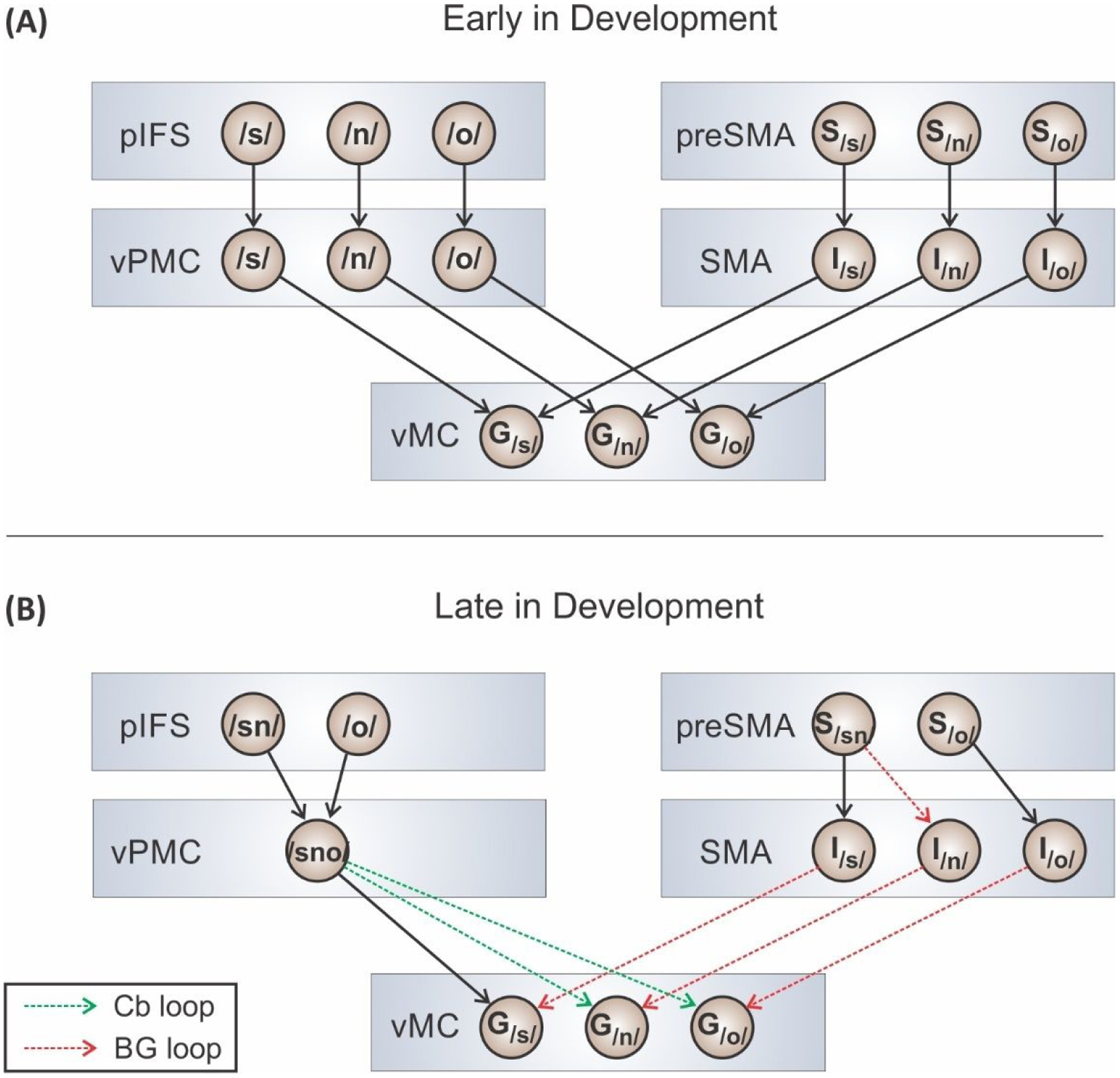
Illustration of speech sequence learning via “chunking” in the GODIVA model. (A) Network involved in producing the word “snow” early in speech motor development. Cortico-cortical projections are indicated by black arrows. (B) Network involved in producing the word “snow” later in development. The development of basal ganglia (red dashed arrows) and cerebellar (green dashed arrows) loops allow for the use of fewer cortical nodes and projections. [Abbreviations: BG, basal ganglia; Cb, cerebellum; G, gestural node; I, initiation map node; pIFS, posterior inferior frontal sulcus; preSMA, presupplementary motor area; S, syllabic structure node; SMA, supplementary motor area; vMC, ventral primary motor cortex; vPMC, ventral premotor cortex]

References

    1. Alm Per A. 2004. “Stuttering and the Basal Ganglia Circuits: A Critical Review of Possible Relations.” Journal of Communication Disorders 37 (4): 325–69. - PubMed
    1. Anthony Jason L, and Francis David J. 2005. “Development of Phonological Awareness.” Current Directions in Psychological Science 14 (5): 255–59.
    1. Anthony JL, Lonigan CJ, Driscoll K, Phillips BM and Burgess SR 2003. “Phonological sensitivity: A quasi-parallel progression of word structure units and cognitive operations.” Reading Research Quarterly 38(4): 470–487.
    1. Benedict Helen. 1979. “Early Lexical Development: Comprehension and Production.” Journal of Child Language 6 (2): 183–200. - PubMed
    1. Bohland Jason W., Bullock Daniel, and Guenther Frank H.. 2010. “Neural Representations and Mechanisms for the Performance of Simple Speech Sequences.” Journal of Cognitive Neuroscience 22 (7): 1504–29. 10.1162/jocn.2009.21306. - DOI - PMC - PubMed

Publication types

LinkOut - more resources