


Root coverage with apical tunnel approach using propolis as a root conditioning agent: A case report with 2-year follow-up and review of the literature
- PMID: 37338508
- PMCID: PMC10441594
- DOI: 10.1002/cre2.751
Root coverage with apical tunnel approach using propolis as a root conditioning agent: A case report with 2-year follow-up and review of the literature
Abstract
Objectives: One of the main challenges in performing root coverage is patient discomfort and donor site morbidity. This case report presents a minimally invasive apical tunnel surgical technique, with propolis for root conditioning, to correct gingival recession defects without harvesting donor grafts, flap elevation, or sutures. Propolis is a natural anti-infective, anti-inflammatory, and antioxidant agent.
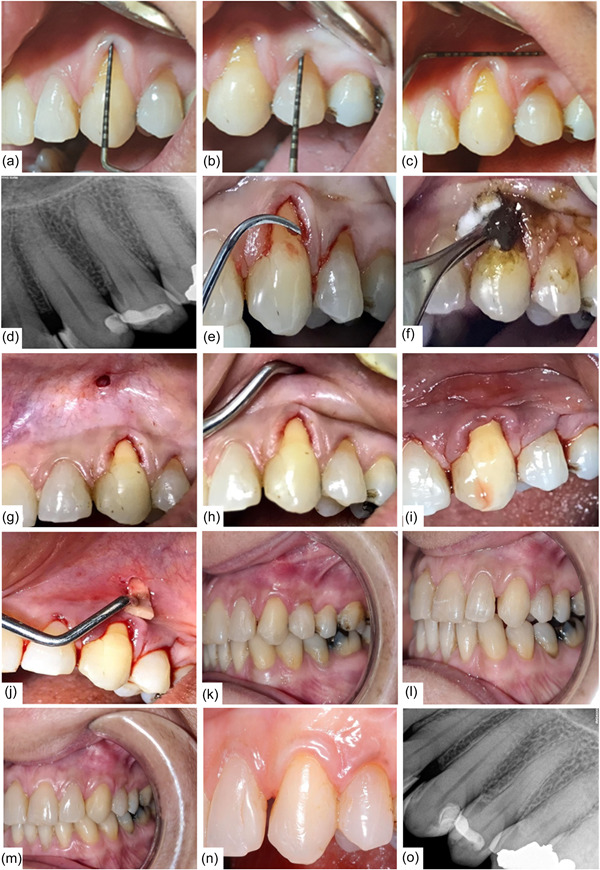
Material and methods: A 58-year-old woman with no significant medical history was presented for root coverage of her upper left canine and first premolar with recession type (RT)1A (+). Propolis was used as a root conditioning agent to promote soft tissue coverage via an apical tunnel approach. During the apical tunnel approach, a small apical hole was made 6 mm below the mucogingival junction, and the mucosa and associated attached gingiva was away from the tooth so the flap could be repositioned coronally. Collagen matrix was used as a soft tissue graft material.
Results: At the 2-month, 6-month, 8-month, and 2-year follow-up, complete root coverage was achieved for both teeth. No bleeding on probing was noticed nor recurrent GRs at the treated sites.
Conclusion: Without incisions, donor site reflection, or flaps, the apical tunnel approach can be successfully used to cover the exposed roots. Additionally, propolis is a potential root conditioning agent during soft tissue graft procedure due to its anti-inflammatory and antioxidant properties.
Keywords: apical tunnel approach; gingival recession; propolis; root coverage.
© 2023 The Authors. Clinical and Experimental Dental Research published by John Wiley & Sons Ltd.
Conflict of interest statement
The authors declare no conflict of interest.
Figures
References
-
- Anuroopa, P. , Ambadi, S. , Naidu, P. , & Savita, S. (2018). Treatment of gingival recession by a novel pinhole technique: A report of two cases. Journal of Dentistry, Oral Disorders & Therapy, 6(2), 1–5.
-
- Barootchi, S. , Tavelli, L. , Di Gianfilippo, R. , Shedden, K. , Oh, T. J. , Rasperini, G. , Neiva, R. , Giannobile, W. V. , & Wang, H. L. (2022). Soft tissue phenotype modification predicts gingival margin long‐term (10‐year) stability: Longitudinal analysis of six randomized clinical trials. Journal of Clinical Periodontology, 49(7), 672–683. - PMC - PubMed
-
- Barootchi, S. , Tavelli, L. , Zucchelli, G. , Giannobile, W. V. , & Wang, H. L. (2020). Gingival phenotype modification therapies on natural teeth: A network meta‐analysis. Journal of Periodontology, 91(11), 1386–1399. - PubMed
Publication types
MeSH terms
Substances
LinkOut - more resources
Full Text Sources
