Clinical Trial
. 2023 Aug 1;80(8):779-788.
doi: 10.1001/jamaneurol.2023.1660.

Safety and Efficacy of ApTOLL in Patients With Ischemic Stroke Undergoing Endovascular Treatment: A Phase 1/2 Randomized Clinical Trial

Affiliations
Clinical Trial

Safety and Efficacy of ApTOLL in Patients With Ischemic Stroke Undergoing Endovascular Treatment: A Phase 1/2 Randomized Clinical Trial

Macarena Hernández-Jiménez et al. JAMA Neurol. .

Erratum in

  • Error in Author Surname.
    [No authors listed] [No authors listed] JAMA Neurol. 2024 Feb 26;81(4):425. doi: 10.1001/jamaneurol.2024.0165. Online ahead of print. JAMA Neurol. 2024. PMID: 38407880 Free PMC article. No abstract available.

Abstract

Importance: ApTOLL is a TLR4 antagonist with proven preclinical neuroprotective effect and a safe profile in healthy volunteers.

Objective: To assess the safety and efficacy of ApTOLL in combination with endovascular treatment (EVT) for patients with ischemic stroke.

Design, setting, and participants: This phase 1b/2a, double-blind, randomized, placebo-controlled study was conducted at 15 sites in Spain and France from 2020 to 2022. Participants included patients aged 18 to 90 years who had ischemic stroke due to large vessel occlusion and were seen within 6 hours after stroke onset; other criteria were an Alberta Stroke Program Early CT Score of 6 to 10, estimated infarct core volume on baseline computed tomography perfusion of 5 to 70 mL, and the intention to undergo EVT. During the study period, 4174 patients underwent EVT.

Interventions: In phase 1b, 0.025, 0.05, 0.1, or 0.2 mg/kg of ApTOLL or placebo; in phase 2a, 0.05 or 0.2 mg/kg of ApTOLL or placebo; and in both phases, treatment with EVT and intravenous thrombolysis if indicated.

Main outcomes and measures: The primary end point was the safety of ApTOLL based on death, symptomatic intracranial hemorrhage (sICH), malignant stroke, and recurrent stroke. Secondary efficacy end points included final infarct volume (via MRI at 72 hours), NIHSS score at 72 hours, and disability at 90 days (modified Rankin Scale [mRS] score).

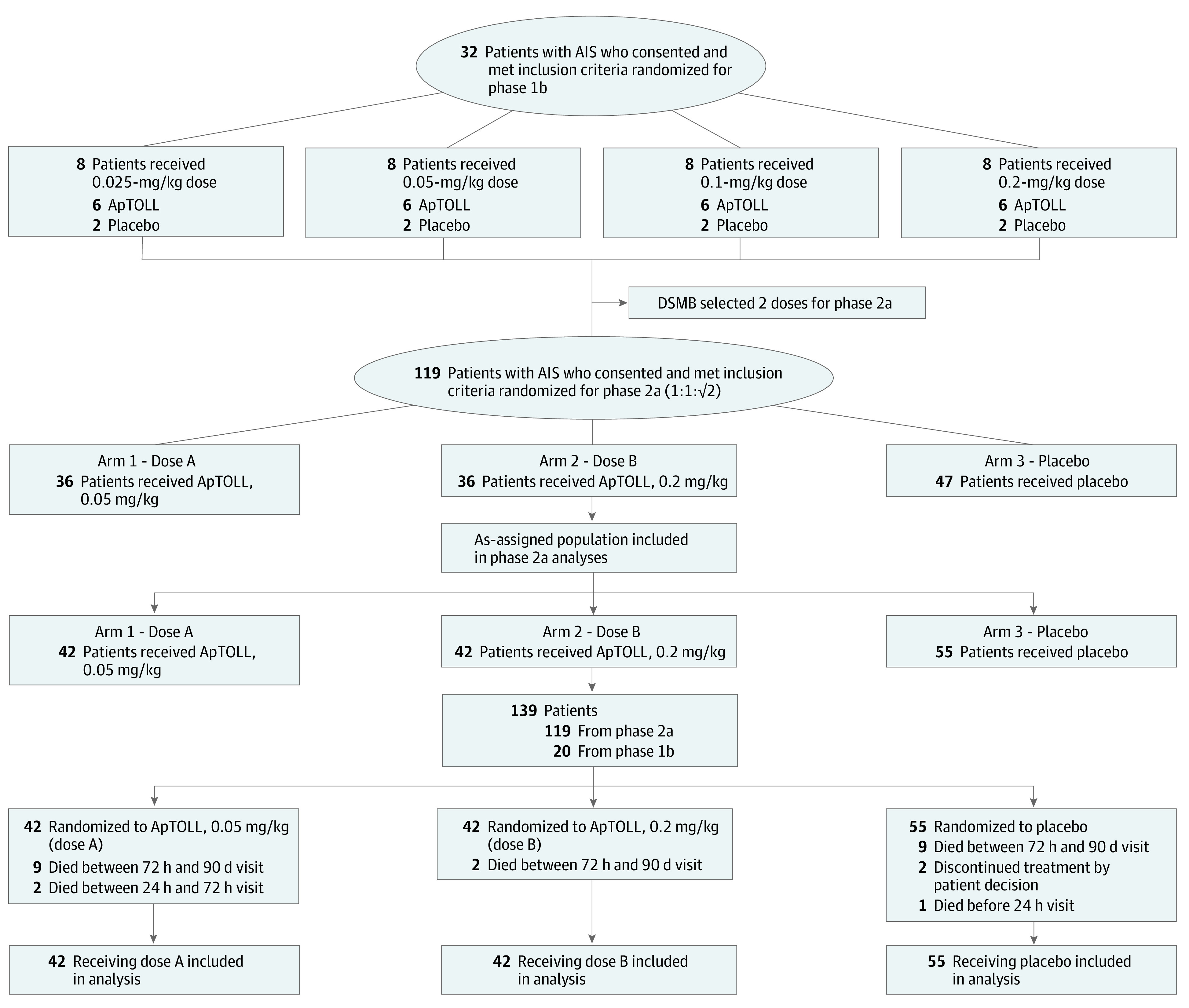
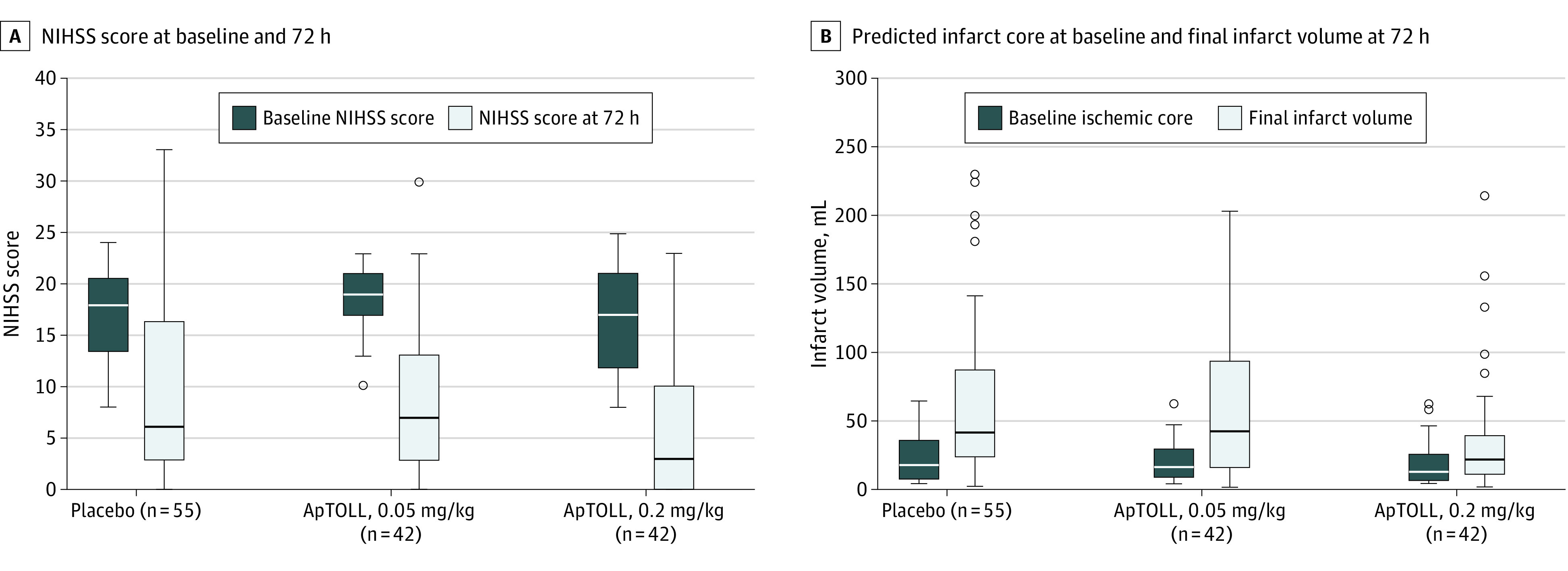
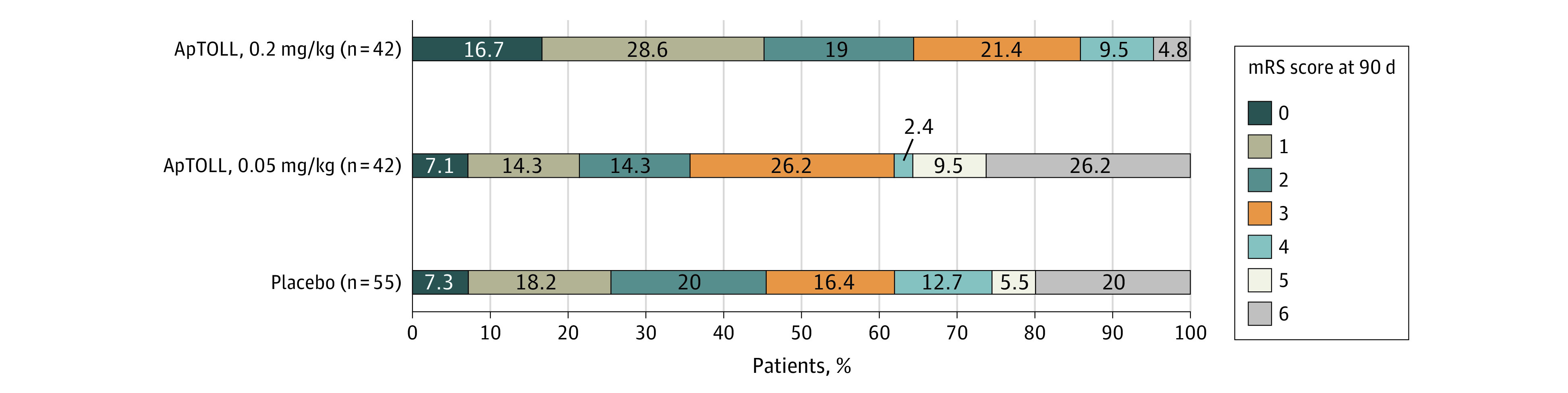
Results: In phase Ib, 32 patients were allocated evenly to the 4 dose groups. After phase 1b was completed with no safety concerns, 2 doses were selected for phase 2a; these 119 patients were randomized to receive ApTOLL, 0.05 mg/kg (n = 36); ApTOLL, 0.2 mg/kg (n = 36), or placebo (n = 47) in a 1:1:√2 ratio. The pooled population of 139 patients had a mean (SD) age of 70 (12) years, 81 patients (58%) were male, and 58 (42%) were female. The primary end point occurred in 16 of 55 patients (29%) receiving placebo (10 deaths [18.2%], 4 sICH [7.3%], 4 malignant strokes [7.3%], and 2 recurrent strokes [3.6%]); in 15 of 42 patients (36%) receiving ApTOLL, 0.05 mg/kg (11 deaths [26.2%], 3 sICH [7.2%], 2 malignant strokes [4.8%], and 2 recurrent strokes [4.8%]); and in 6 of 42 patients (14%) receiving ApTOLL, 0.2 mg/kg (2 deaths [4.8%], 2 sICH [4.8%], and 3 recurrent strokes [7.1%]). ApTOLL, 0.2 mg/kg, was associated with lower NIHSS score at 72 hours (mean difference log-transformed vs placebo, -45%; 95% CI, -67% to -10%), smaller final infarct volume (mean difference log-transformed vs placebo, -42%; 95% CI, -66% to 1%), and lower degrees of disability at 90 days (common odds ratio for a better outcome vs placebo, 2.44; 95% CI, 1.76 to 5.00).

Conclusions and relevance: In acute ischemic stroke, 0.2 mg/kg of ApTOLL administered within 6 hours of onset in combination with EVT was safe and associated with a potential meaningful clinical effect, reducing mortality and disability at 90 days compared with placebo. These preliminary findings await confirmation from larger pivotal trials.

Trial registration: ClinicalTrials.gov Identifier: NCT04734548.


Conflict of interest statement

Conflict of Interest Disclosures: Dr Hernández-Jiménez reported personal fees from aptaTargets during the conduct of the study and having patents issued to aptaTargets for (WO2020230108A1, WO2020230109A1) and a patent pending (EP23382006.7). Dr Abad-Santos reported serving on a drug safety committee for aptaTargets during the conduct of the study and a phase 1 clinical trial for aptaTargets outside the submitted work. Dr Jilma reported advisory and committee memberships for aptaTargets during the conduct of the study. Dr Flores reported being a member of the clinical adjudication committee for the study. Dr Jovin reported stock ownership from Viz.ai, Kandu Health, Galaxy, Route92, FreeOx Biotech, Methinks, and Anaconda; advisor fees from Cerenovus; and grants from Medtronic and Stryker outside the submitted work. Dr Hernández-Pérez reported grants from Instituto de Salud Carlos III during the conduct of the study. Dr Casariego reported consultant fees from aptaTargets. Dr Dalsgaard reported personal fees from aptaTargets during the conduct of the study. Dr Liebeskind reported imaging core lab work from aptaTargets during the conduct of the study and from Cerenovus, Genentech, Medtronic, Stryker, and Rapid Medical outside the submitted work. Dr Cobo reported personal fees from aptaTargets during the conduct of the study. Dr Castellanos reported patient inclusion work from aptaTargets during the conduct of the study. Dr Masjuán reported grants from aptaTargets during the conduct of the study. Dr Arenillas reported grants from the Ministry of Science of Spain, Bristol Myers Squibb–Pfizer, and AstraZeneca and personal fees from Medtronic, Boehringer Ingelheim, Amgen, Bayer, AstraZeneca, Bristol Myers Squibb–Pfizer, and Daiichi Sankyo outside the submitted work. Dr Olivot reported consulting fees from aptaTargets during the conduct of the study and research grants from the French Ministry of Health; consulting fees from AbbVie, Acticor, and Bioxodes; and speaking fees from Bristol Myers Squibb and Boehringer Ingelheim outside the submitted work. Dr Calviere reported nonfinancial support from Pfizer and personal fees from RE-Imagine Health Agency outside the submitted work. Dr Mazighi reported consulting fees from Asticot Biotech, Boehringer Ingelheim, and Novo Nordisk outside the submitted work. Dr Pugliese reported grants from Ministerio Ciencia e Innovación and CDTI during the conduct of the study. Dr González reported a patent issued to aptaTargets (WO2015197706-A1). Dr Moro reported a patent issued to aptaTargets (WO2015197706-A1). Dr Lizasoain reported a patent issued to aptaTargets (WO2015197706-A1). Dr Ribo reported consultant fees from aptaTargets, Anaconda Biomed, Philips, Medtronic, Cerenovus, Vesalio, and Rapid Pulse outside the submitted work. No other disclosures were reported.

Figures

Figure 1.
Figure 1.. Study Flow Chart
AIS indicates acute ischemic stroke; DSMB, data and safety monitoring board.
Figure 2.
Figure 2.. Secondary Efficacy Outcomes Based on Final Infarct Volume and National Institutes of Health Stroke Scale (NIHSS) Score at 72 Hours
Boxplots representing baseline and 72-hour NIHSS score according to treatment allocation (A) and baseline predicted infarct core on computed tomography perfusion and final infarct volume (magnetic resonance imaging at 72 hours) according to treatment allocation (B). The horizontal line inside each box indicates the median value; upper and lower bound of each box, IQR; whiskers, range of values; circles, outliers.
Figure 3.
Figure 3.. Distribution of Global Disability at 90 Days According to Treatment Allocation
Stacked bar plots representing the distribution of the modified Rankin Scale (mRS) score at 90 days according to treatment allocation.

References

    1. National Institute of Neurological Disorders and Stroke rt-PA Stroke Study Group . Tissue plasminogen activator for acute ischemic stroke. N Engl J Med. 1995;333(24):1581-1587. doi:10.1056/NEJM199512143332401 - DOI - PubMed
    1. Goyal M, Menon BK, van Zwam WH, et al. ; HERMES Collaborators . Endovascular thrombectomy after large-vessel ischaemic stroke: a meta-analysis of individual patient data from five randomised trials. Lancet. 2016;387(10029):1723-1731. doi:10.1016/S0140-6736(16)00163-X - DOI - PubMed
    1. Jovin TG, Nogueira RG; DAWN Investigators . Thrombectomy 6 to 24 hours after stroke. N Engl J Med. 2018;378(12):1161-1162. doi:10.1056/NEJMc1801530 - DOI - PubMed
    1. Albers GW, Marks MP, Kemp S, et al. ; DEFUSE 3 Investigators . Thrombectomy for stroke at 6 to 16 hours with selection by perfusion imaging. N Engl J Med. 2018;378(8):708-718. doi:10.1056/NEJMoa1713973 - DOI - PMC - PubMed
    1. Yoshimura S, Sakai N, Yamagami H, et al. . Endovascular therapy for acute stroke with a large ischemic region. N Engl J Med. 2022;386(14):1303-1313. doi:10.1056/NEJMoa2118191 - DOI - PubMed

Publication types

Associated data