


Real-life experiments in supermarkets to encourage healthy dietary-related behaviours: opportunities, challenges and lessons learned
- PMID: 37340326
- PMCID: PMC10280909
- DOI: 10.1186/s12966-023-01448-8
Real-life experiments in supermarkets to encourage healthy dietary-related behaviours: opportunities, challenges and lessons learned
Abstract
Background: Supermarkets are the primary source of food for many people yet their full potential as a setting to encourage healthy dietary-related behaviours remains underutilised. Sharing the experiences from research groups who have worked with supermarket chains to evaluate strategies that promote healthy eating could improve the efficiency of building such relationships and enhance the design quality of future research studies.
Methods: A collective case study approach was used to synthesise experiences of engaging and sustaining research collaborations with national supermarket chains to test the effectiveness of health-focused in-store interventions. The collective narrative covers studies conducted in three high-income countries: Australia, the Netherlands and the United Kingdom.
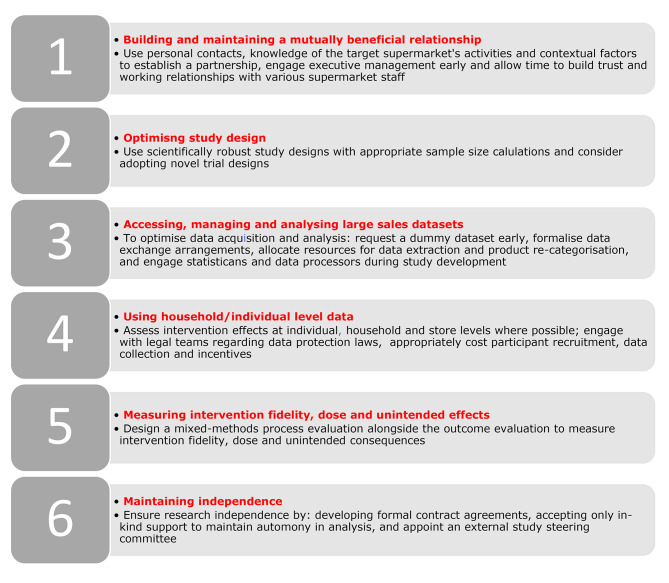
Results: We have distilled our experiences and lessons learned into six recommendations for conducting high quality public health research with commercial supermarket chains. These include: (i) using personal contacts, knowledge of supermarket activities and engaging executive management to establish a partnership and allowing time to build trust; (ii) using scientifically robust study designs with appropriate sample size calculations; (iii) formalising data exchange arrangements and allocating adequate resource for data extraction and re-categorisation; (iv) assessing effects at individual/households level where possible; (v) designing a mixed-methods process evaluation to measure intervention fidelity, dose and unintended consequences; and (vi) ensuring scientific independence through formal contract agreements.
Conclusions: Our collective experiences of working in non-financial partnerships with national supermarket chains could be useful for other research groups looking to develop and implement supermarket studies in an efficient manner. Further evidence from real-life supermarket interventions is necessary to identify sustainable strategies that can improve population diet and maintain necessary commercial outcomes.
Keywords: Diet; Food environments; Public-private partnerships; Supermarkets.
© 2023. The Author(s).
Conflict of interest statement
All authors have been involved in a non-financial collaboration with a national supermarket chain in Australia, the Netherlands or the UK. CV, CD, MH, PD, MP, JM, SC, JC and KB have no conflicts of interests to declare and no financial disclosures to make. JB has received grant research support from Danone Nutricia Early Life Nutrition but this grant is not related to the work outlined in this manuscript.
Figures
References
-
- Abajobir AA, Abate KH, Abbafati C, Abbas KM, Abd-Allah F, Abdulle AM, Abera SF, Aboyans V, Abu-Raddad LJ, Abu-Rmeileh NME et al. Global, regional, and national comparative risk assessment of 84 behaviournvironmental and occupational, and metabolic risks or clusters of risks, 1990–2016: a systematic analysis for the Global Burden of Disease Study 2016.The Lancet, 390(10100):1345–1422. - PMC - PubMed
-
- Middel CNH, Schuitmaker-Warnaar TJ, Mackenbach JD, Broerse JEW. Systematic review: a systems innovation perspective on barriers and facilitators for the implementation of healthy food-store interventions. Int J Behav Nutr Phys Act. 2019;16(1):108. doi: 10.1186/s12966-019-0867-5. - DOI - PMC - PubMed
-
- Department for Environment Food and Rural Affairs. : Food Statistics in your pocket: Food Chain. In. York, UK; 2020.
Publication types
MeSH terms
Grants and funding
LinkOut - more resources
Full Text Sources
