


Associations of systemic oxygen consumption with age and body temperature under general anesthesia: retrospective cohort study
- PMID: 37340340
- PMCID: PMC10280978
- DOI: 10.1186/s12871-023-02182-1
Associations of systemic oxygen consumption with age and body temperature under general anesthesia: retrospective cohort study
Retraction in
-
Retraction Note: Associations of systemic oxygen consumption with age and body temperature under general anesthesia: retrospective cohort study.BMC Anesthesiol. 2023 Oct 31;23(1):354. doi: 10.1186/s12871-023-02323-6. BMC Anesthesiol. 2023. PMID: 37907888 Free PMC article. No abstract available.
Abstract
Background: Body temperature (BT) is thought to have associations with oxygen consumption (VO2). However, there have been few studies in which the association between systemic VO2 and BT in humans was investigated in a wide range of BTs. The aims of this study were 1) to determine the association between VO2 and age and 2) to determine the association between VO2 and BT.
Methods: This study was a retrospective study of patients who underwent surgery under general anesthesia at a tertiary teaching hospital. VO2 was measured by the Dräger Perseus A500 anesthesia workstation (Dräger Medical, Lubeck, Germany). The associations of VO2 with age and BT were examined using spline regression and multivariable regression analysis with a random effect.
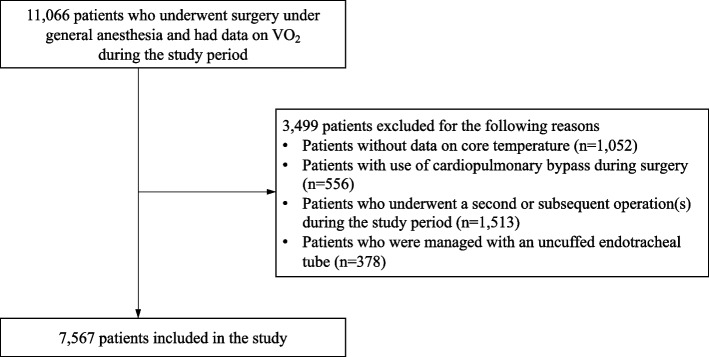
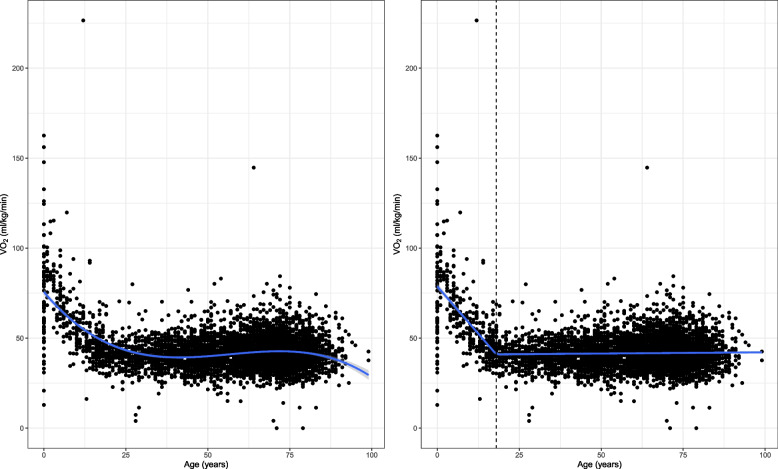
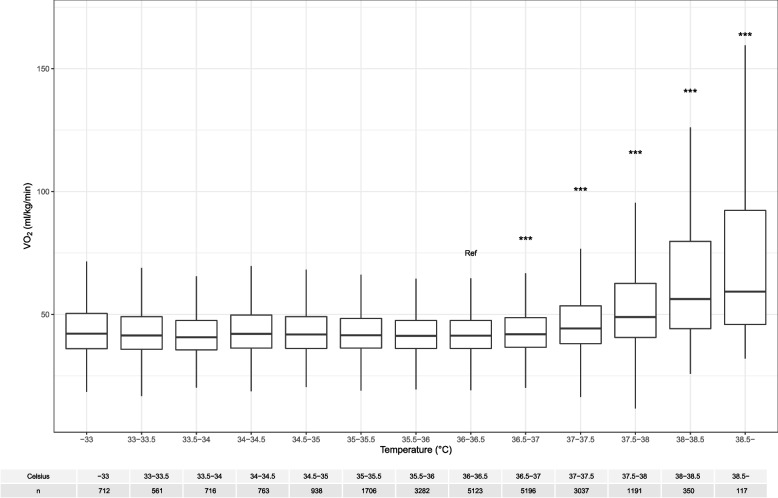
Results: A total of 7,567 cases were included in this study. A linear spline with one knot shows that VO2 was reduced by 2.1 ml/kg/min with one year of age (p < 0.001) among patients less than 18 years of age and that there was no significant change in VO2 among patients 18 years of age or older (estimate: 0.014 ml/kg/min, p = 0.08). VO2 in all bands of BT < 36.0 °C was not significantly different from VO2 in BT > = 36 °C and < 36.5 °C. Multivariable linear regression analysis showed that compared with VO2 in BT > = 36 °C and < 36.5 °C as a reference, VO2 levels were significantly higher by 0.57 ml/kg/min in BT > = 36.5 °C and < 37 °C (p < 0.001), by 1.8 ml/kg/min in BT > = 37 °C and < 37.5 °C (p < 0.001), by 3.6 ml/kg/min in BT > = 37.5 °C and < 38 °C (p < 0.001), by 4.9 ml/kg/min in BT > = 38 °C and < 38.5 °C (p < 0.001), and by 5.7 ml/kg/min in BT > = 38.5 °C (p < 0.001). The associations between VO2 and BT were significantly different among categorized age groups (p = 0.03).
Conclusions: VO2 increases in parallel with increase in body temperature in a hyperthermic state but remains constant in a hypothermic state. Neonates and infants, who have high VO2, may have a large systemic organ response in VO2 to change in BT.
Keywords: Body Temperature; General Anesthesia; Oxygen Consumption.
© 2023. The Author(s).
Conflict of interest statement
The authors declare that they have no competing interests.
Figures
References
-
- Hypothermia after Cardiac Arrest Study G: Mild therapeutic hypothermia to improve the neurologic outcome after cardiac arrest. N Engl J Med 2002; 346(8):549–556. - PubMed
Publication types
MeSH terms
Substances
LinkOut - more resources
Full Text Sources
