Review
. 2023 Jun 20;30(1):43.
doi: 10.1186/s12929-023-00939-x.

Self-healing hydrogel as an injectable implant: translation in brain diseases

Affiliations
Review

Self-healing hydrogel as an injectable implant: translation in brain diseases

Junpeng Xu et al. J Biomed Sci. .

Abstract

Tissue engineering biomaterials are aimed to mimic natural tissue and promote new tissue formation for the treatment of impaired or diseased tissues. Highly porous biomaterial scaffolds are often used to carry cells or drugs to regenerate tissue-like structures. Meanwhile, self-healing hydrogel as a category of smart soft hydrogel with the ability to automatically repair its own structure after damage has been developed for various applications through designs of dynamic crosslinking networks. Due to flexibility, biocompatibility, and ease of functionalization, self-healing hydrogel has great potential in regenerative medicine, especially in restoring the structure and function of impaired neural tissue. Recent researchers have developed self-healing hydrogel as drug/cell carriers or tissue support matrices for targeted injection via minimally invasive surgery, which has become a promising strategy in treating brain diseases. In this review, the development history of self-healing hydrogel for biomedical applications and the design strategies according to different crosslinking (gel formation) mechanisms are summarized. The current therapeutic progress of self-healing hydrogels for brain diseases is described as well, with an emphasis on the potential therapeutic applications validated by in vivo experiments. The most recent aspect as well as the design rationale of self-healing hydrogel for different brain diseases is also addressed.

Keywords: Injectable implant; Neural tissue engineering; Neurodegenerative disease; Self-healing hydrogel; Stroke; Translation medicine; Traumatic brain injury.


Conflict of interest statement

The authors declare that they have no competing interests.

Figures
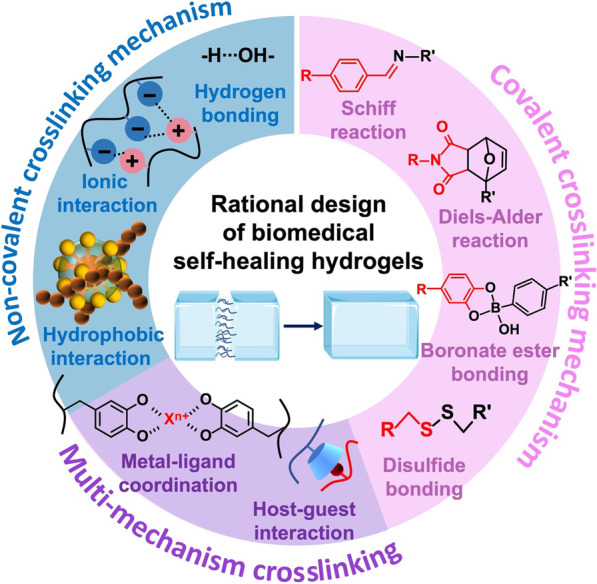
Fig. 1
Fig. 1
Schematics of chemistries and mechanisms for rational design of biomedical self-healing hydrogels, including covalent crosslinking mechanism, non-covalent crosslinking mechanism, and multi-mechanism crosslinking
Fig. 2
Fig. 2
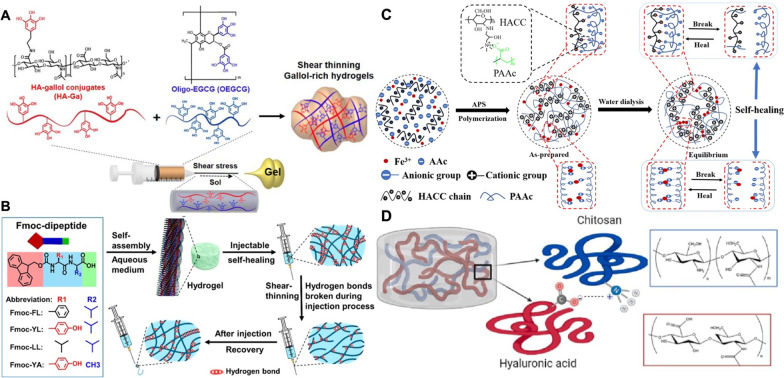
A Schematic illustration for preparing self-healing hydrogels of HA-gallol/gallol-rich oligomeric crosslinker (OEGCG) with shear-thinning property. Reprinted with permission from [70]. Copyright © 2017 American Chemical Society. B Schematic illustration of Fmoc-dipeptide self-assembly hydrogels with shear-thinning and self-healing properties. Reprinted with permission from [71]. Copyright © 2020 American Chemical Society. C Schematic diagram of the preparation of the dual ionic crosslinking hydrogel and a possible network structure of the hydrogel. Reprinted with permission from [72]. Copyright © 2019 Springer Science Business Media, LLC, part of Springer Nature. D Scheme of electrostatic interactions between hyaluronic acid and chitosan. Reprinted with permission from [75]. Copyright © 2021 Elsevier B.V
Fig. 3
Fig. 3
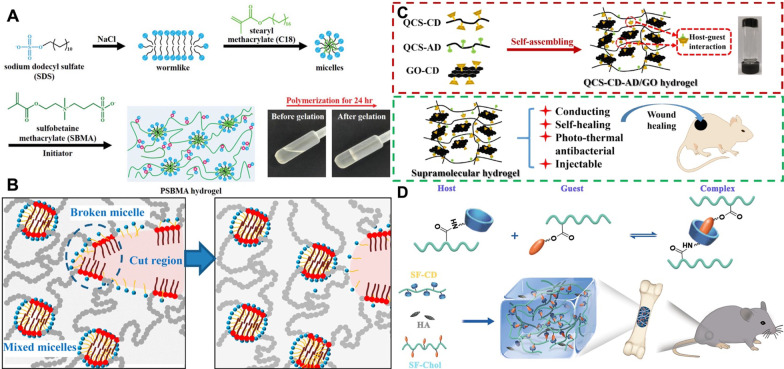
A Synthesis scheme for the hydrogels displaying the formation of hydrogels. Reprinted with permission from [81]. Copyright © 2022 Wiley‐VCH GmbH. B Cartoon showing the self-healing mechanism of micellar hydrogels indicating the gel region before and after healing. Reprinted with permission from [84]. Copyright © 2016 American Chemical Society. C Schematic illustration for preparation of supramolecular hydrogel via host–guest self-assembly of QCS-CD, QCS-AD, and GO-CD polymers with the application in wound healing. Reprinted with permission from [90]. Copyright © 2020 Elsevier B.V. D Schematic of supramolecular hydrogel formation through host–guest complexation and its application as bone graft for promoting bone regeneration. Reprinted with permission from [91]. Copyright © 2020 Elsevier B.V
Fig. 4
Fig. 4
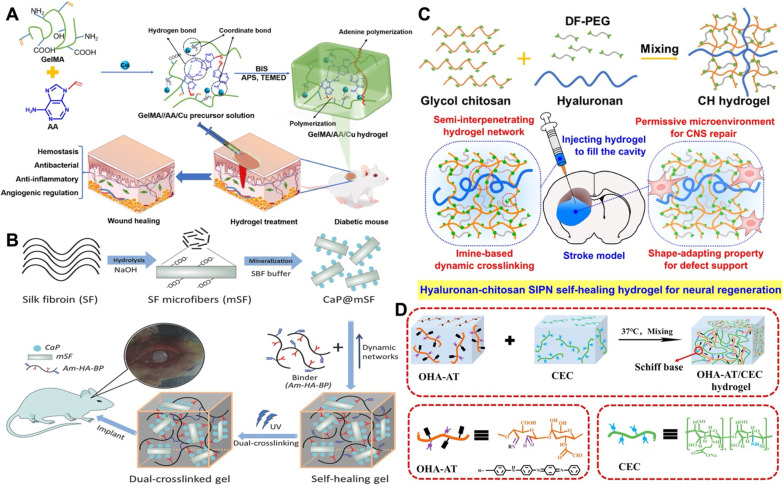
A Preparation of GelMA/AA/Cu2+ hydrogels and biomedical applications in a mouse wound healing model. Reprinted with permission from [94]. Copyright © 2022 Elsevier B.V. B Schematic of the fabrication of self-healing SF-based hydrogel for bone regeneration. SBF: simulated body fluid. Am-HA-BP: BP modified acrylamide-grafted hyaluronan biopolymer. Reprinted with permission from [95]. Copyright © 2017 Wiley‐VCH GmbH. C Schematic of the formation of CH hydrogel and the potential biomedical application. Reprinted with permission from [21]. Copyright © 2020 American Chemical Society. D Synthesis scheme of OHA-AT/CEC hydrogel. Reprinted with permission from [99]. Copyright © 2019 Elsevier B.V
Fig. 5
Fig. 5
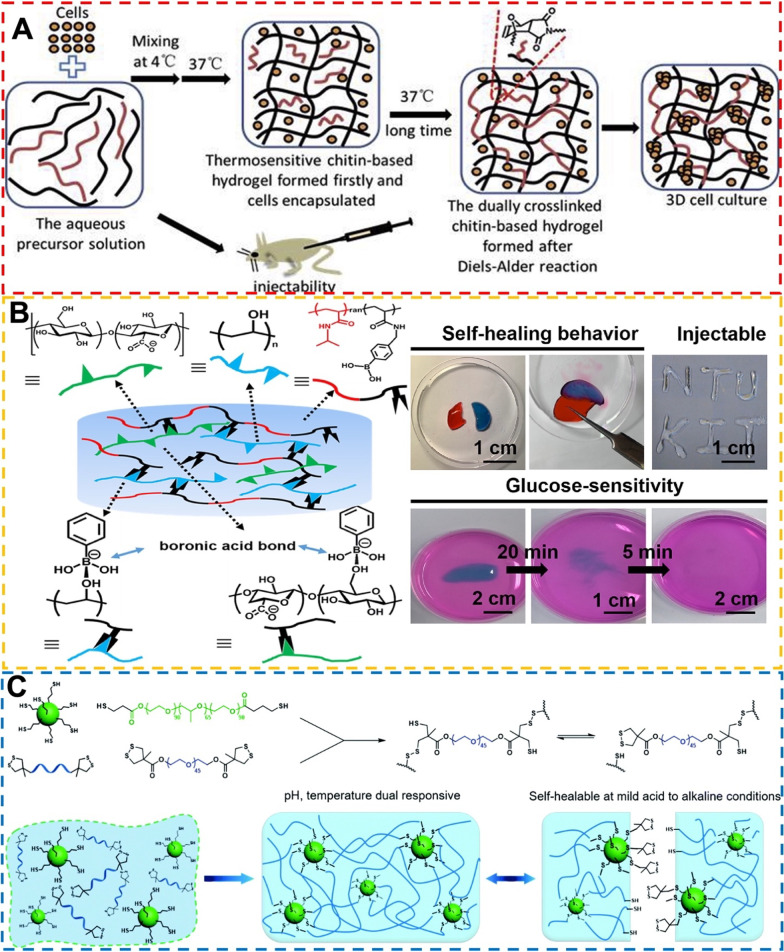
A Preparation of the double crosslinked self-healing hydrogels with injectability. Reprinted with permission from [102]. Copyright © 2019 Elsevier B.V. B Preparation of boronic ester-based self-healing hydrogel and macroscopic observation for the self-healing and glucose-sensitive behaviors of hydrogels. Reprinted with permission from [106]. Copyright © 2020 Elsevier Ltd. C Schematic illustration of the design, synthesis and application of the injectable self-healing hydrogel using reversible thiol/disulfide exchange reaction. Reprinted with permission from [109]. Copyright © 2017 Royal Society of Chemistry
Fig. 6
Fig. 6
Schematic of the potential in vivo applications of injectable hydrogels in the treatment of stroke. Reprinted with permission from [110]. Copyright © 2019 Royal Society of Chemistry
Fig. 7
Fig. 7
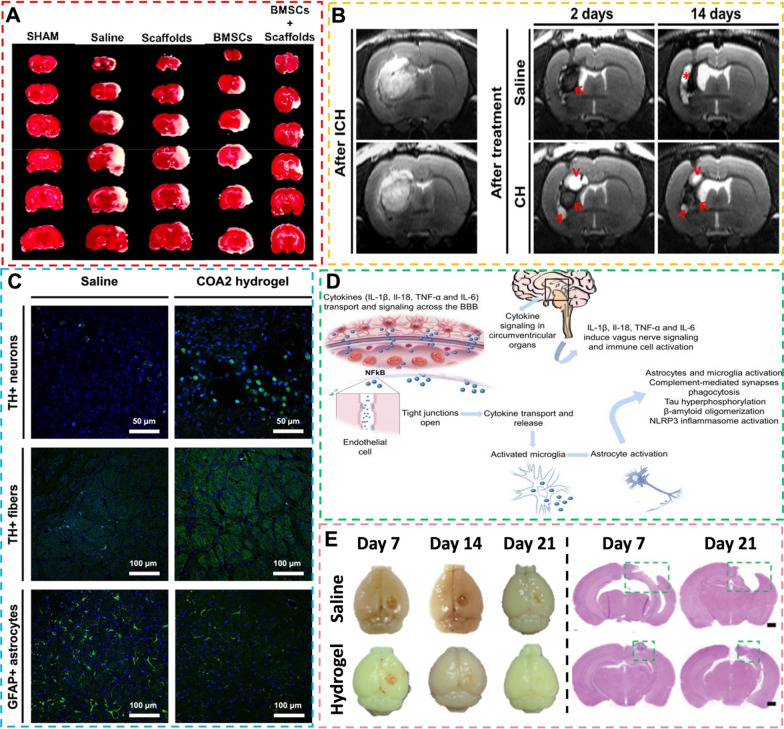
A BMSCs loaded in composite self-healing hydrogel (“scaffolds” in figure) ameliorated ischemic stroke. The effects of BMSCs and BMSC-loaded self-healing hydrogel (“BMSCs + scaffolds” in figure) were assessed by TTC staining. Reprinted with permission from [118]. Copyright © 2023 Pei et al. First published by Elsevier Ltd. B Efficacy of the CH hydrogel in alleviating the brain atrophy and neurological deficits in the ICH rat model. Reprinted with permission from [21]. Copyright © 2020 American Chemical Society. C The capabilities of conductive self-healing hydrogels (COA2 hydrogel) injected in the brain of PD rats to protect dopaminergic neurons/fibers, to reduce neural inflammation, and to improve motor functions. TH: tyrosine hydroxylase. GFAP: glial fibrillary acidic protein. Reprinted with permission from [132]. Copyright © 2023 Xu et al. First published by BioMed Central Ltd. D Schematic representation of the systemic process of inflammation in AD neuroinflammation. Reprinted with permission from [139]. Copyright © 2021 Cunha et al. First published by Dove Medical Press Ltd. E Tissue regeneration status of TBI rat brain after the self-healing hydrogel injection for 21 days. Reprinted with permission from [160]. Copyright © 2022 Wiley‐VCH GmbH

References

    1. Vacanti JP, Langer R. Tissue engineering: the design and fabrication of living replacement devices for surgical reconstruction and transplantation. Lancet. 1999;354:S32–S34. doi: 10.1016/S0140-6736(99)90247-7. - DOI - PubMed
    1. Khademhosseini A, Vacanti JP, Langer R. Progress in tissue engineering. Sci Am. 2009;300(5):64–71. doi: 10.1038/scientificamerican0509-64. - DOI - PubMed
    1. Gaharwar AK, Peppas NA, Khademhosseini A. Nanocomposite hydrogels for biomedical applications. Biotechnol Bioeng. 2014;111(3):441–453. doi: 10.1002/bit.25160. - DOI - PMC - PubMed
    1. Memic A, Navaei A, Mirani B, Cordova JAV, Aldhahri M, Dolatshahi-Pirouz A, Akbari M, Nikkhah M. Bioprinting technologies for disease modeling. Biotech Lett. 2017;39(9):1279–1290. doi: 10.1007/s10529-017-2360-z. - DOI - PubMed
    1. Khademhosseini A, Langer R. A decade of progress in tissue engineering. Nat Protoc. 2016;11(10):1775–1781. doi: 10.1038/nprot.2016.123. - DOI - PubMed