


Femoral blood gas analysis, another tool to assess hemorrhage severity following trauma: an exploratory prospective study
- PMID: 37340485
- PMCID: PMC10280927
- DOI: 10.1186/s13049-023-01095-9
Femoral blood gas analysis, another tool to assess hemorrhage severity following trauma: an exploratory prospective study
Abstract
Background: Veno-arterial carbon dioxide tension difference (ΔPCO2) and mixed venous oxygen saturation (SvO2) have been shown to be markers of the adequacy between cardiac output and metabolic needs in critical care patients. However, they have hardly been assessed in trauma patients. We hypothesized that femoral ΔPCO2 (ΔPCO2 fem) and SvO2 (SvO2 fem) could predict the need for red blood cell (RBC) transfusion following severe trauma.
Methods: We conducted a prospective and observational study in a French level I trauma center. Patients admitted to the trauma room following severe trauma with an Injury Severity Score (ISS) > 15, who had arterial and venous femoral catheters inserted were included. ΔPCO2 fem, SvO2 fem and arterial blood lactate were measured over the first 24 h of admission. Their abilities to predict the transfusion of at least one pack of RBC (pRBCH6) or hemostatic procedure during the first six hours of admission were assessed using receiver operating characteristics curve.
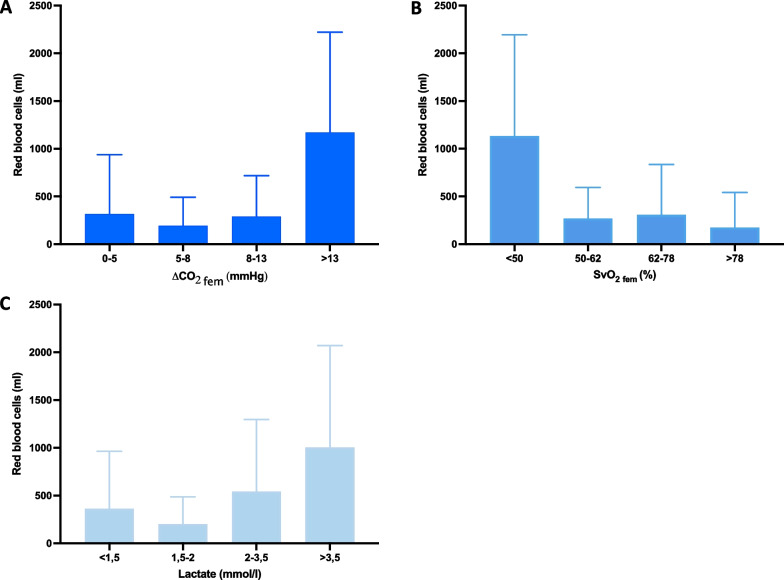
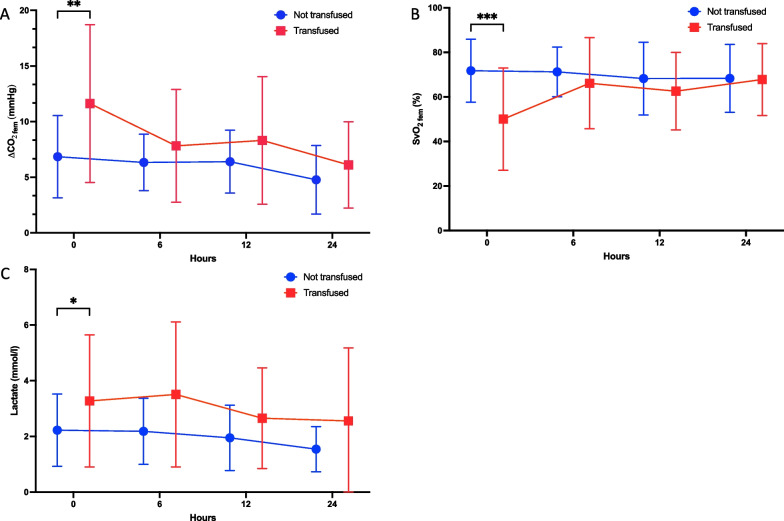
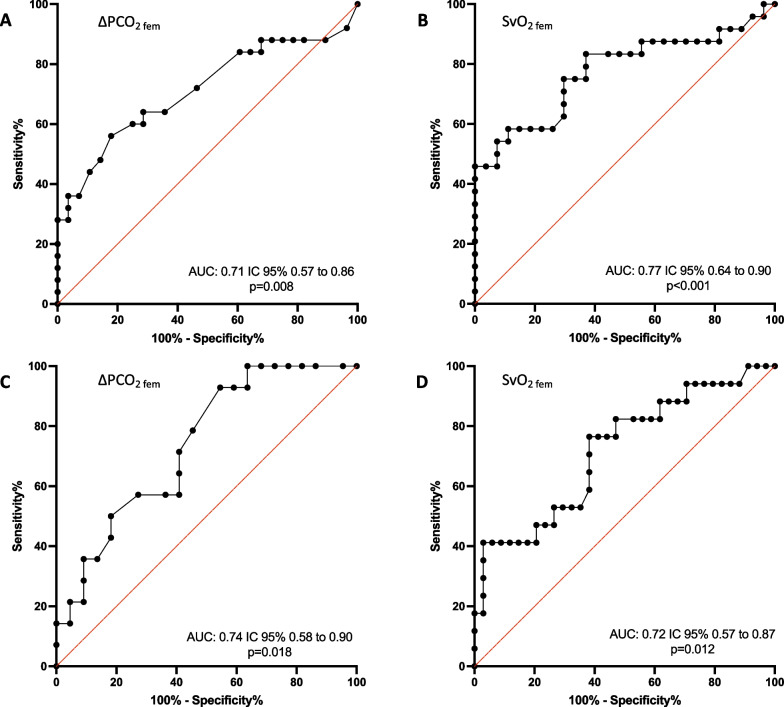
Results: 59 trauma patients were included in the study. Median ISS was 26 (22-32). 28 patients (47%) received at least one pRBCH6 and 21 patients (35,6%) had a hemostatic procedure performed during the first six hours of admission. At admission, ΔPCO2 fem was 9.1 ± 6.0 mmHg, SvO2 fem 61.5 ± 21.6% and blood lactate was 2.7 ± 1.9 mmol/l. ΔPCO2 fem was significantly higher (11.6 ± 7.1 mmHg vs. 6.8 ± 3.7 mmHg, P = 0.003) and SvO2 fem was significantly lower (50 ± 23 mmHg vs. 71.8 ± 14.1 mmHg, P < 0.001) in patients who were transfused than in those who were not transfused. Best thresholds to predict pRBCH6 were 8.1 mmHg for ΔPCO2 fem and 63% for SvO2 fem. Best thresholds to predict the need for a hemostatic procedure were 5.9 mmHg for ΔPCO2 fem and 63% for SvO2 fem. Blood lactate was not predictive of pRBCH6 or the need for a hemostatic procedure.
Conclusion: In severe trauma patients, ΔPCO2 fem and SvO2 fem at admission were predictive for the need of RBC transfusion and hemostatic procedures during the first six hours of management while admission lactate was not. ΔPCO2 fem and SvO2 fem appear thus to be more sensitive to blood loss than blood lactate in trauma patients, which might be of importance to early assess the adequation of tissue blood flow with metabolic needs.
Keywords: Hemorrhagic shock; Lactate; Severe trauma; Tissue hypoxia; Veno-arterial carbon dioxide tension difference; Venous oxygen saturation.
© 2023. The Author(s).
Conflict of interest statement
The authors declare that they have no competing interests.
Figures
References
-
- Dutton RP, Stansbury LG, Leone S, Kramer E, Hess JR, Scalea TM. Trauma mortality in mature trauma systems: are we doing better? An analysis of trauma mortality patterns, 1997–2008. J Trauma. 2010;69(3):620–626. - PubMed
Publication types
MeSH terms
Substances
LinkOut - more resources
Full Text Sources
Medical
