. 2023 Aug;12(15):16221-16230.
doi: 10.1002/cam4.6284. Epub 2023 Jun 21.

MCP-1 expression in breast cancer and its association with distant relapse

Affiliations

MCP-1 expression in breast cancer and its association with distant relapse

Bridie S Mulholland et al. Cancer Med. 2023 Aug.

Abstract

Background: Distant relapse of breast cancer complicates management of the disease and accounts for 90% of breast cancer-related deaths. Monocyte chemoattractant protein-1 (MCP-1) has critical roles in breast cancer progression and is widely accepted as a pro-metastatic chemokine.

Methods: This study explored MCP-1 expression in the primary tumour of 251 breast cancer patients. A simplified 'histoscore' was used to determine if each tumour had high or low expression of MCP-1. Patient breast cancers were retrospectively staged based on available patient data. p < 0.05 was used to determine significance and changes in hazard ratios between models were considered.

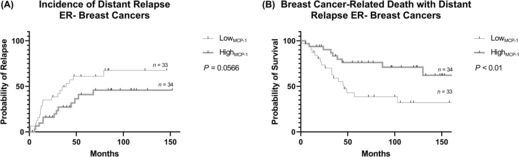
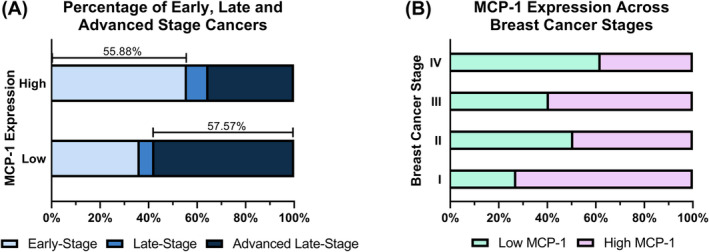
Results: Low MCP-1 expression in the primary tumour was associated with breast cancer-related death with distant relapse in ER- breast cancers (p < 0.01); however, this was likely a result of most low MCP-1-expressing ER- breast cancers being Stage III or Stage IV, with high MCP-1 expression in the primary tumour significantly correlated with Stage I breast cancers (p < 0.05). Expression of MCP-1 in the primary ER- tumours varied across Stage I, II, III and IV and we highlighted a switch in MCP-1 expression from high in Stage I ER- cancers to low in Stage IV ER- cancers.

Conclusion: This study has emphasised a critical need for further investigation into MCP-1's role in breast cancer progression and improved characterisation of MCP-1 in breast cancers, particularly in light of the development of anti-MCP-1, anti-metastatic therapies.

Keywords: CCL2; metastasis; neoplasm; protein; tumour.


Conflict of interest statement

The authors declare that they have no competing interests.

Figures
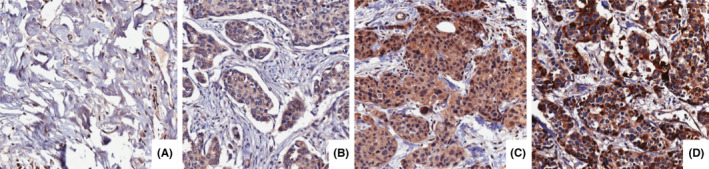
FIGURE 1
FIGURE 1
Representative immunohistochemical staining intensities at 20× magnification. (A) represents normal breast tissue; (B) represents 1+ cytoplasmic staining intensity in invasive breast carcinoma epithelium; (C) represents 2+ cytoplasmic staining intensity in invasive breast carcinoma epithelium; (D) represents 3+ cytoplasmic staining intensity in invasive breast carcinoma epithelium.
FIGURE 2
FIGURE 2
Kaplan–Meier curve describing probability of distant relapse and breast cancer‐related death with distant relapse in patients with high and low expression of MCP‐1 in primary ER‐ breast tumours. The log‐rank test was used to compare probability between groups. Censored patients are represented as solid black lines. ER, oestrogen receptor; MCP‐1, monocyte chemoattractant protein‐1; (−), negative.
FIGURE 3
FIGURE 3
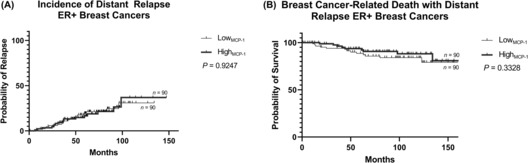
Kaplan–Meier curve describing probability of distant relapse and breast cancer‐related death with distant relapse in patients with high and low expression of MCP‐1 in primary ER+ breast tumours. The log‐rank test was used to compare probability between groups. Censored patients are represented as solid black lines. ER, oestrogen receptor; MCP‐1, monocyte chemoattractant protein‐1; (+), positive.
FIGURE 4
FIGURE 4
(A) Percentage of low MCP‐1 expression and high MCP‐1 expression groups that were early‐stage (Stage I and II), late‐stage (Stage III) and advanced late‐stage breast cancers (Stage IV). (B) Percentage of low MCP‐1 expression and high MCP‐1 expression cancers in Stage I, Stage II, Stage III and Stage IV cancers. These visual representations were adapted from Hofstee et al. monocyte chemoattractant protein‐1 (MCP‐1).

References

    1. Feng Y, Spezia M, Huang S, et al. Breast cancer development and progression: risk factors, cancer stem cells, signaling pathways, genomics, and molecular pathogenesis. Genes Dis. 2018;5(2):77‐106. - PMC - PubMed
    1. Chen W, Hoffmann AD, Liu H, Liu X. Organotropism: new insights into molecular mechanisms of breast cancer metastasis. NPJ Precis Oncol. 2018;2(1):1‐12. - PMC - PubMed
    1. Weilbaecher KN, Guise TA, McCauley LK. Cancer to bone: a fatal attraction. Nat Rev Cancer. 2011;11(6):411‐425. - PMC - PubMed
    1. Tsang J, Tse GM. Molecular classification of breast cancer. Adv Anat Pathol. 2020;27(1):27‐35. - PubMed
    1. Harbeck N, Thomssen C, Gnant M. St. Gallen 2013: brief preliminary summary of the consensus discussion. Breast Care. 2013;8(2):102‐109. - PMC - PubMed

Publication types