


Birth size, growth trajectory and later cardio-metabolic risk
- PMID: 37342257
- PMCID: PMC10277632
- DOI: 10.3389/fendo.2023.1187261
Birth size, growth trajectory and later cardio-metabolic risk
Abstract
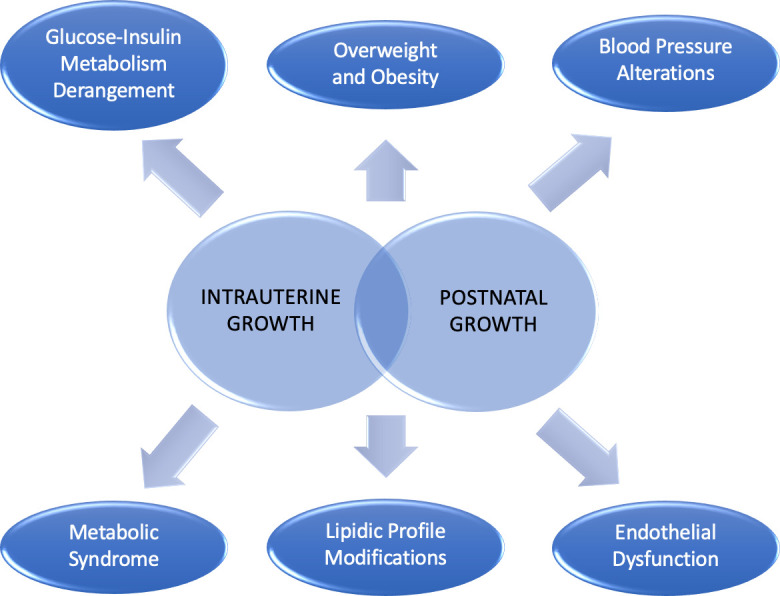
There is increasing evidence of a strong association between intrauterine growth and subsequent development of chronic disease in adult life. Birth size and growth trajectory have been demonstrated to have an impact on cardio-metabolic health, both in childhood and adult life. Hence, careful observation of the children's growth pattern, starting from the intrauterine period and the first years of life, should be emphasized to detect the possible onset of cardio-metabolic sequelae. This allows to intervene on them as soon as they are detected, first of all through lifestyle interventions, whose efficacy seems to be higher when they are started early. Recent papers suggest that prematurity may constitute an independent risk factor for the development of cardiovascular disease and metabolic syndrome, regardless of birth weight. The purpose of the present review is to examine and summarize the available knowledge about the dynamic association between intrauterine and postnatal growth and cardio-metabolic risk, from childhood to adulthood.
Keywords: birth weight; cardiovascular risk; intrauterine growth; preterm; small for gestational age.
Copyright © 2023 Cauzzo, Chiavaroli, Di Valerio and Chiarelli.
Conflict of interest statement
The authors declare that the research was conducted in the absence of any commercial or financial relationships that could be construed as a potential conflict of interest.
Figures
Comment in
-
Editorial: Exploring obesity risk, prevention, and research innovation in the first 2000 days of life, volume II.Front Endocrinol (Lausanne). 2024 Feb 5;15:1372551. doi: 10.3389/fendo.2024.1372551. eCollection 2024. Front Endocrinol (Lausanne). 2024. PMID: 38375200 Free PMC article. No abstract available.
References
-
- Lozano R, Naghavi M, Foreman K, Lim S, Shibuya K, Aboyans V, et al. Global and regional mortality from 235 causes of death for 20 age groups in 1990 and 2010: a systematic analysis for the global burden of disease study 2010. Lancet (2012) 380(9859):2095–128. doi: 10.1016/S0140-6736(12)61728-0 - DOI - PMC - PubMed
Publication types
MeSH terms
LinkOut - more resources
Full Text Sources
Medical
