. 2023 Jun 5:14:1204661.
doi: 10.3389/fimmu.2023.1204661. eCollection 2023.

Fucosylated N-glycans as early biomarkers of COVID-19 severity

Affiliations

Fucosylated N-glycans as early biomarkers of COVID-19 severity

Beatrix Paton et al. Front Immunol. .

Abstract

Background: The pathological mechanisms of SARS-CoV-2 in humans remain unclear and the unpredictability of COVID-19 progression may be attributed to the absence of biomarkers that contribute to the prognosis of this disease. Therefore, the discovery of biomarkers is needed for reliable risk stratification and to identify patients who are more likely to progress to a critical stage.

Methods: Aiming to identify new biomarkers we analysed N-glycan traits in plasma from 196 patients with COVID-19. Samples were classified into three groups according to their severity (mild, severe and critical) and obtained at diagnosis (baseline) and at 4 weeks of follow-up (postdiagnosis), to evaluate their behaviour through disease progression. N-glycans were released with PNGase F and labelled with Rapifluor-MS, followed by their analysis by LC-MS/MS. The Simglycan structural identification tool and Glycostore database were employed to predict the structure of glycans.

Results: We determined that plasma from SARS-CoV-2-infected patients display different N-glycosylation profiles depending on the disease severity. Specifically, levels of fucosylation and galactosylation decreased with increasing severity and Fuc1Hex5HexNAc5 was identified as the most suitable biomarker to stratify patients at diagnosis and distinguish mild from critical outcomes.

Conclusion: In this study we explored the global plasma glycosignature, reflecting the inflammatory state of the organs during the infectious disease. Our findings show the promising potential of glycans as biomarkers of COVID-19 severity.

Keywords: COVID-19; LC-MS/MS; N-glycosylation; biomarker; fucosylation.


Conflict of interest statement

The authors declare that the research was conducted in the absence of any commercial or financial relationships that could be construed as a potential conflict of interest.

Figures
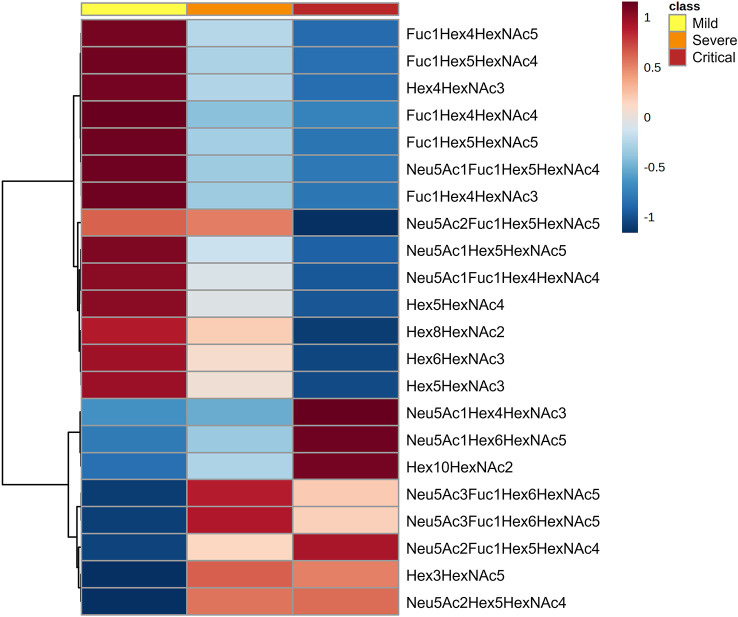
Figure 1
Figure 1
N-glycan signatures associated with COVID-19 disease severity. Heatmap plotting the significant relative abundance of N-glycans increasing or decreasing at diagnosis in accordance with disease severity. Significant differences (p < 0.05) between mild, severe and critical COVID‐19 groups of patients were determined by Kruskal-Wallis test. Columns indicate the degree of disease severity: mild (left), severe (centre) and critical (right) groups. Mean values for each compound in each COVID‐19 group (columns) are colour‐coded based on relative abundance, low (blue) and high (red).
Figure 2
Figure 2
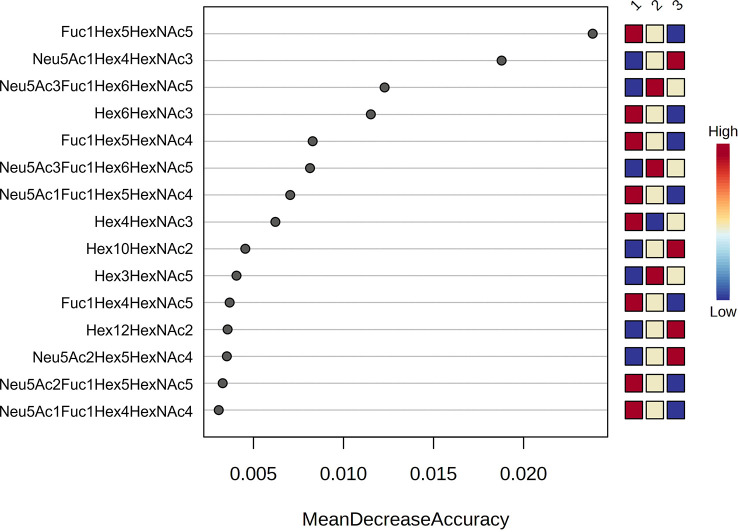
Random forest analysis. Random forest modelling of the top 15 significant N-glycans with the highest discriminatory power between groups (1 = mild, 2 = severe and 3 = critical). Coloured boxes on the right indicate the relative concentrations of the corresponding N-glycan in each group.
Figure 3
Figure 3
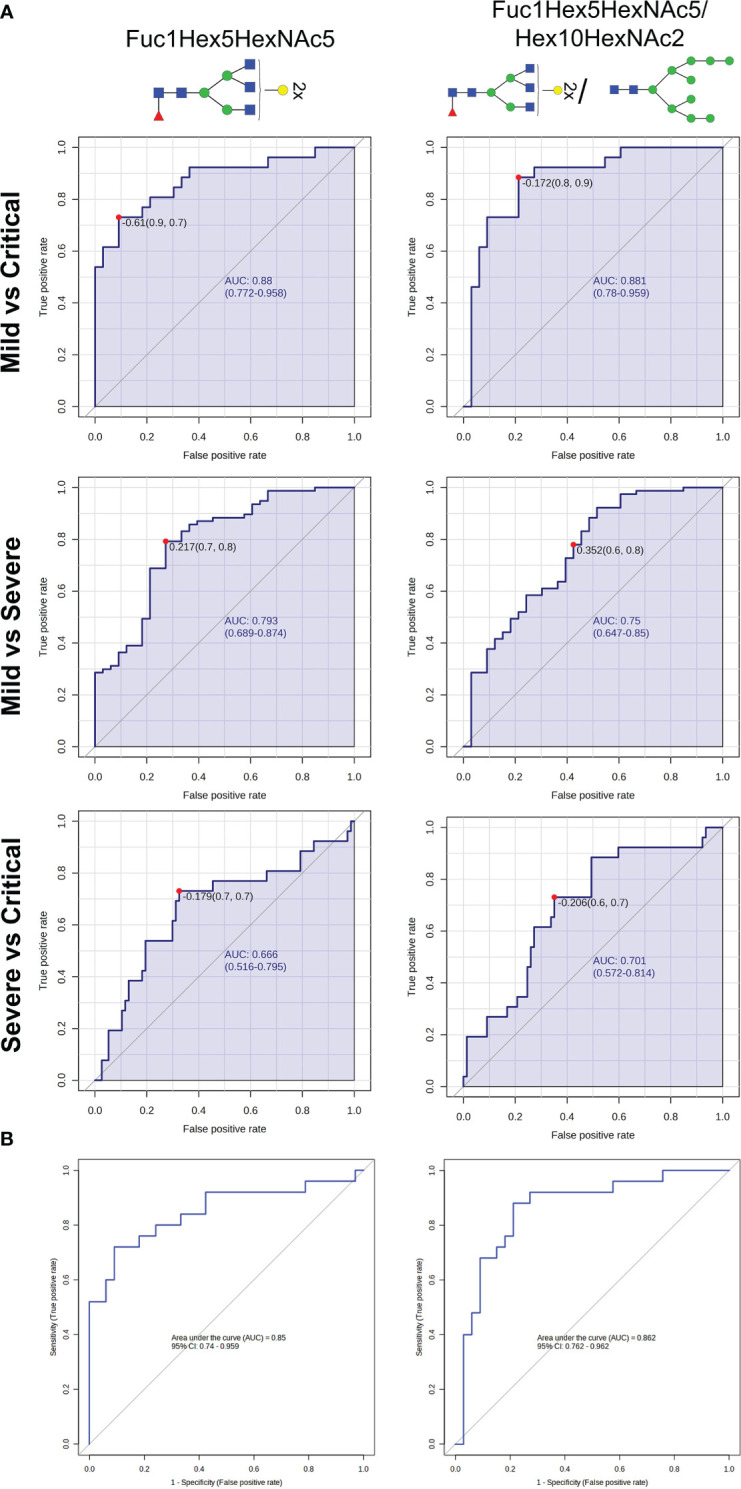
N-glycan biomarkers to indicate COVID-19 severity at diagnosis. (A) Receiver operating characteristic (ROC) curves analyses of Fuc1Hex5HexNAc5 and Fuc1Hex5HexNAc5/Hex10HexNAc2 for distinguishing COVID-19 patients between groups of severity. (B) Binary logistic regression modelling analysis testing the accuracy of Fuc1Hex5HexNAc5 and Fuc1Hex5HexNAc5/Hex10HexNAc2 to differentiate mild from critically ill patients with COVID-19 in a randomly selected set of patients. For the N-glycan cartoons, green circles denote mannose, yellow circles denote galactose, blue squares denote N-acetylglucosamine, red triangles denote fucose, and purple diamonds denote N-acetylneuraminic acid.
Figure 4
Figure 4
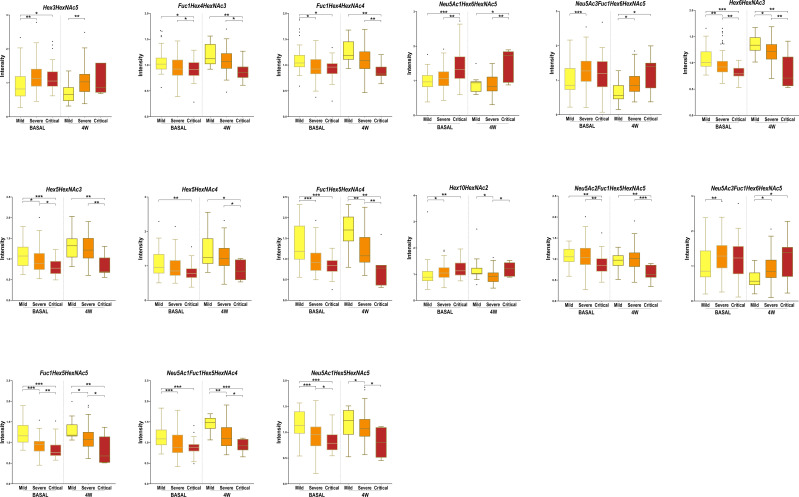
Box-and-whisker plots showing N-glycan abundance levels in COVID-19 patients. Relative abundance of total plasma N-glycans in different COVID-19 severities (mild, severe and critical) at diagnosis (BASAL) and at 4 weeks postdiagnosis (4W). Kruskal-Wallis, *p-value < 0.05; **p-value < 0.01 ***p-value < 0.001.
Figure 5
Figure 5
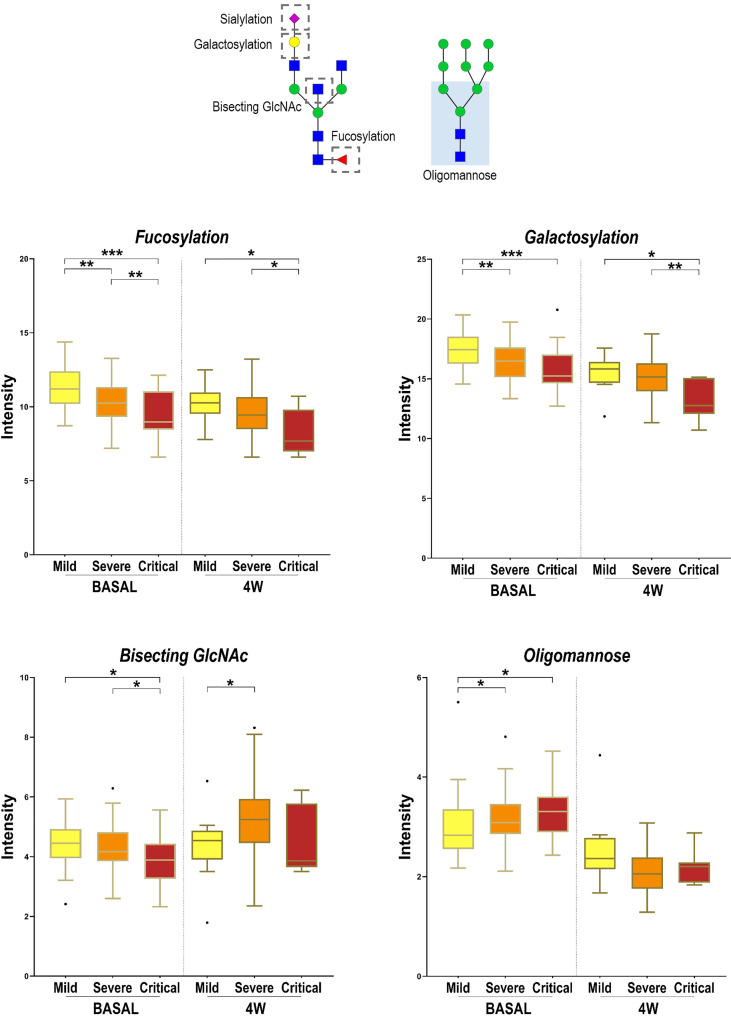
Alterations in four N-glycan families according to disease severity. Relative abundance of total Bisecting GlcNAc, fucosylation, galactosylation and oligomannose structures in different COVID-19 severities (mild, severe and critical) at diagnosis (BASAL) and at 4 weeks postdiagnosis (4W). Kruskal-Wallis, *p-value < 0.05; **p-value < 0.01; ***p-value < 0.001. For the N-glycan cartoons, green circles denote mannose, yellow circles denote galactose, blue squares denote N-acetylglucosamine, red triangles denote fucose, and purple diamonds denote N-acetylneuraminic acid.

References

    1. Wang C, Horby PW, Hayden FG, Gao GF. A novel coronavirus outbreak of global health concern. Lancet (London England) (2020) 395(10223):470. doi: 10.1016/S0140-6736(20)30185-9 - DOI - PMC - PubMed
    1. World Health Organization . COVID-19 weekly epidemiological update (2022). Available at: https://www.who.int/publications/m/item/covid-19-weekly-epidemiological-... (Accessed January 16, 2023).
    1. Chen N, Zhou M, Dong X, Qu J, Gong F, Han Y. Epidemiological and clinical characteristics of 99 cases of 2019 novel coronavirus pneumonia in wuhan, China: a descriptive study. Lancet (London England) (2020) 395(10223):507. doi: 10.1016/S0140-6736(20)30211-7 - DOI - PMC - PubMed
    1. Xu XW, Wu XX, Jiang XG, Xu KJ, Ying LJ, Ma CL. Clinical findings in a group of patients infected with the 2019 novel coronavirus (SARS-Cov-2) outside of wuhan, China: retrospective case series. BMJ. (2020) 368. doi: 10.1136/BMJ.M606 - DOI - PMC - PubMed
    1. Wölfel R, Corman VM, Guggemos W, Seilmaier M, Zange S, Müller MA. Virological assessment of hospitalized patients with COVID-2019. Nature (2020) 581(7809):465–9. doi: 10.1038/s41586-020-2196-x - DOI - PubMed

Publication types