


The impact of sports participation on mental health and social outcomes in adults: a systematic review and the 'Mental Health through Sport' conceptual model
- PMID: 37344901
- PMCID: PMC10286465
- DOI: 10.1186/s13643-023-02264-8
The impact of sports participation on mental health and social outcomes in adults: a systematic review and the 'Mental Health through Sport' conceptual model
Abstract
Background: Sport is a subset of physical activity that can be particularly beneficial for short-and-long-term physical and mental health, and social outcomes in adults. This study presents the results of an updated systematic review of the mental health and social outcomes of community and elite-level sport participation for adults. The findings have informed the development of the 'Mental Health through Sport' conceptual model for adults.
Methods: Nine electronic databases were searched, with studies published between 2012 and March 2020 screened for inclusion. Eligible qualitative and quantitative studies reported on the relationship between sport participation and mental health and/or social outcomes in adult populations. Risk of bias (ROB) was determined using the Quality Assessment Tool (quantitative studies) or Critical Appraisal Skills Programme (qualitative studies).
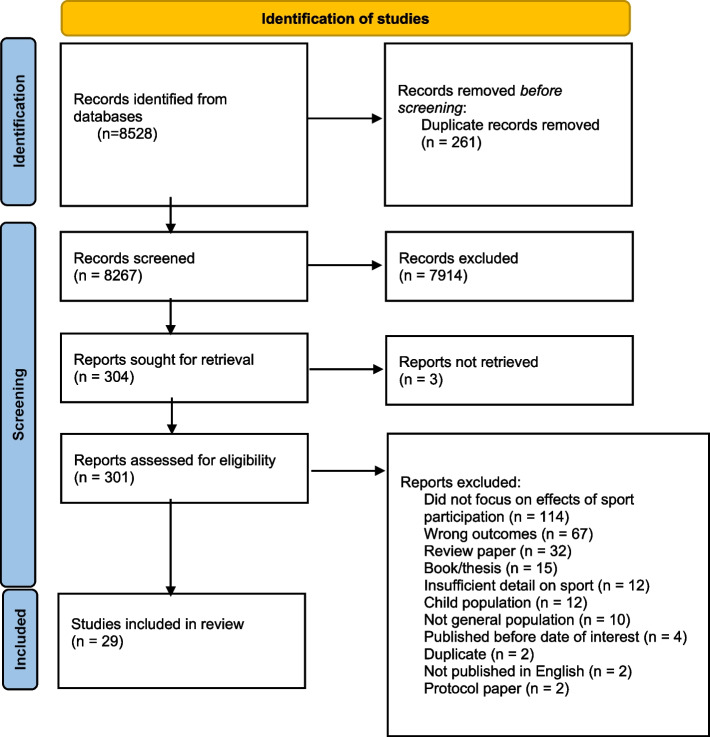
Results: The search strategy located 8528 articles, of which, 29 involving adults 18-84 years were included for analysis. Data was extracted for demographics, methodology, and study outcomes, and results presented according to study design. The evidence indicates that participation in sport (community and elite) is related to better mental health, including improved psychological well-being (for example, higher self-esteem and life satisfaction) and lower psychological ill-being (for example, reduced levels of depression, anxiety, and stress), and improved social outcomes (for example, improved self-control, pro-social behavior, interpersonal communication, and fostering a sense of belonging). Overall, adults participating in team sport had more favorable health outcomes than those participating in individual sport, and those participating in sports more often generally report the greatest benefits; however, some evidence suggests that adults in elite sport may experience higher levels of psychological distress. Low ROB was observed for qualitative studies, but quantitative studies demonstrated inconsistencies in methodological quality.
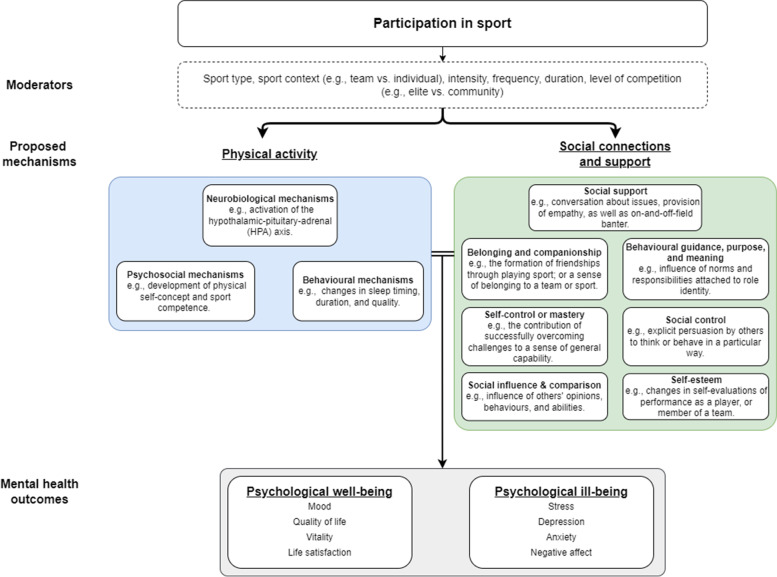
Conclusions: The findings of this review confirm that participation in sport of any form (team or individual) is beneficial for improving mental health and social outcomes amongst adults. Team sports, however, may provide more potent and additional benefits for mental and social outcomes across adulthood. This review also provides preliminary evidence for the Mental Health through Sport model, though further experimental and longitudinal evidence is needed to establish the mechanisms responsible for sports effect on mental health and moderators of intervention effects. Additional qualitative work is also required to gain a better understanding of the relationship between specific elements of the sporting environment and mental health and social outcomes in adult participants.
Keywords: Adults; Experimental; Mental health; Model; Observational; Psychological health; Review; Social health; Sport.
© 2023. The Author(s).
Conflict of interest statement
The authors declare they have no competing interests.
Figures
References
-
- Eime RM, Young JA, Harvey JT, Charity MJ, Payne WR. A systematic review of the psychological and social benefits of participation in sport for adults: informing development of a conceptual model of health through sport. Int J Behav Nutr Phys Act. 2013;10:135. doi: 10.1186/1479-5868-10-135. - DOI - PMC - PubMed
-
- Ishihara T, Nakajima T, Yamatsu K, Okita K, Sagawa M, Morita N. Relationship of participation in specific sports to academic performance in adolescents: a 2-year longitudinal study. Scand J Med Sci Sports. 2020. - PubMed
-
- Cope E, Bailey R, Pearce G. Why do children take part in, and remain involved in sport?: implications for children’s sport coaches. Int J Coach Sci. 2013;7:55–74.
Publication types
MeSH terms
LinkOut - more resources
Full Text Sources
Medical
