


Leptomeningeal disease in histone-mutant gliomas
- PMID: 37346983
- PMCID: PMC10281361
- DOI: 10.1093/noajnl/vdad068
Leptomeningeal disease in histone-mutant gliomas
Abstract
Background: The 2016 WHO classification described a subtype of midline gliomas harboring histone 3 (H3) K27M alterations, and the 2021 edition added a new subtype of hemispheric diffuse gliomas with H3 G34R/V mutations. The incidence and clinical behavior of leptomeningeal disease (LMD) in these patients is not well defined.
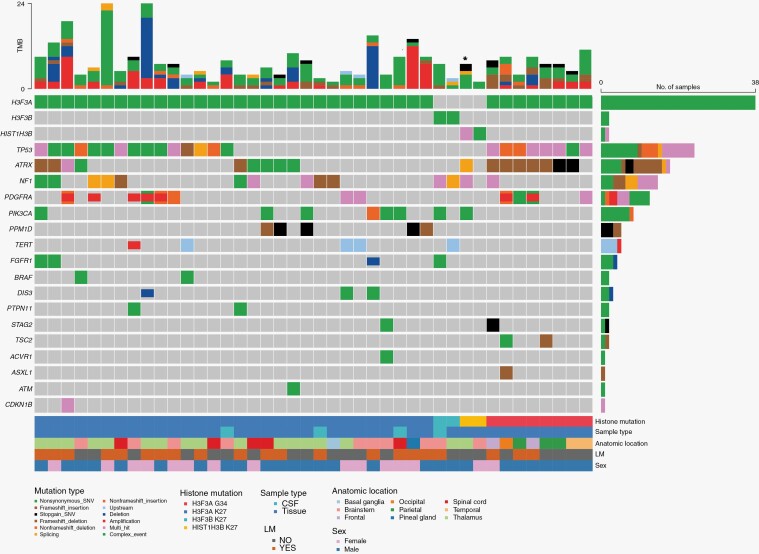
Methods: Retrospective study of patients with H3-altered gliomas diagnosed from 01/2012 to 08/2021; histone mutations were identified through next-generation sequencing (NGS) of tumor biopsy and/or cerebrospinal fluid (CSF).
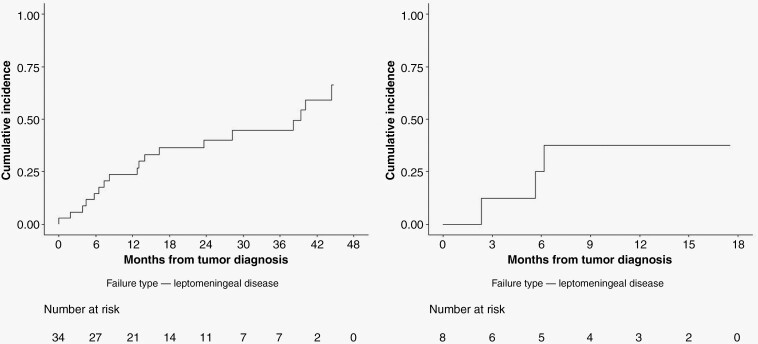
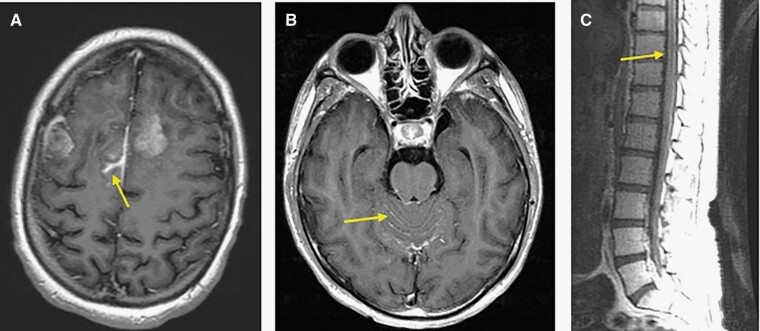
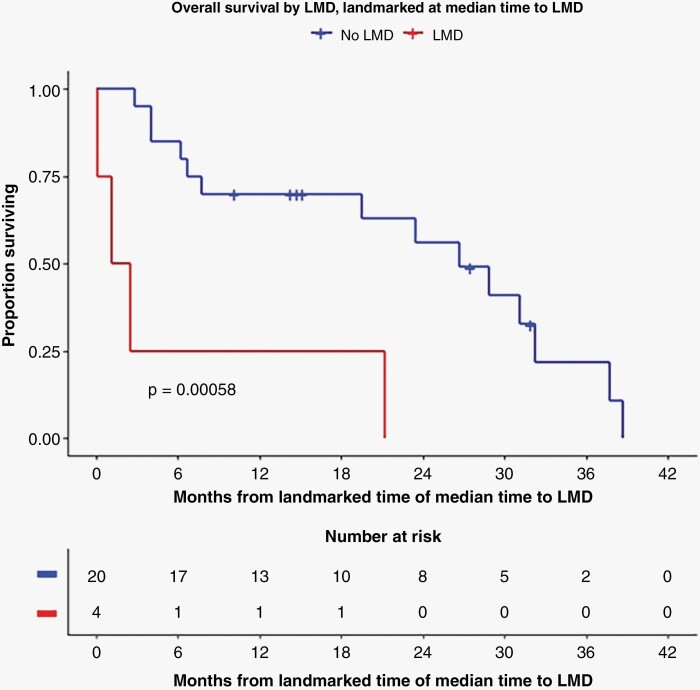
Results: We identified 42 patients harboring H3 mutations (K27M mutations in 33 patients, G34R/V in 8, and both in one). Median age was 21 (4-70); 27 were male. LMD was diagnosed in 21/42 (50%) patients, corresponding to a 3-year cumulative incidence of 44.7% (95% confidence interval (CI): 26.1%-63.4%) for the K27-mutant group and a 1-year cumulative incidence of 37.5% in the G34-mutant group (95% CI: 0.01%-74.4%; no events after 1 year). Median time from tumor diagnosis to LMD was 12.9 months for H3-K27 patients and 5.6 months for H3-G34 patients. H3 mutation was detected in CSF in all patients with LMD who had NGS (8 H3-K27-mutant patients). In the H3-K27-mutant group, modeled risk of death was increased in patients who developed LMD (hazard ratio: 7.37, 95% CI: 2.98-18.23, P < .0001).
Conclusions: In our cohort, 50% of patients developed LMD. Although further studies are needed, CSF ctDNA characterization may aid in identifying molecular tumor profiles in glioma patients with LMD, and neuroaxis imaging and CSF NGS should be considered for early LMD detection.
Keywords: cerebrospinal fluid; circulating tumor DNA; diffuse hemispheric glioma; diffuse midline histone mutations; glioma; leptomeningeal disease.
© The Author(s) 2023. Published by Oxford University Press, the Society for Neuro-Oncology and the European Association of Neuro-Oncology.
Conflict of interest statement
A.L.L has received Research funding from Bristol Myer Squib. For the remaining authors, none were declared.
Figures
References
-
- Louis DN, Perry A, Reifenberger G, et al. The 2016 World Health Organization classification of tumors of the central nervous system: a summary. Acta Neuropathol. 2016;131(6):803–820. - PubMed
-
- Sethi R, Allen J, Donahue B, et al. Prospective neuraxis MRI surveillance reveals a high risk of leptomeningeal dissemination in diffuse intrinsic pontine glioma. J Neurooncol. 2011;102(1):121–127. - PubMed
Grants and funding
LinkOut - more resources
Full Text Sources